Artwork
The Straw Manikin
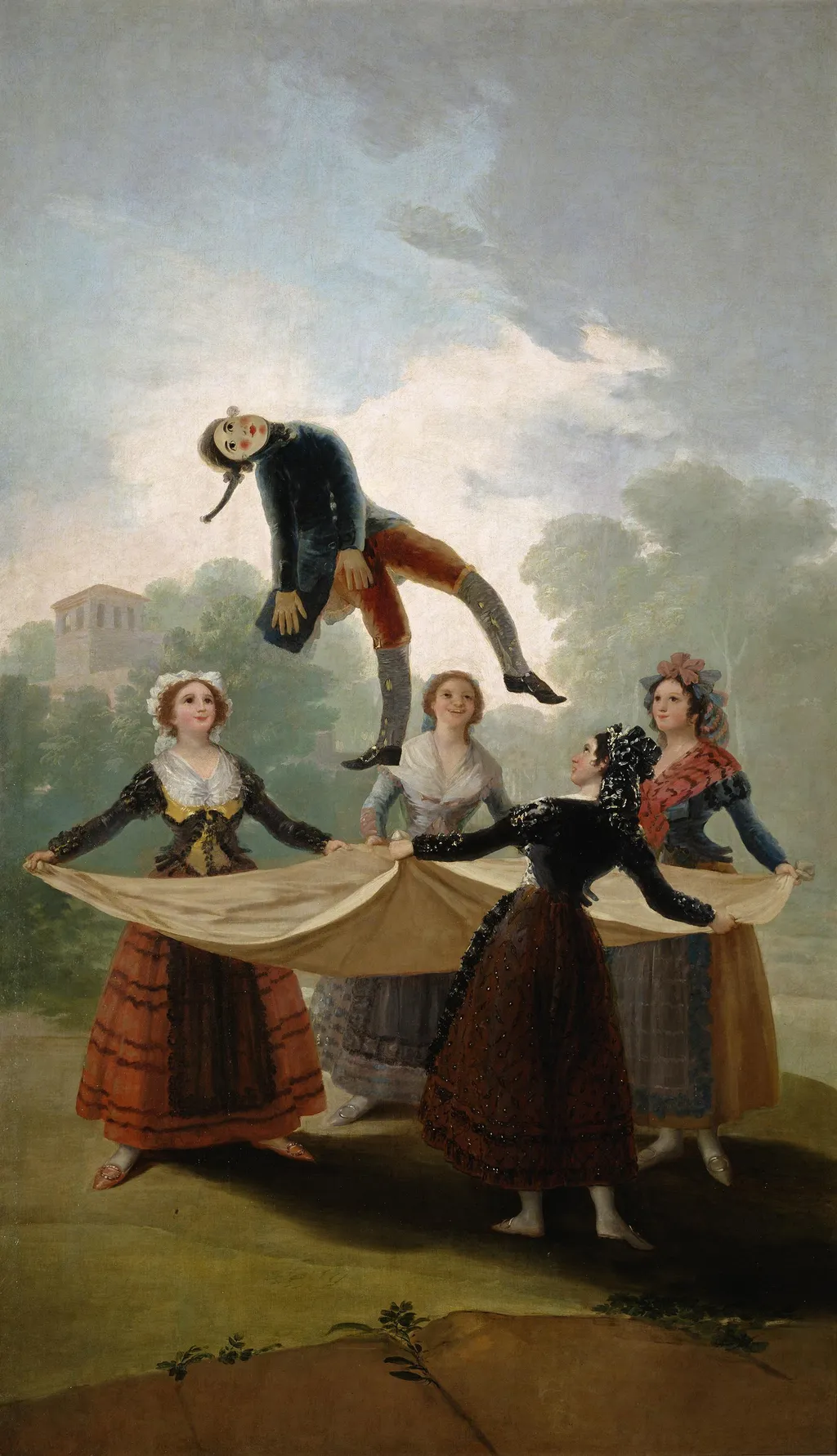
The Straw Manikin is an oil painting by the Spanish Baroque Tenebrist artist Francisco de Goya. It dates from 1796 and is held in the collection of the Museo del Prado.
About this work
Subject & Meaning
The puppet's drooping head and contracted posture in the final version convey sadness and reinforce an implicit theme of violence in women's treatment of men.
The painting depicts four young women of high social standing in a park-like setting, tossing a costumed and masked straw manikin into the air using a stretched blanket. The scene illustrates the traditional Spanish game of pelele, a social pastime in which a straw-stuffed puppet representing an unloved person was flung skyward to the accompaniment of mocking songs.
The work carries multilayered symbolism. The women's amused expressions underscore their capricious power over the male figure, suggesting an allegory of women mocking men by treating them as playthings. The puppet's drooping head and contracted posture in the final version convey sadness and reinforce an implicit theme of violence in women's treatment of men. This ironic gender dynamic anticipates Goya's later Caprichos series.
Scholars have also proposed political readings: the French Wikipedia source notes possible allusion to the political instability of 1792 and the succession of various prime ministers. The Italian source additionally suggests a satirical reference to Fortune, derived from a picaresque novel illustration.
Technique & Style
The Straw Manikin is an oil painting on canvas measuring 267 cm in height and 160 cm in width, created by Francisco Goya in 1791. It depicts four women of high social standing using a cloth to toss a straw-stuffed manikin into the air, a traditional Spanish game symbolizing mockery of men. The work was part of a series of cartoons for tapestries commissioned by King Charles IV, intended for display at the Palacio del Escurial.
Goya’s final version shows a slumped, saddened figure, contrasting with earlier drafts in which the manikin appeared more joyful, reflecting themes of gender dynamics and social irony. The painting’s formal style features vibrant colors and swift brushwork, characteristic of late 18th-century Spanish art, with a composition that balances playful movement and psychological depth. It is housed in the Museo del Prado in Madrid and was rediscovered in 1869 before being added to the museum’s collection in 1870.
History & Provenance
The Straw Manikin (El Pelele) was commissioned by King Charles IV of Spain on February 11, 1789, as part of a series of tapestry cartoons for his office at the El Escorial palace. The monarch specified that the themes should be "rural and cheerful." Although Goya had been working for the royal court since 1786, he delayed execution of this specific commission until May 1791, completing the oil-on-canvas work in 1792.
The painting served as a full-scale model for weavers at the Royal Tapestry Factory of Santa Bárbara in Madrid.
The work remained in the royal collection until it was considered lost, only to be rediscovered in 1869 in the basement of the Royal Palace of Madrid by Gregorio Cruzada Villaamil. Following royal ordinances issued on January 19 and February 9, 1870, the canvas was transferred to the Museo del Prado, where it was first officially cataloged in 1876.
The Straw Manikin is held in the Museo del Prado in Madrid, where it is exhibited in Room 93. The work was discovered in the basement of the Royal Palace of Madrid in 1869 by Gregorio Cruzada Villaamil and officially transferred to the Prado by royal ordinances dated January 19 and February 9, 1870. It was first listed in the museum's catalog in 1876.
Prior to this, the painting was considered lost. The canvas, measuring 267 by 160 cm, has remained part of the Prado's permanent collection since its accession. A preliminary oil study related to the composition is held at the Hammer Museum in Los Angeles.
Context
Created for the seventh series of tapestry cartoons intended for Charles IV's office at the Escorial, this work marks the final phase of Goya's royal commissions before his shift toward darker themes. Scholars interpret the scene of women tossing a male effigy as an ironic commentary on gender relations that anticipates the satire found in the artist's later Caprichos prints. Some analysis suggests the imagery also alludes to the political instability of 1792, symbolizing the rapid turnover of prime ministers through the figure of the helpless puppet.
The painting's cynical undertones, particularly the lifeless expression of the manikin, are viewed as a precursor to the unsettling atmosphere characteristic of Goya's mature oeuvre. Historically significant, the canvas was considered lost until its discovery in the Royal Palace basement in 1869, after which it entered the Museo del Prado collection.
Legacy
The Straw Manikin (El Pelele) became a foundational motif in Goya's legacy, directly inspiring later artistic works and cultural reinterpretations. Its symbolic use of the straw figure, representing mockery, gender dynamics, and political satire, resonated across centuries. The painting's visual language, particularly the depiction of women playfully yet cruelly manipulating the puppet, prefigures the satirical intensity of his Caprichos series.
This thematic continuity influenced composers like Enrique Granados, who adapted the imagery into his opera Goyescas, and later artists who referenced its narrative of power reversal. The work's survival and rediscovery in 1870, followed by its inclusion in major Goya retrospectives, cemented its status as a key piece in understanding his transition from court decorator to subversive social critic. Its frequent reproduction on Spanish postage and presence in global museum collections further underscore its enduring cultural footprint.
Overview
Francisco Goya painted The Straw Manikin in 1796 using oil on canvas. The work is part of the Prado Museum’s collection and exemplifies the Spanish Baroque tenebrist style, marked by strong contrasts of light and dark. It presents a lively scene in which several figures interact around a large, beige blanket.
Artist & collection
Artist
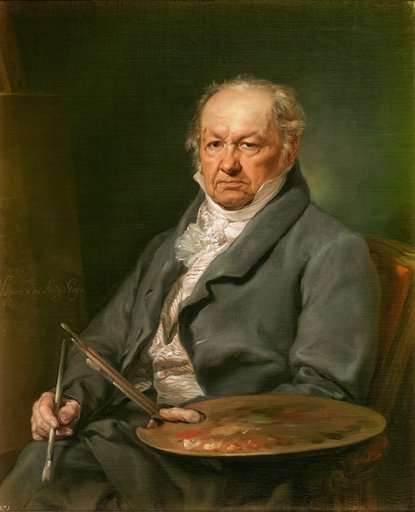
Francisco José de Goya y Lucientes was a Spanish romantic painter and printmaker.