Artwork
Blind Man's Bluff
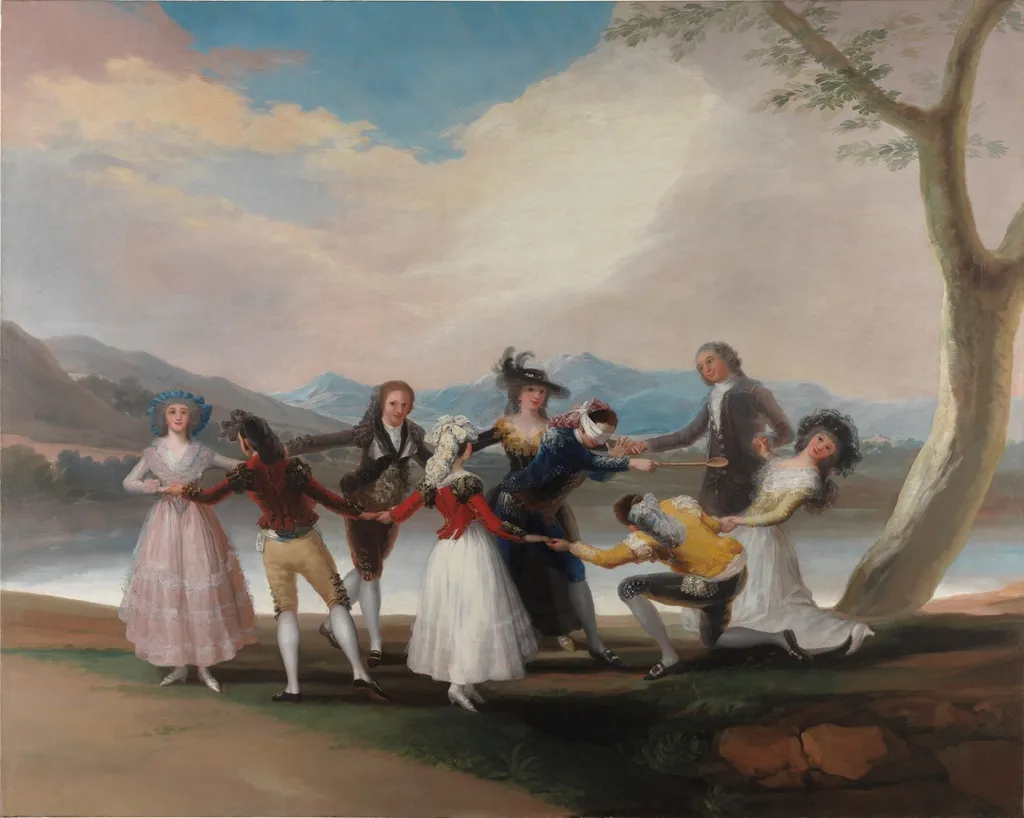
Blind Man's Bluff is an oil painting by the Rococo painting artist Francisco de Goya. It dates from 1794 and is held in the collection of the Museo del Prado.
About this work
Subject & Meaning
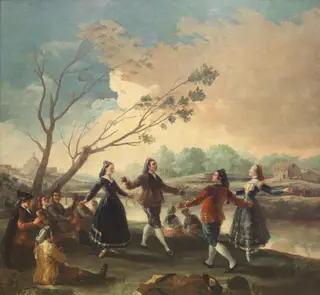
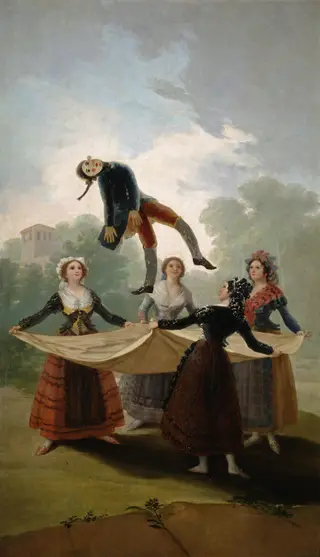
Blind Man's Bluff depicts boys and girls playing the popular Spanish pastime known as "la gallina ciega," the equivalent of blind man's bluff.
Blind Man's Bluff depicts boys and girls playing the popular Spanish pastime known as "la gallina ciega," the equivalent of blind man's bluff. A blindfolded figure at the center wields a large spoon, attempting to catch the others who dance around him in a circle. The youngsters are dressed as majos and majas, the attire of the humble classes of Spanish society that aristocrats, like those also shown in the painting, liked to adopt. Some figures, by contrast, wear velvet jackets and feathered headdresses following French upper-class fashion.
The composition alternates figures between foreground and background gaps, contrasting a crouching young man dodging the ladle on the right with a woman leaning backward as another youth leans forward. As a tapestry cartoon, the work reflects a Rococo sensibility of vivacity, immediacy, and soft pink chromatism, capturing a luminous moment of enjoyment of life with possibilities of flirtation, and embodying the social mingling of nobility and Madrid's popular classes during the late Ancien Régime.
Technique & Style
Blind Man's Bluff is an oil-on-linen cartoon painted by Francisco de Goya in 1788 for tapestry production at the Royal Palace of El Pardo. The work measures 269 cm by 350 cm and depicts children playing the game blind man's bluff, with a blindfolded figure holding a large spoon while others dance around him. The figures are dressed as majos and majas, reflecting both humble Spanish attire and aristocratic French fashion, and the composition alternates foreground and background elements to create dynamic movement.
The painting exemplifies the Rococo style through its vivacity, immediacy, soft rose chromaticism, gauze-like textures in the women's skirts, luminous landscape background, and a sense of fleeting, flirtatious enjoyment of life. It is part of Goya's sixth series of cartoons intended for the Infantes' bedroom at the Palacio del Pardo and is housed in the Museo del Prado in Madrid.
History & Provenance
Blind Man's Bluff is a 1788 oil on canvas painting by Francisco Goya, created as a cartoon for tapestry decoration intended for the bedroom of the Infantas at the Palacio del Pardo for Charles IV and María Luisa. It was commissioned by the Spanish royal court for the Royal Tapestry Factory of Santa Bárbara and remained in the Museo del Prado collection from its rediscovery in 1869 and formal accession in 1870, first cataloged in 1876. The work is part of Goya's sixth series of cartoon designs produced between 1788 and 1792, dedicated to leisure and rural amusements, and represents a genre scene of children playing the game 'blind man's bluff' with figures dressed as majos and majas, reflecting both popular pastimes and aristocratic imitation of elite French fashion, characteristic of Rococo stylistic traits such as vivacity, chromatic softness, and textured fabrics.
Blind Man's Bluff and its preliminary sketch are held by the Museo del Prado in Madrid. The painting was considered lost until 1869, when Gregorio Cruzada Villaamil discovered it in the basement of the Royal Palace of Madrid. It was subsequently transferred to the Museo del Prado in 1870 by government ordinances dated January 19 and February 9, and was first listed in the museum's catalogue in 1876. By the late 19th century, the work was exhibited in the museum's room 93.
Context
Blind Man's Bluff belongs to Goya’s sixth tapestry cartoon series, commissioned in 1788 for the infantes’ bedchamber at the Royal Palace of El Pardo and completed in spring of the same year. The work exemplifies the late Rococo style, characterized by vivacity, immediacy, and a palette of soft pinks and gauzy textures, while embedding a moment of aristocratic sociability and flirtation within a luminous landscape setting.
Scholarly reception emphasizes its place at the stylistic transition between Rococo frivolity and Goya’s emergent critical realism. The painting was lost after its initial palace installation, rediscovered in 1869 beneath the Royal Palace of Madrid, and transferred to the Museo del Prado in 1870, where it has been exhibited continuously since the museum’s 1876 catalogue.
Legacy
Blind Man's Bluff, painted by Francisco Goya in 1788, was created as a cartoon for tapestry decoration in the Royal Palace of El Pardo, intended for the bedroom of the infantas of the Prince of Asturias. The work, held in the Museo del Prado in Madrid, depicts children playing the game of blind man's bluff, with one blindfolded figure holding a spoon while others dance around him. The figures are dressed as majos and majas, reflecting both popular Spanish attire and aristocratic fashion influenced by French styles.
The painting exemplifies the Rococo style through its vivacity, chromatic softness, and textural details such as gauze skirts and luminous backgrounds. It was part of a series of cartoons produced between 1788 and 1792, dedicated to leisure and recreational activities, and was later transferred to tapestry by the Royal Tapestry Factory of Santa Bárbara. The work was rediscovered in 1869 and entered the Prado's collection in 1870, where it remains on display.
The painting's composition uses spatial contrast and dynamic movement to capture a fleeting moment of social interaction, blending elements of Spanish and French cultural aesthetics. Its legacy lies in representing the final phase of the Ancien Régime in Spain, illustrating the interplay between social classes and the influence of Enlightenment-era tastes on elite artistic patronage.
Overview
Francisco de Goya’s oil‑on‑linen work titled Blind Man’s Bluff presents a light‑hearted outdoor gathering of eight figures engaged in the children’s game of the same name. The participants, dressed in elaborate eighteenth‑century attire, form a circle around a blindfolded man who clutches a spoon, suggesting a playful, communal activity set against a bright, pastoral landscape.
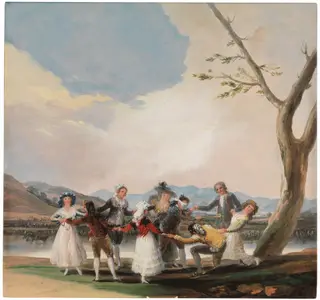
Own this work as a print
Artist & collection
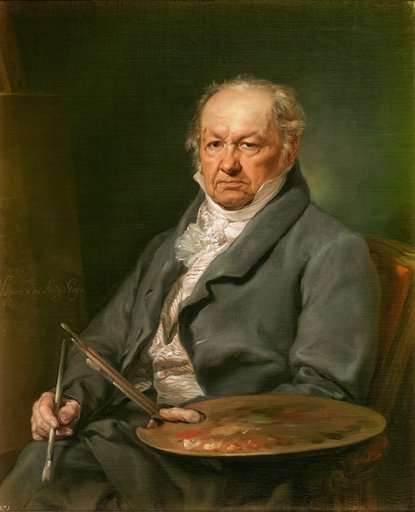
Artist
Francisco José de Goya y Lucientes was a Spanish romantic painter and printmaker.