Artwork
The Parasol
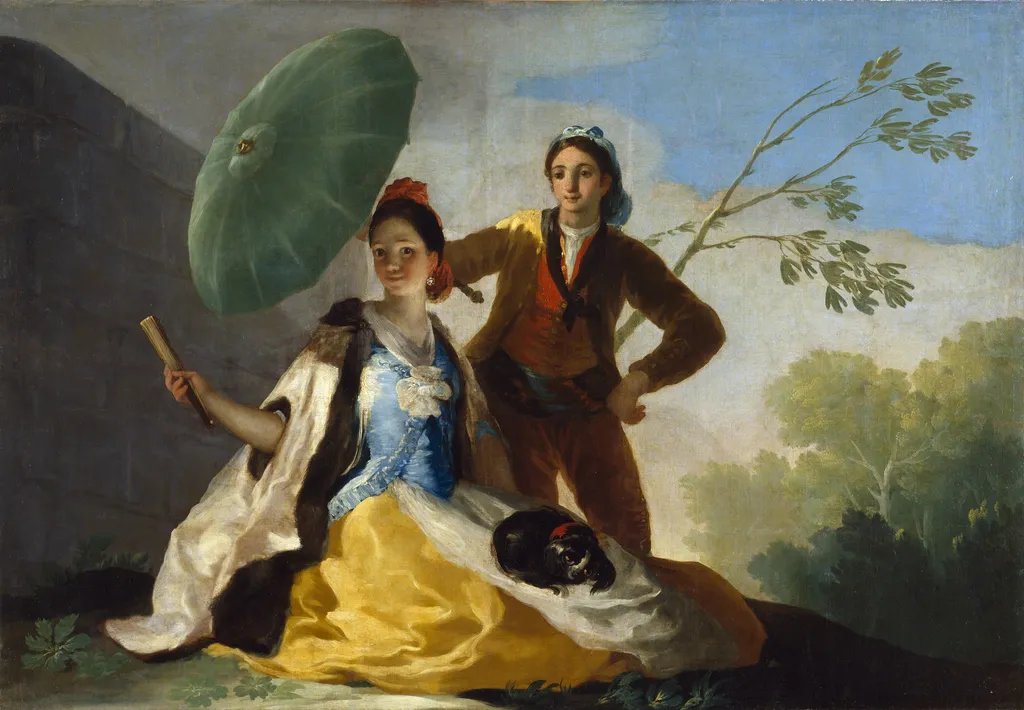
The Parasol is an oil painting by the Rococo painting artist Francisco de Goya. It dates from 1789 and is held in the collection of the Museo del Prado. Francisco Goya created a small oil painting on linen that served as a preparatory design for a tapestry.
About this work
Subject & Meaning
The two figures were modeled on the deities Voltumna and Pomona, traditionally shown as a couple, recalling Jean Ranc's painting Vertumne et Pomone.
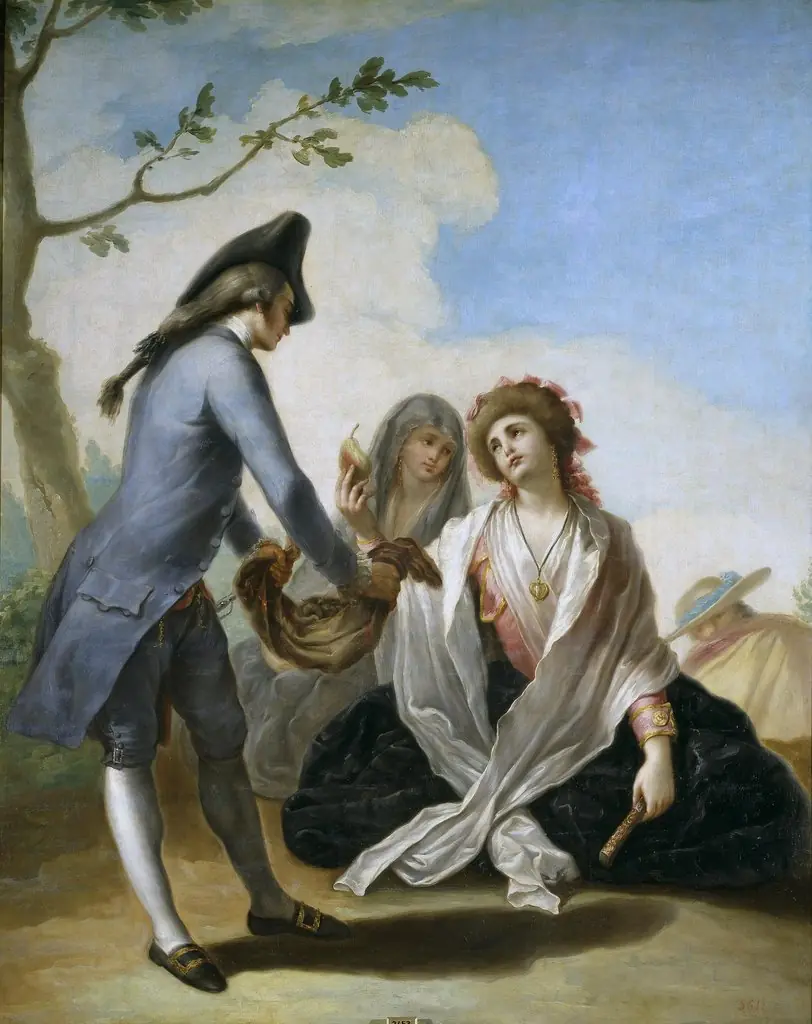
The painting depicts a young woman seated on the ground holding a closed fan, with a small dog nestled in her lap, while a young man stands behind her sheltering her face with a parasol. The woman wears French-style dress of the period in blue and yellow satin, whereas the young man is styled as a majo, with his hair gathered in a net and a colorful silk belt, signaling his lower-class identity. The pairing of a maja and majo in an innocent amorous exchange was a popular theme of the era.
According to Goya scholar Manuela B. Mena Marqués, the artist here "leaves the field of folklore and describes the eternal game of feminine seduction." The composition is read as a pyramidal arrangement, with the parasol filtering green-tinted light onto the woman's face, itself brightened from below by reflection from her yellow dress. The two figures were modeled on the deities Voltumna and Pomona, traditionally shown as a couple, recalling Jean Ranc's painting Vertumne et Pomone.
The work radiates a calm warmth offset by dark clouds and bending trees that hint at an approaching storm, while the man's triumphant stance suggests he is heroically shielding his companion. Its luminosity and joyful palette have been read as an allusion to the enlightened reign of Charles III of Spain.
Technique & Style
Executed in 1777, the work is an oil on canvas measuring 104 × 152 cm. The composition is arranged in a pyramidal arrangement that focuses attention on the seated woman, whose face is softly modeled by filtered light passing through the green parasol above. The palette employs bright, resonant hues, saturated blue and yellow satin for the woman’s dress, a green parasol, and a small black dog, set against a shallow backdrop of wind-stirred foliage under a storm-laden sky. Goya’s handling is fluid and direct, with broad, luminous color fields and a light touch that conveys spontaneity rather than meticulous finish. The scene’s calm warmth is contrasted by the breezy agitation of the trees, yet the figures remain poised within a controlled, almost theatrical framing that anticipates the tapestry’s intended placement high on a wall.
History & Provenance
Painted by Francisco Goya in 1777, *The Parasol* (El Quitasol) was created as a cartoon for a tapestry intended for the dining room of the Prince and Princess of Asturias at the Royal Palace of El Pardo. Goya executed the work between March 3 and August 12, 1777, delivering the canvas to the Royal Tapestry Factory of Santa Bárbara in Madrid on the latter date. Although originally designated for the dining room at San Lorenzo de El Escorial, the tapestry series was ultimately installed in the palace of El Pardo. The painting was considered lost until 1869, when it was rediscovered in the basement of the Royal Palace of Madrid by Gregorio Cruzada Villaamil. It officially entered the collection of the Museo del Prado in 1870 following royal ordinances issued in January and February of that year. The Parasol has been part of the collection of the Museo del Prado in Madrid since 1870. Prior to this acquisition, the painting was stored in the cellar of the Royal Palace of Madrid during 1856 and 1857 before being rediscovered in 1869. It was formally transferred to the museum via ordinances issued in January and February 1870 and first appeared in the museum's catalog in 1876. Within the Prado, the work is displayed in Room 086 (also referenced as Room 85). Regarding its exhibition history, the painting was featured in "Goya Prophet der Moderne," which traveled from the Alte Nationalgalerie in Berlin to the Kunsthistorisches Museum in Vienna between 2005 and 2006. It was also included in the exhibition "Goya en Madrid. Cartones para tapices 1775-1794," held at the Museo del Prado from late 2014 to May 2015.
Context
Painted between 3 March and 12 August 1777, when it was delivered to the Real Fábrica de Tapices de Santa Bárbara, The Parasol belongs to the second series of tapestry cartoons Goya produced for the dining room of the Prince and Princess of Asturias at the Royal Palace of El Pardo. The painting was undervalued at the time, receiving a modest payment likely because of its limited cast of figures and sparse landscape. Considered lost, it was rediscovered in 1869 by Gregorio Cruzada Villaamil in the basement of the Royal Palace of Madrid and entered the Museo del Prado in 1870, appearing in its catalogue by 1876. Scholars situate the work within Goya's formative tapestry-cartoon period (1775-1792), which honed his observation of everyday life and launched his court career, leading to his election to the Royal Academy of San Fernando in 1780. Manuela B. Mena Marqués reads the painting as transcending folklore to depict the "eternal game of feminine seduction," while Italian commentators note its pyramidal composition and the spontaneous handling of pure red pigment, qualities linking it to Corrado Giaquinto's Italianate palette and prefiguring later Romantic and even Impressionist practice.
Legacy
The Parasol has been celebrated as a touchstone of Goya’s early maturity and a defining example of his tapestry-cartoon practice, anchoring his reputation as a modernizer of Spanish genre painting. After its 1870 transfer to the Museo del Prado, the work entered the museum’s permanent galleries and has since been featured in major Goya retrospectives, including "Goya Prophet der Moderne" (2005) in Berlin and Vienna and "Goya en Madrid. Cartones para tapices 1775-1794" (2014-15) at the Prado, reinforcing its canonical status within eighteenth-century Spanish art. Critics have repeatedly underscored its masterful light, saturated color, and subtle social play between maja and majo, elements that prefigure Goya’s later achievements in portraiture and social critique.
Own this work as a print
Artist & collection
Artist
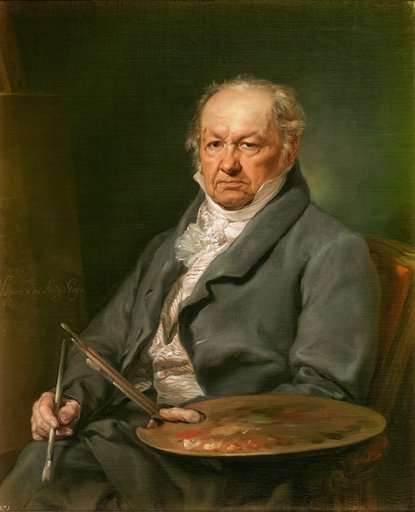
Francisco José de Goya y Lucientes was a Spanish romantic painter and printmaker.