Artwork
Church Building in Brazil
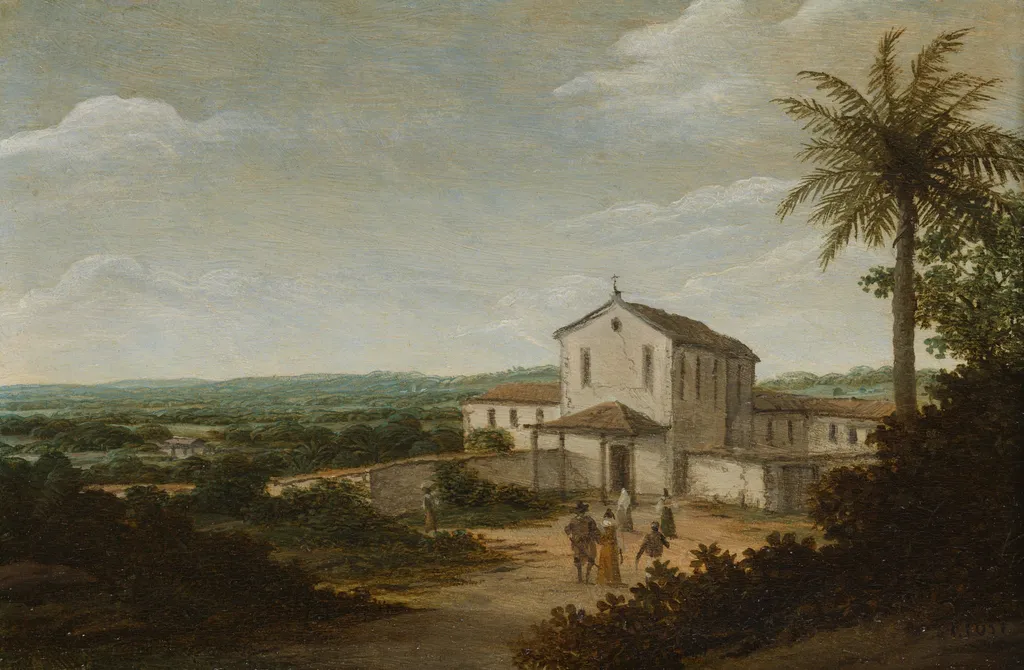
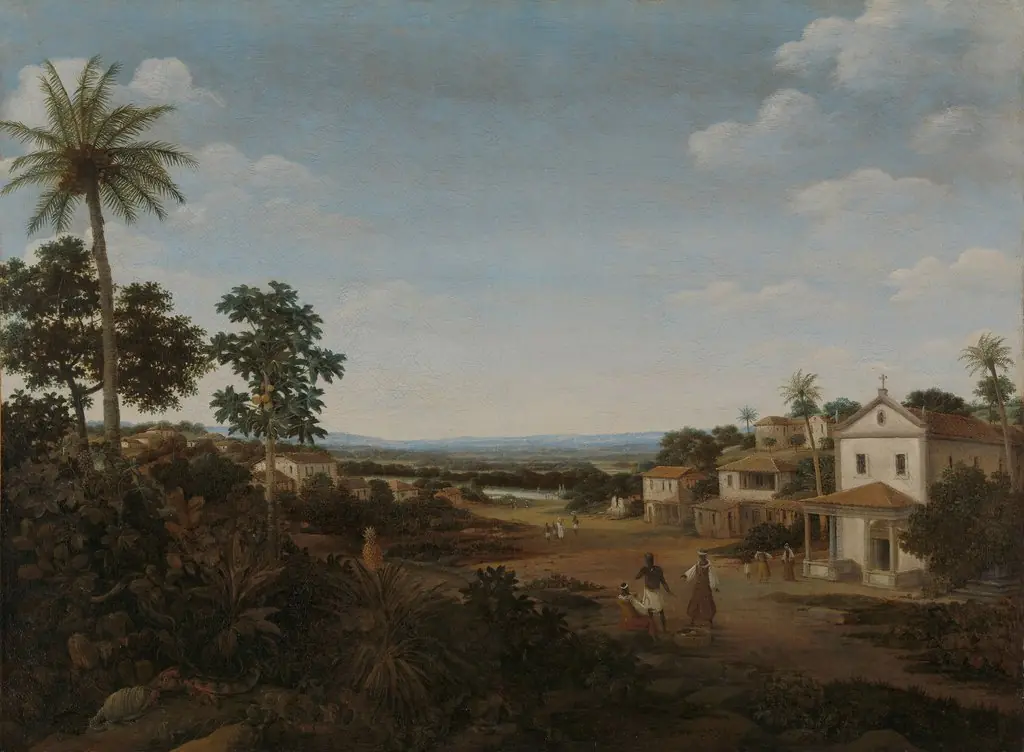
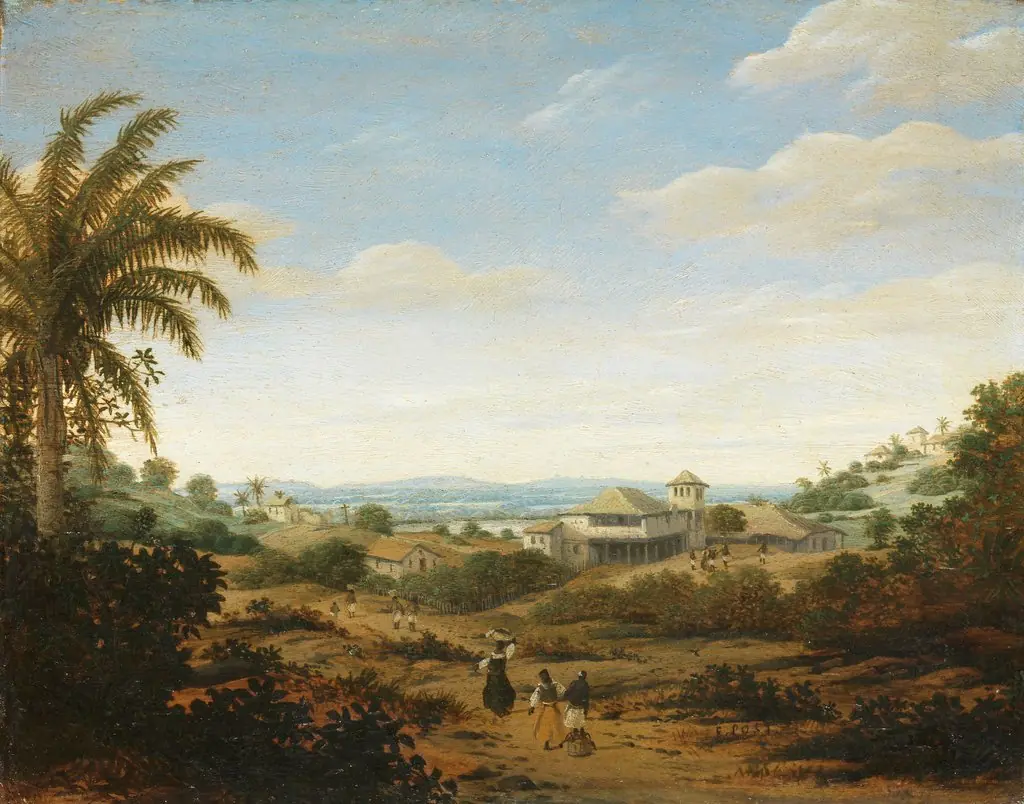
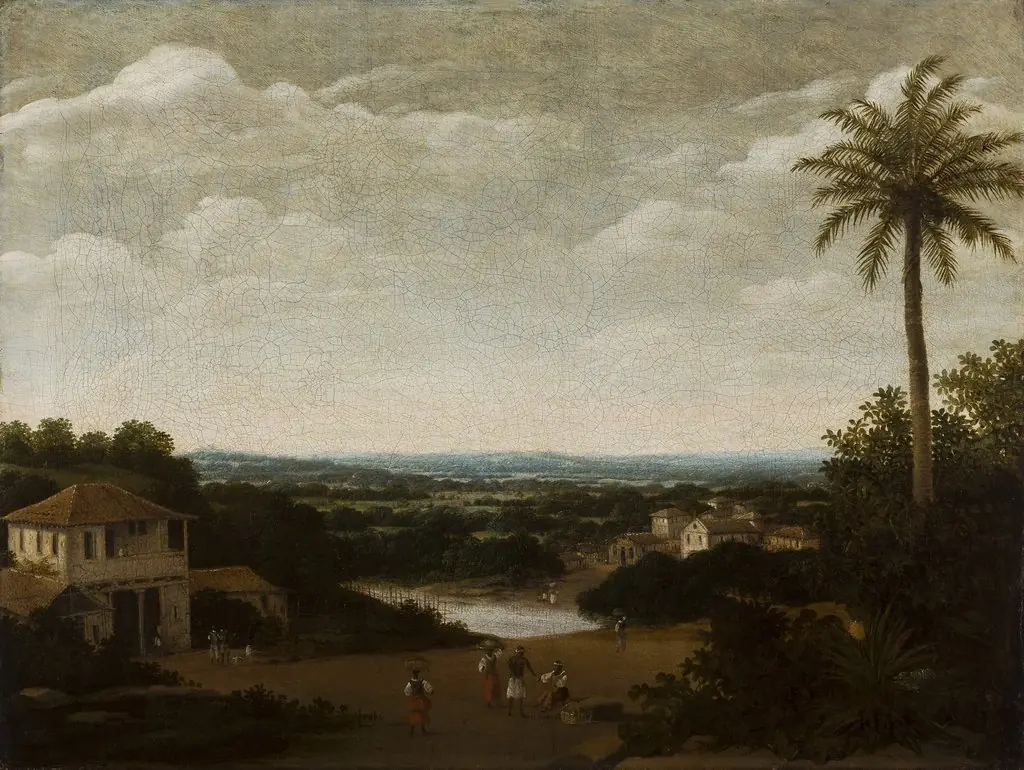
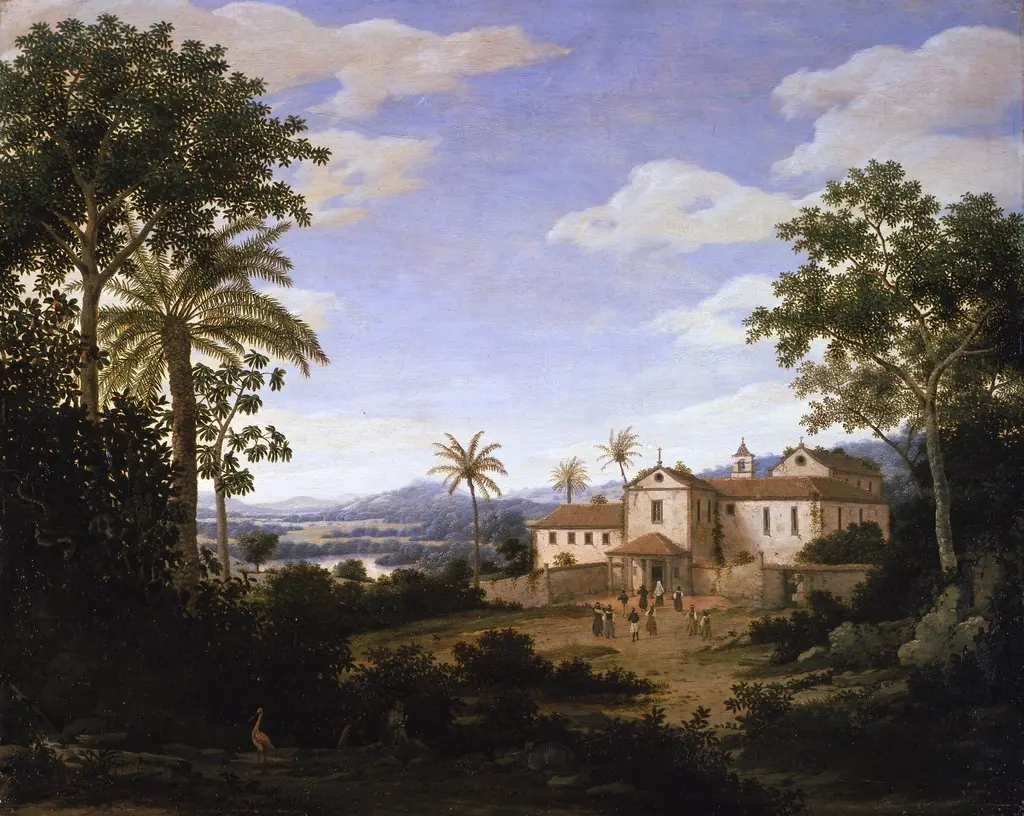
Church Building in Brazil is an unspecified painting by the Barbizon school artist Frans Post. It dates from 1678 and is held in the collection of the Rijksmuseum.
About this work
Subject & Meaning
Such works often represented the idealized vision of Dutch rule, portraying conquered territories as orderly and prosperous under European governance.
Frans Jansz Post’s Church Building in Brazil depicts a colonial religious structure in Dutch Brazil, reflecting the era’s European settlement and missionary efforts. The painting integrates the church into a lush Brazilian landscape, symbolizing the intersection of Dutch colonial authority and local geography. Such works often represented the idealized vision of Dutch rule, portraying conquered territories as orderly and prosperous under European governance.
The presence of the church underscores the role of Christianity in legitimizing colonial expansion, while the surrounding flora and fauna, typical of Post’s oeuvre, evoke the exoticism of the Americas as perceived by European audiences. The composition blends documentary realism with imaginative elements, aligning with Post’s post-1644 style, which favored vibrant colors and baroque idealization over his earlier, more somber Brazilian sketches.
Technique & Style
Frans Jansz Post’s Church Building in Brazil (1675–1680) is executed in oil on canvas, a medium typical of Dutch Golden Age landscape painting. The work reflects Post’s mature technique, developed after his return to the Netherlands, characterized by a brighter palette and heightened idealization of Brazilian scenery. His handling is precise, with meticulous attention to architectural details and foliage, though the composition retains a decorative, almost fantastical quality, diverging from the stark realism of his earlier Brazilian sketches.
Stylistically, the painting aligns with Baroque conventions, employing a balanced, horizontal composition to evoke depth and grandeur. The sky, rendered in vivid blues, contrasts with lush greenery, a hallmark of Post’s post-Brazilian works, where pigments often exhibit discoloration, particularly the fading of yellows in green areas, leaving residual blue tones. The support remains in stable condition, though specific restorations are not documented in the sources.
History & Provenance
Frans Jansz Post’s Church Building in Brazil is dated 1675–1680, placing it late in the artist’s career after his return from Dutch Brazil.
The work was commissioned and later gifted by Johan Maurits, Prince of Nassau-Siegen, who had invited Post to Brazil in 1636 and thereafter assembled a group of artists and scholars to document the colony. In 1679 Nassau-Siegen presented a group of Post’s Brazilian landscapes to Louis XIV of France; among these donated works was the present painting, which entered the French royal collection and has remained in public ownership in France since.
No private ownership chain is documented for this specific painting beyond its inclusion in the 1679 gift to Louis XIV.
Context
Frans Jansz Post’s Brazilian landscapes, including Church Building in Brazil, occupy a singular place in European art as the first sustained European visual record of the Americas. Early scholarship, notably Erik Larsen and Wolfgang Stechow, emphasized the documentary fidelity of works painted in Brazil (1637–1644), treating Post’s on-site sketches and paintings as quasi-cartographic evidence of Dutch colonial geography and settlement. These studies were later presented to Louis XIV in 1679, reinforcing their status as authoritative images of the colony.
By contrast, post-1644 paintings, produced in Haarlem, were received as imaginative reconstructions that idealized Dutch rule, blending exotic motifs with Baroque compositional devices.
Exhibitions since 1990 have framed Post within transnational colonial culture: the 1990 Basel/Tübingen survey underscored his role as a mediator between Brazilian topography and Dutch taste, while the Louvre’s 2005 retrospective repositioned his oeuvre within the politics of collecting and display at Versailles. Modern catalogues raisonnés, especially Pedro Corrêa do Lago’s 2007 publication, consolidated this reception by cataloguing 155 paintings, 57 drawings, and 35 prints, anchoring Post’s works in both art-historical narratives and colonial historiography.
Legacy
Frans Post is recognized as the first European artist to document landscapes of the Americas, establishing a visual record of Dutch Brazil that combined topographical accuracy with imaginative elements. His works were widely collected across Europe and Brazil, serving as idealized representations of colonial rule that popularized interest in the region's flora, fauna, and indigenous populations. While his contemporary Albert Eckhout often received greater historical attention, Post's paintings remain unique testimonies to the era, housed in major institutions such as the Louvre, the Rijksmuseum, and the Instituto Ricardo Brennand.
Post's legacy includes his contribution to the 1648 scientific volume Historia Naturalis Brasiliae and the 1647 chronicle commissioned by John Maurice, Prince of Nassau-Siegen. A significant portion of his oeuvre, including a series originally gifted to Louis XIV, continues to be studied for its evolution from stark realism to decorative, exoticized baroque compositions. Modern exhibitions in cities like Basel, Paris, and Munich have reaffirmed his status as a pivotal figure in introducing South American imagery to European art.
Overview
Frans Post’s canvas depicts a modest white church capped with a red roof, set amid a grassy meadow beneath an expansive sky. The composition combines a church and a Franciscan monastery, echoing the architectural forms typical of coastal settlements in Pernambuco, Brazil.
Own this work as a print
Artist & collection
Artist
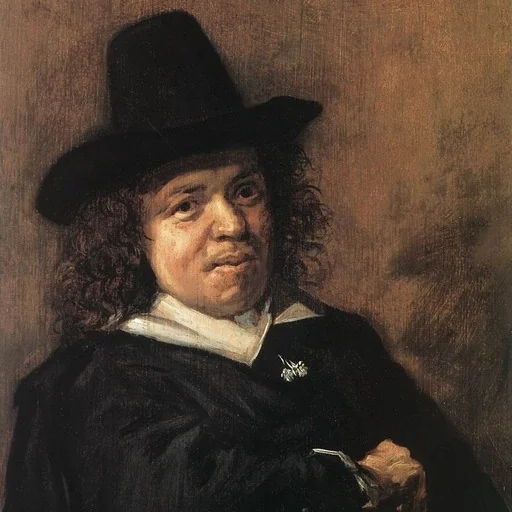
Frans Janszoon Post (17 November 1612 – 17 February 1680) was a painter during the Dutch Golden Age.