Artwork
In the Corner
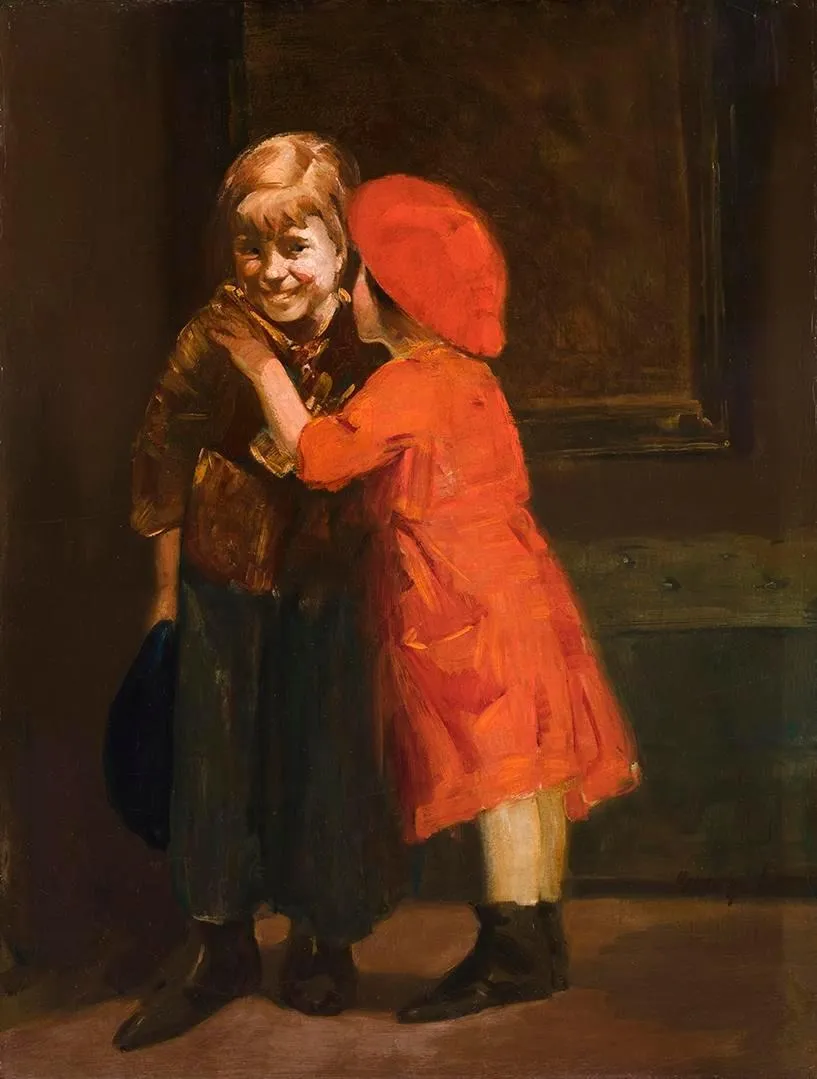
In the Corner is an unspecified painting by the Ashcan School artist George Luks. It dates from 1920 and is held in the collection of the Crystal Bridges Museum of American Art.
About this work
Overview
This painting captures a quiet, unposed moment in a crowded city neighborhood, reflecting Luks’s enduring interest in ordinary people and their environments.
George Luks completed In the Corner in 1920, near the end of his career. A former newspaper illustrator, he was closely linked to the Ashcan School, a group of American artists who turned away from academic traditions to depict everyday urban life. This painting captures a quiet, unposed moment in a crowded city neighborhood, reflecting Luks’s enduring interest in ordinary people and their environments.
Subject & Meaning
Two children stand side by side in a dimly lit interior, their proximity suggesting a bond forged in shared circumstance. The child on the left meets the viewer’s gaze directly, while the other, dressed in a vivid red hat and coat, appears absorbed in the moment. The absence of context, no furniture, no windows, focuses attention on their quiet coexistence, evoking solitude and resilience rather than narrative.
Technique & Style
Luks employed loose, expressive brushwork and a restrained palette dominated by dark tones, allowing the child’s red garments to stand out as the sole point of chromatic emphasis. The background recedes into near-obscurity, isolating the figures and heightening their emotional presence. His approach blends realism with a tactile immediacy, rooted in his illustration background but refined through direct observation.
History & Provenance
Painted in 1920, In the Corner emerged during a period when Luks had moved beyond the radical energy of the Ashcan School’s early years. While the painting was not exhibited widely at the time, it remained in private collections before entering a public institution. Its survival reflects a growing appreciation for Ashcan artists’ documentation of urban life, even as their reputations fluctuated in the decades after their peak.
Context
In early 20th-century New York, the Lower East Side housed waves of immigrants living in dense, often impoverished conditions. Luks, like his Ashcan peers, sought to portray these communities without sentimentality or moralizing. In the Corner avoids overt social commentary, instead offering a restrained glimpse into the private world of children navigating urban hardship with quiet dignity.
Legacy
Though less celebrated than some Ashcan works, In the Corner exemplifies Luks’s ability to convey emotional depth through understated composition. It contributes to a broader American realist tradition that valued authenticity over idealization. The painting continues to be studied for its empathetic portrayal of childhood in marginalized urban settings, influencing later generations of socially attuned artists.
Artist & collection

Artist
George Benjamin Luks (August 13, 1867 – October 29, 1933) was an American artist, identified with the aggressively realistic Ashcan School of American painting.

Museum
Crystal Bridges Museum of American Art
Continue through works from the same source collection.
- Pikkusiskoaan ruokkiva poika
 Two Boys: Study after 'Spanish Boys Playing at Bull-fighting' (NG 534)
 Sisarukset, Nelma ja Ilma
 Two Young Girls
 Copii plângând
 Gamins de Paris
 Peasant girl
 Artist’s son with a dog
 Leikkiviä poikia rannalla, harjoitelma
 Paul and Edmond Roger, the Artist's Stepchildren
 Les Boëchelles. Two Walloon Peasant Children
 Portrait of Olga Wassiljewna Surikowa, the artist's daughter (Girl with Doll)