Artwork
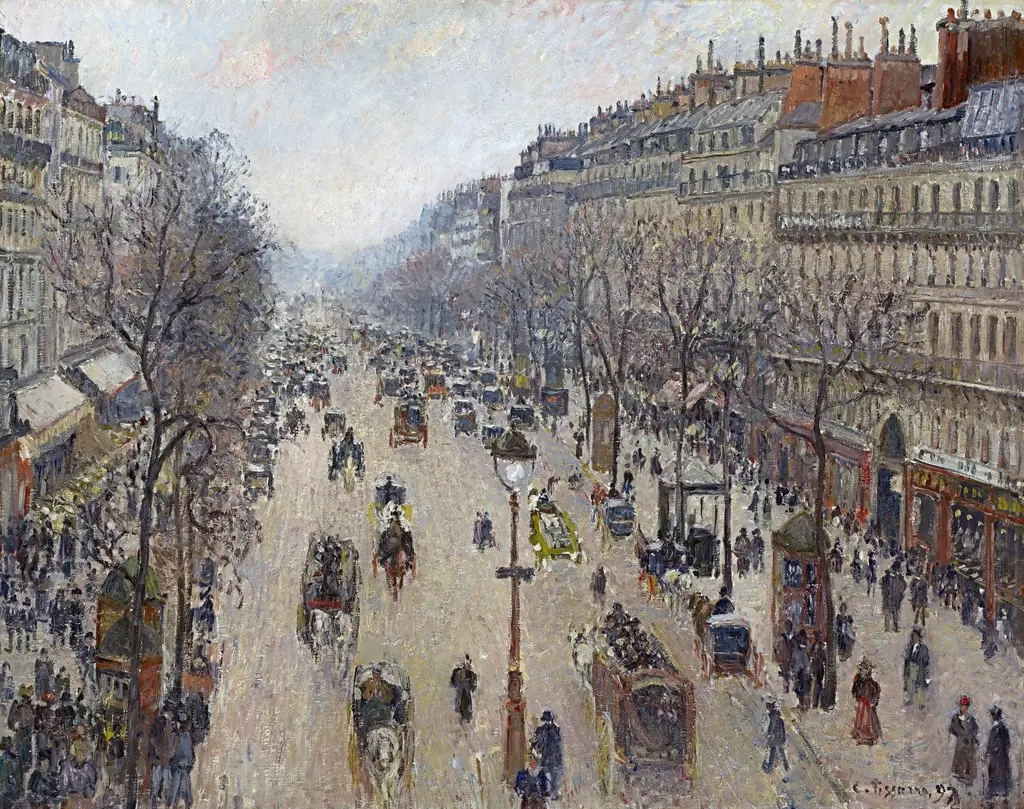
Boulevard Montmartre, sunny afternoon
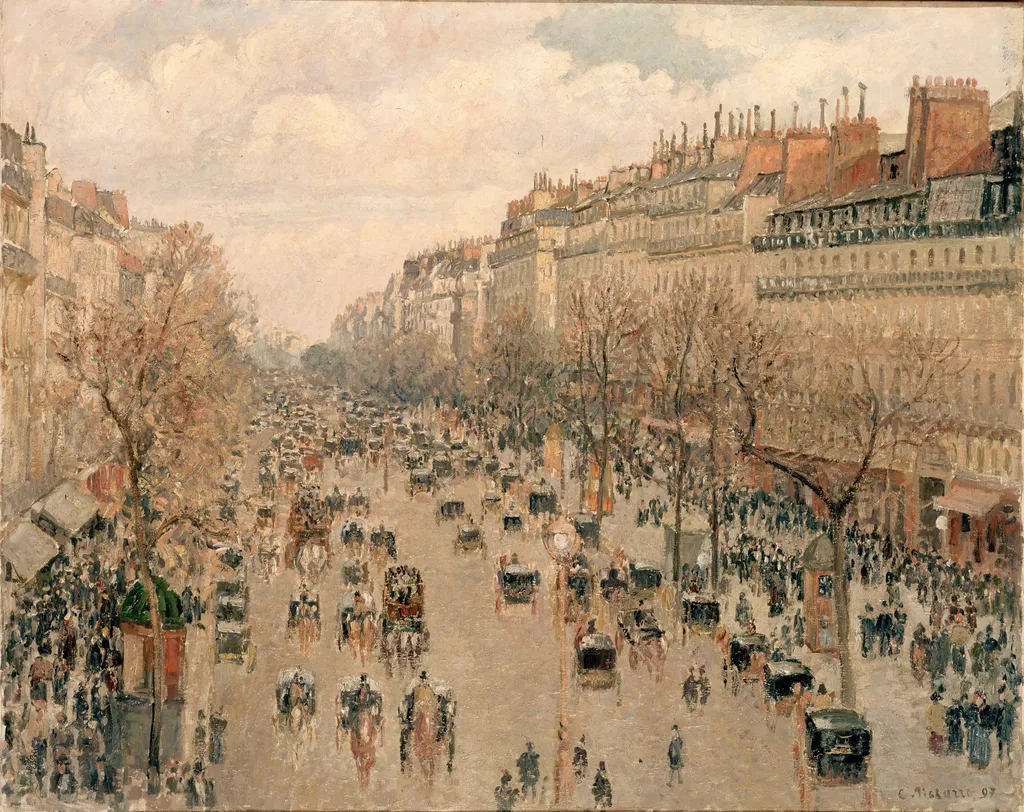
Boulevard Montmartre, sunny afternoon is an oil painting by the Impressionist artist Camille Pissarro. It dates from 1899 and is held in the collection of the Hermitage Museum.
About this work
Subject & Meaning
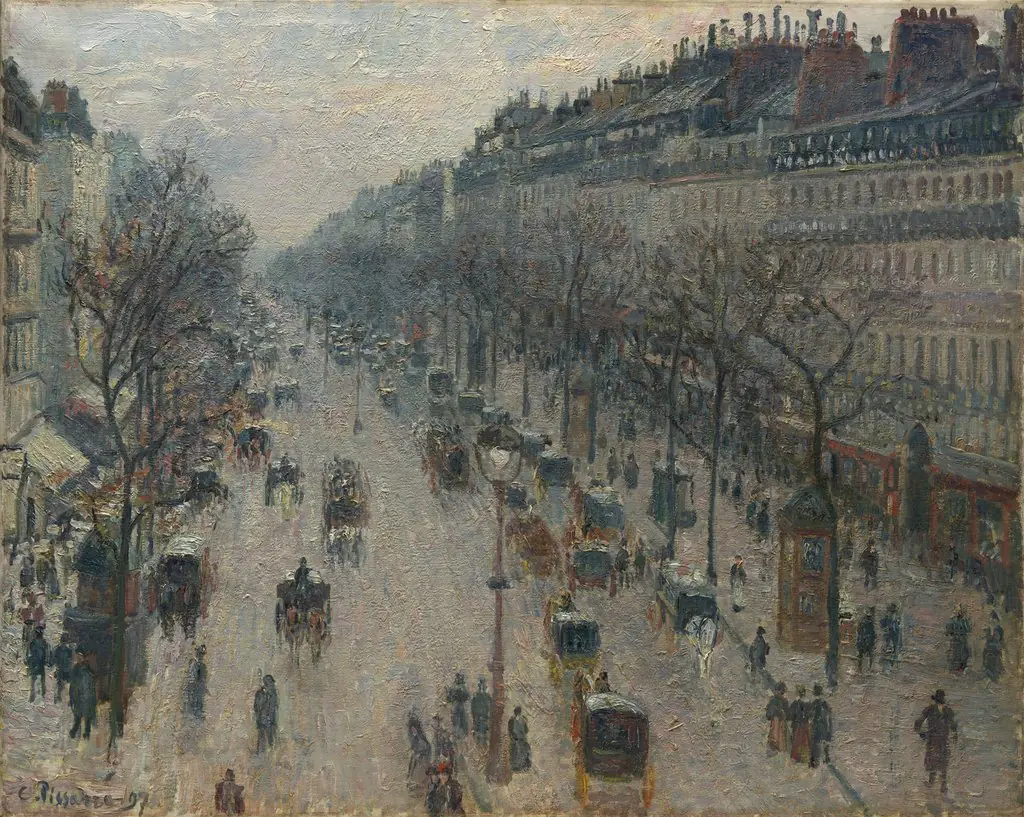
Figures and carriages rendered sketchily convey lively movement, balanced by the calmness imparted by the gentle sunlight and orderly procession of people.
The painting depicts a bustling Parisian boulevard in winter late afternoon, capturing the urban energy and seasonal transition. Blurred trees and leafless branches indicate the end of winter, while the low sun filtering through clouds suggests the approach of spring, symbolizing renewal and anticipation. The composition emphasizes the ordered perspective of Hausmann's redesigned Paris, with streets lined by classicist buildings and numerous chimneys reflecting the season's chill.
Figures and carriages rendered sketchily convey lively movement, balanced by the calmness imparted by the gentle sunlight and orderly procession of people. The work resonates with Monet's Boulevard des Capucines, reflecting Impressionist influences, while Pissarro's brief use of pointillist techniques in earlier years is evident in textured surfaces before he returned to core Impressionist principles. This series, painted from his hotel room at the Grand Hôtel de Russie in February–March 1897, exemplifies his exploration of light and weather effects across a single urban space, underscoring his role as a pioneer of Impressionism.
Technique & Style
Pissarro employed oil paint on canvas to render Boulevard Montmartre, sunny afternoon in 1897, creating a cityscape that captures the boulevard’s Haussmannian architecture and bustling traffic through layered brushwork and modulated light. The work measures 74 × 92.8 cm and is executed in a naturalistic yet impressionistic style, using color and atmospheric effects to convey the fleeting quality of late‑winter sunlight. Pissarro’s handling of perspective emphasizes the street’s vanishing point, while subtle remnants of pointillist technique appear in the pavement and foliage, reflecting his brief engagement with Neo‑Impressionism before returning to core Impressionist principles.
History & Provenance
Camille Pissarro executed Boulevard Montmartre, sunny afternoon in 1897 as part of a series of fourteen views depicting the Parisian boulevard. The artist created this body of work between February and March while residing at the Grand Hôtel de Russie, painting the scene from his hotel room overlooking the rue Drouot. This specific canvas, measuring 74 by 92.8 centimeters, captures the late winter atmosphere with leafless trees and low afternoon sunlight.
The painting currently resides in the collection of the Hermitage Museum in Saint Petersburg, where it is displayed in the gallery dedicated to Alfred Sisley and Pissarro.
Camille Pissarro's Boulevard Montmartre, sunny afternoon is held by the Hermitage Museum in Saint Petersburg. The painting is displayed in the Alfred Sisley and Camille Pissarro room, specifically designated as room 406. Created in 1897, this oil-on-canvas work measures 74 cm in height and 92.8 cm in width.
The source material confirms the artwork's current location within the Hermitage collection but does not provide a specific inventory or accession number. Furthermore, the provided texts contain no information regarding the painting's exhibition history, past loans, or public display events prior to its current residence.
Context
Boulevard Montmartre, sunny afternoon belongs to Camille Pissarro’s late-career series of fourteen works painted from a hotel window in early 1897, exemplifying his lifelong pursuit of capturing fleeting light and weather through serial observation. Critics have framed the series as a distillation of Impressionist principles, emphasizing the artist’s return to foundational concerns after a brief engagement with Neo-Impressionist technique in the early 1890s. The composition’s ordered perspectival lines and subdued palette align with late Impressionism’s measured vitality, contrasting with the more fractured optics of pointillism that Pissarro had earlier explored under Georges Seurat and Paul Signac.
The work’s placement in the Hermitage Museum situates it within a broader tradition of European landscape display, where Pissarro’s Parisian boulevards sit alongside other urban panoramas. Its dialogue with Monet’s Boulevard des Capucines (1873) underscores a shared ambition to render modern metropolitan life while preserving atmospheric calm, a tension that became central to the critical reception of late Impressionist serial painting.
Legacy
The series of fourteen paintings depicting Boulevard Montmartre, including this work, established Pissarro's reputation for exploring urban modernity through systematic studies of light and atmosphere. His methodical approach to capturing the boulevard at different times influenced later artists such as Monet, who had earlier pioneered similar series, and the Neo-Impressionists Seurat and Signac, who inspired Pissarro's brief use of pointillist techniques in the early 1890s. The work's presence in the Hermitage Museum since its acquisition has ensured ongoing scholarly attention to Pissarro's contribution to urban Impressionism, with exhibitions and publications continuing to highlight its significance in the evolution of cityscape painting.
Overview
Camille Pissarro’s 1899 oil painting titled Boulevard Montmartre, sunny afternoon captures a lively Parisian thoroughfare. The canvas presents a wide street flanked by tall, window‑lined buildings and a row of leafless trees that bisect the avenue. Pedestrians, horse‑drawn carriages, and idle figures populate the scene beneath a pale sky dotted with soft clouds, conveying the rhythm of urban life in the late nineteenth century.
Own this work as a print
Artist & collection