Artwork
Music
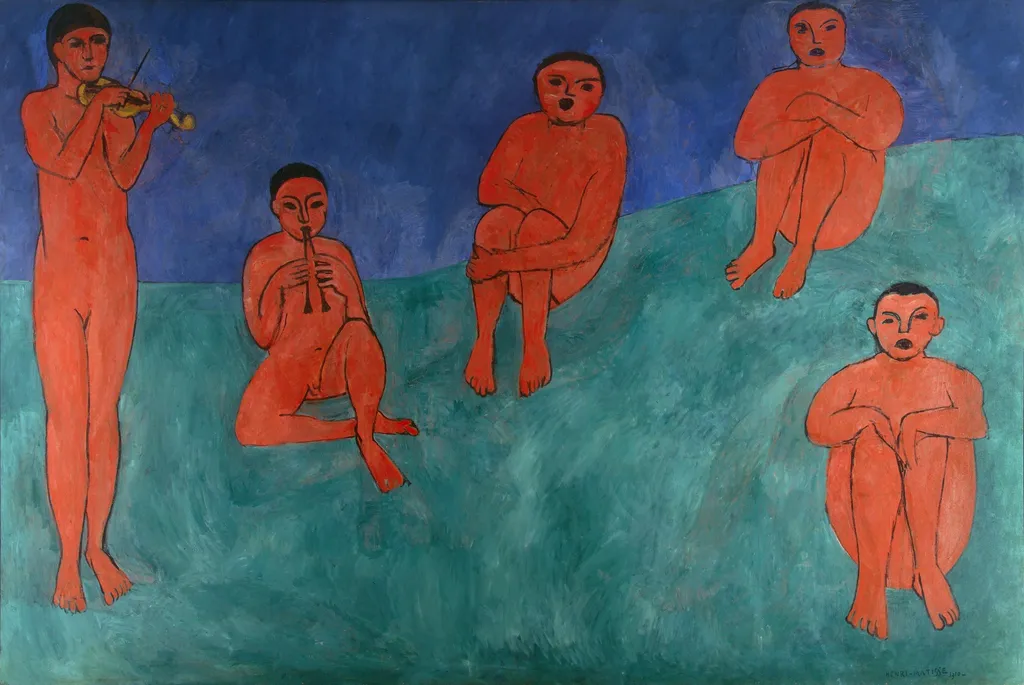
Music is an oil painting by the Post-Impressionist artist Henri Matisse. It dates from 1910 and is held in the collection of the Hermitage Museum.
About this work
Subject & Meaning
The scene thus stages a small ensemble of singer, instrumentalists, and choir, condensing the act of music-making into a single frieze.
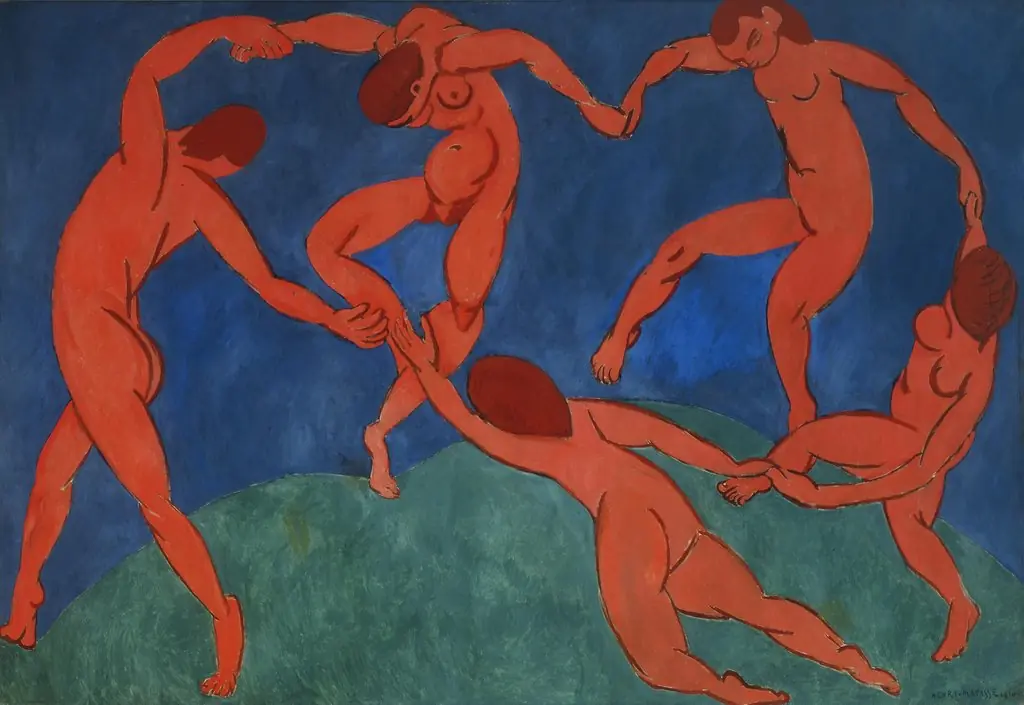
Music depicts five nude figures arranged across a green ground beneath a blue sky. Two figures on the left play instruments, one a violin, the other a wind instrument, while the remaining three figures sing, their open mouths indicating vocal performance. The scene thus stages a small ensemble of singer, instrumentalists, and choir, condensing the act of music-making into a single frieze.
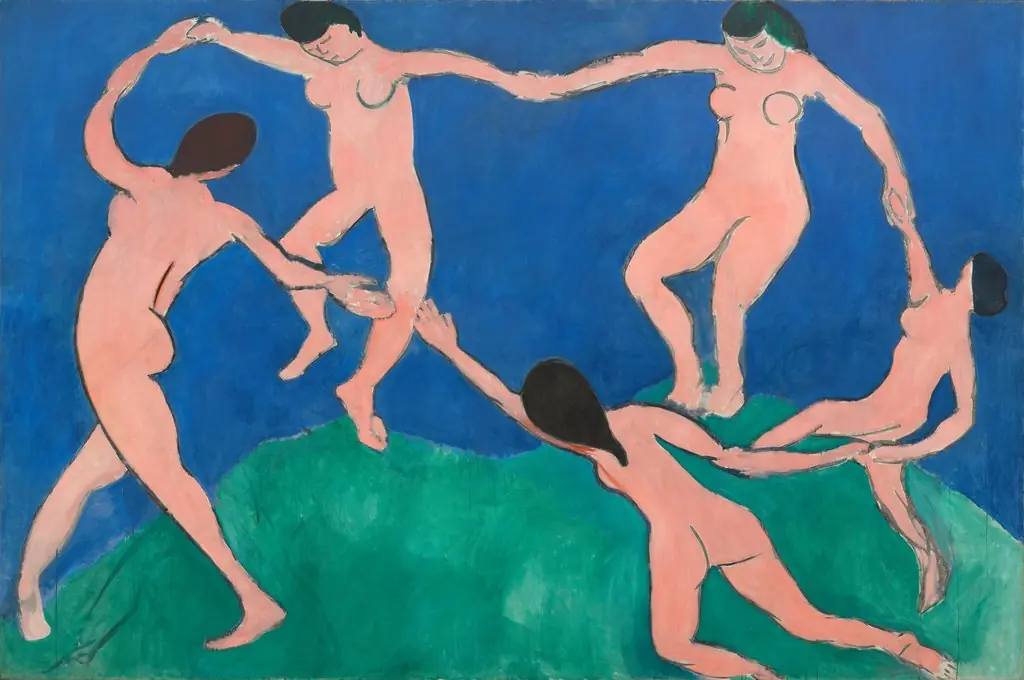
Like its companion panel Dance, the work uses a restricted palette of red for the bodies, blue for the sky, and green for the earth, reducing the figures to elemental signs of human activity. Matisse conceived the painting as a counterpart to Dance, with the two panels together expressing complementary aspects of human experience: creative immersion in art and music as a path toward completeness.
Technique & Style
Executed in 1910, Music is a large-scale oil painting on canvas measuring 260 by 389 cm. Matisse created the work without preparatory sketches, resulting in a surface that retains visible traces of modifications and adjustments made during the creative process. The composition employs a restricted palette of three dominant colors: red for the nude human figures, green for the foreground landscape, and blue for the sky. This simplified chromatic scheme emphasizes the rhythmic arrangement of five figures, two playing instruments and three singing, against the flat background. The painting is signed and dated by the artist.
History & Provenance
Matisse painted Music in 1910 in France, working directly on canvas without preparatory sketches; the work’s pentimenti reveal extensive adjustments during execution.
It was commissioned by Sergei Shchukin and first shown at the Salon d’Automne in Paris in 1910, where it met with criticism. After Shchukin accepted the painting, it traveled to his Moscow mansion and was installed alongside Dance on the staircase. During the Russian Revolution the Soviet authorities confiscated the work in 1917.
It was later recovered, exhibited in Moscow and Leningrad, and censored by red overpainting of the nude flute player’s genitalia; restoration removed the added paint. Since then, the painting has resided in the Hermitage Museum in Saint Petersburg, where it is currently displayed in Hall 440.
The work arrived in Moscow on 17 December 1910 and was installed in Shchukin's mansion in 1911 under the artist's supervision. Around 1917 the Soviet government confiscated it during the Russian Revolution; it was recovered in 1930 and subsequently exhibited in Moscow and Leningrad.
Context
Commissioned by Sergei Shchukin to accompany Dance, Music was exhibited at the 1910 Salon d'Automne in Paris prior to delivery. The initial critical reception was largely negative, generating significant controversy that even caused Shchukin to doubt his acquisition before ultimately accepting the work. Created without preparatory sketches, the canvas retains visible traces of Matisse's modifications, offering scholars a direct view of his process in achieving a state of creative completeness.
Following the Russian Revolution, the Soviet government confiscated the painting around 1917. During the 1930s, state censors altered the work by painting over the nudity of a flute player, though later restoration efforts removed these additions to return the piece to its original condition.
Legacy
Matisse’s Music entered the Hermitage after Soviet confiscation during the Revolution and was later censored by the addition of red paint over a flute player’s nudity; restoration removed the overpaint, restoring the original composition.
Its initial reception at the Salon d’Automne in 1910 was unfavorable, and even the patron Sergei Shchukin initially doubted the work, though he ultimately accepted the commission. By the late 1910s, however, the pairing of Music with Dance became emblematic of Matisse’s early modernist achievement and of Shchukin’s Moscow mansion installation, influencing modernist interior display strategies.
Today the painting is a touchstone in the Hermitage’s holdings, frequently cited as a canonical example of early modernist figuration and color structure.
Overview
Henri Matisso’s large‑scale canvas Music, executed in oil in 1910, presents a group of five figures rendered in vivid red against a flat green‑blue background. The composition is arranged on a wall‑sized surface, the figures positioned seated and standing, some holding musical instruments while others adopt contemplative poses.
Artist & collection
Artist
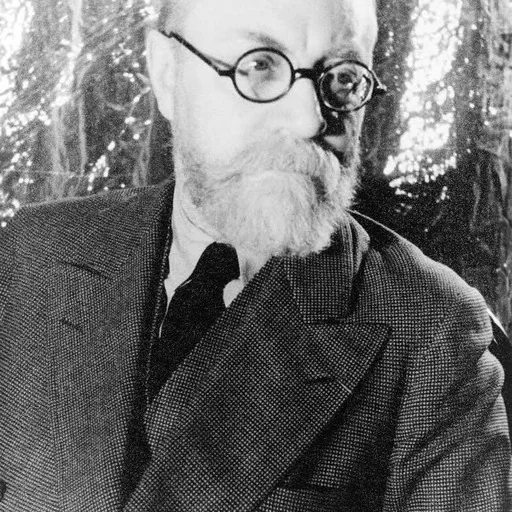
Henri Émile Benoît Matisse (French:; 31 December 1869 – 3 November 1954) was a French visual artist, known for both his use of colour and his fluid and original draughtsmanship.