Artwork
Te Pape Nave Nave (Delectable Waters)
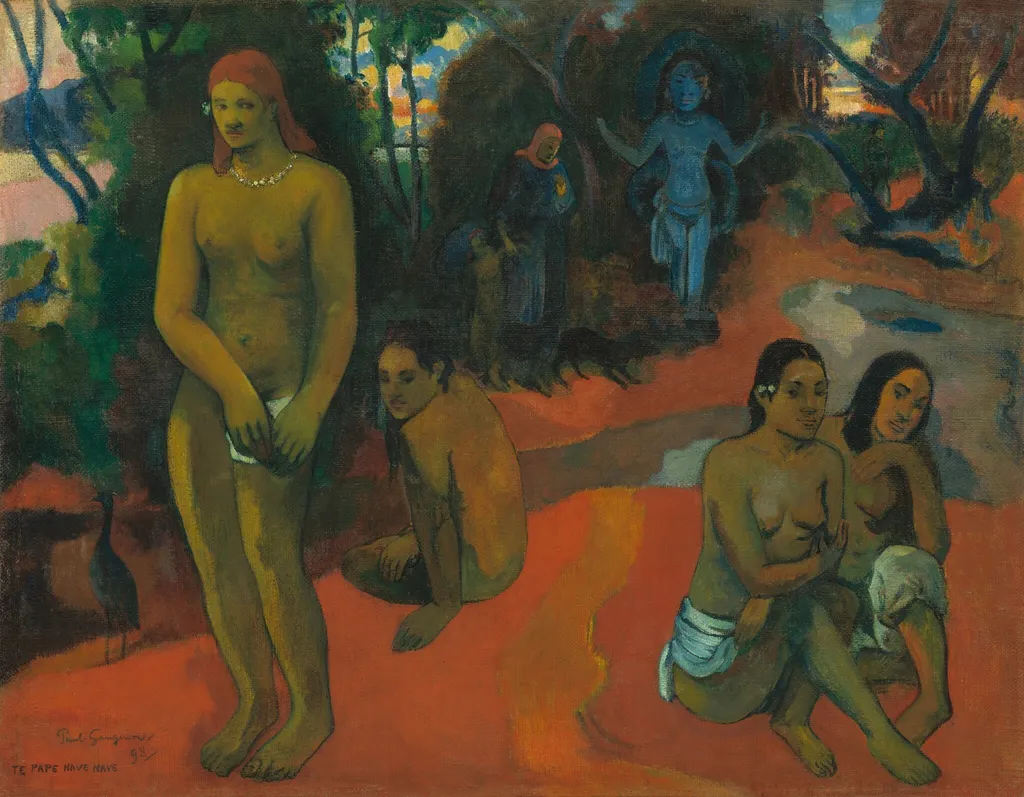
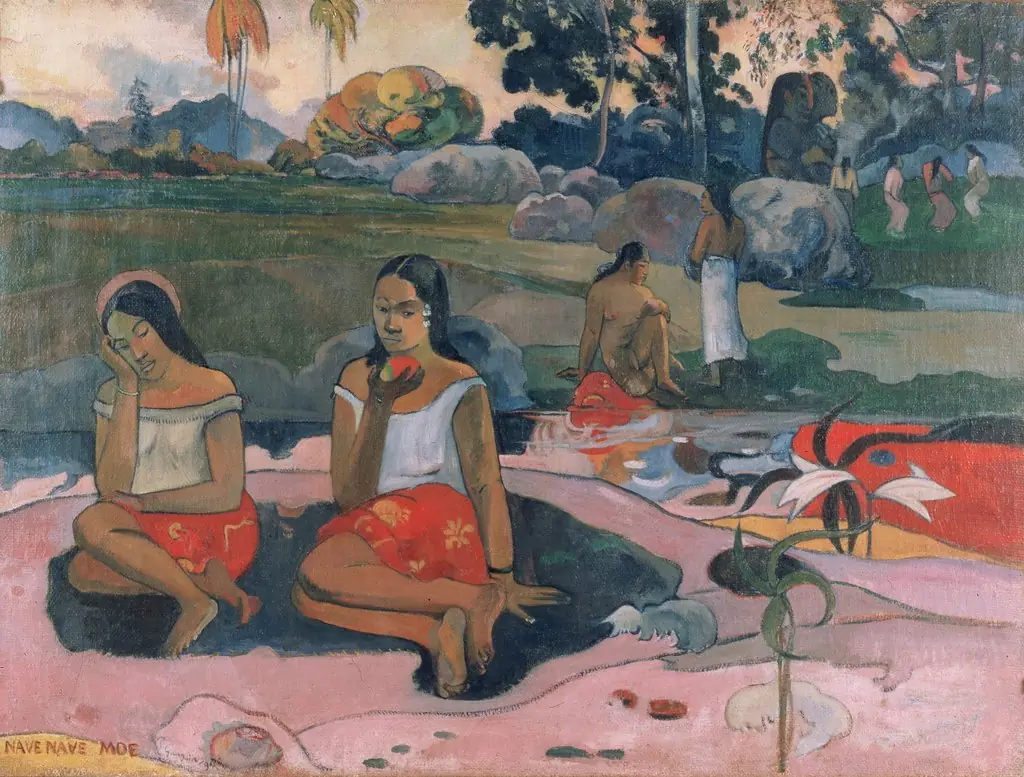
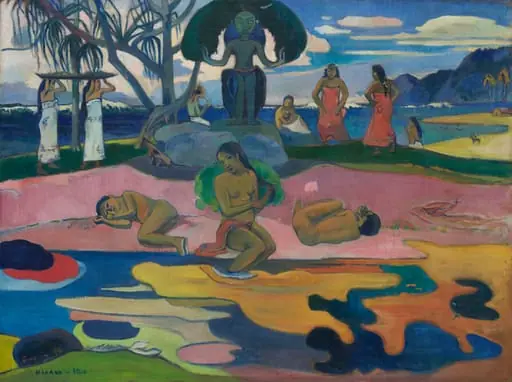
Te Pape Nave Nave (Delectable Waters) is an oil painting by the Impressionist artist Paul Gauguin. It dates from 1898 and is held in the collection of the National Gallery of Art.
- Inscription
- Inscribed:lower left: Paul Gauguin / 98 / TE PAPE NAVE NAVE
About this work
Subject & Meaning
The work thus represents Gauguin’s synthesis of personal experience and imagined paradise, merging observation with mythic interpretation.
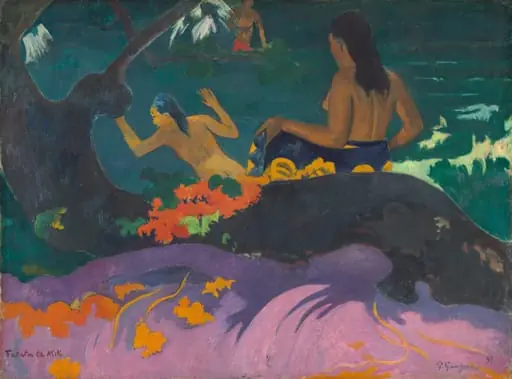
Te Pape Nave Nave (Delectable Waters) depicts a sensual, partially clothed female figure seated on a beach, surrounded by tropical foliage and distant mountains. The subject embodies the allure of the South Pacific environment that fascinated Gauguin during his stay in Tahiti, reflecting his fascination with indigenous life and natural abundance. Symbolic elements such as the flowing water and lush vegetation convey themes of fertility and sensual pleasure, while the composition suggests a dreamlike, idyllic realm beyond European constraints. The work thus represents Gauguin’s synthesis of personal experience and imagined paradise, merging observation with mythic interpretation.
The painting’s meaning centers on the celebration of sensuality and the exotic, positioning the female form as both a natural and mythic presence within an untouched landscape. By emphasizing the tactile qualities of the surface and the vibrant interplay of color and light, Gauguin invites viewers to contemplate the harmony between humanity and nature, a recurring motif in his Tahitian oeuvre.
Technique & Style
The work is an oil painting executed on canvas, measuring 74 cm in height by 95.3 cm in width. It depicts a nude figure in a tropical setting, rendered with loose brushwork that emphasizes flattened forms and symbolic color. The handling of paint conveys a decorative surface pattern, while the composition balances figural presence with ornamental background elements. These stylistic choices reflect Gauguin's synthetist approach, merging natural observation with flattened spatial arrangements and expressive contouring.
The surface condition is stable, with no documented alterations or conservation interventions noted in the provenance records. The painting remains on its original canvas support, exhibiting the characteristic crackle pattern typical of late 19th-century oil on canvas works.
History & Provenance
Te Pape Nave Nave (Delectable Waters) was painted by Paul Gauguin in 1898. According to the Wildenstein-Plattner Institute's 2021 digital catalogue raisonné, the work was possibly on consignment with several dealers over three months that year: George-Daniel de Monfreid in September, Georges-Alfred Chaudet in November, and Ambroise Vollard in November 1898. The painting subsequently passed through Paul Rosenberg et Cie in Paris, and by 1919 had entered the private collection of Bernheim-Jeune in Paris, which retained it until at least 1935.
In 1947, Wildenstein & Co. (London, New York and Paris) acquired the painting and sold it the same year to Leigh B. Block and Mary Lasker Block of Chicago, who held it until at least 1964. Paul Mellon of Upperville, Virginia, owned the work by 1966, and in 1973 he gave it to the National Gallery of Art.
Te Pape Nave Nave (Delectable Waters) is held by the National Gallery of Art in Washington, D.C., where it entered the collection in 1973 as a gift from Paul Mellon (1907–1999) of Upperville, Virginia, who had owned the painting by 1966. Prior to Mellon, the work belonged to Leigh B. Block (1905–1987) and Mary Lasker Block (1904–1981) of Chicago, who acquired it in 1947 through Wildenstein & Co. in London, New York, and Paris. Earlier, it was in the private collection of the Bernheim-Jeune gallery in Paris by 1919 and remained there until at least 1935, having previously passed through Paul Rosenberg et Cie in Paris.
During the Bernheim-Jeune ownership it was lent in 1927 to the exhibition _The Classics of Modern Paintings_ at De Hauke & Co. in New York, and was also published in Bernheim-Jeune's 1919, 1930, and 1935 catalogues.
Overview
Created in 1898, this oil on canvas by Paul Gauguin portrays a nude figure amid a verdant tropical landscape. The composition includes several women and a man arranged in varied poses, standing, seated, and kneeling, against a backdrop of lush foliage rendered in vivid greens, blues, and oranges. The work exemplifies Gauguin’s departure from European academic norms during his stay in Tahiti.
Own this work as a print
Artist & collection
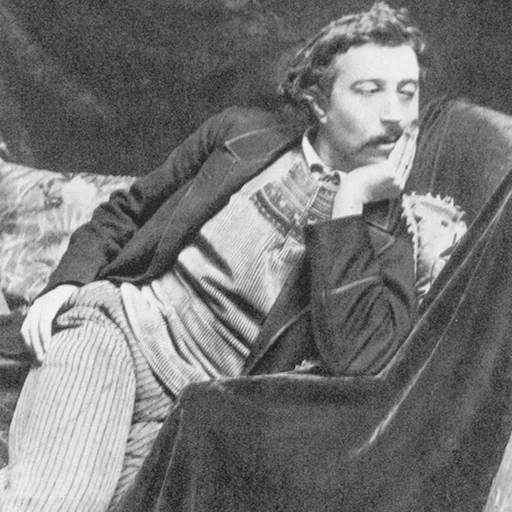
Artist
Eugène Henri Paul Gauguin (; French:; 7 June 1848 – 8 May 1903) was a French painter, sculptor, printmaker, ceramist, and writer, whose work has been primarily associated with the Post-Impressionist and Symbolist movements.