Artwork
Dance II
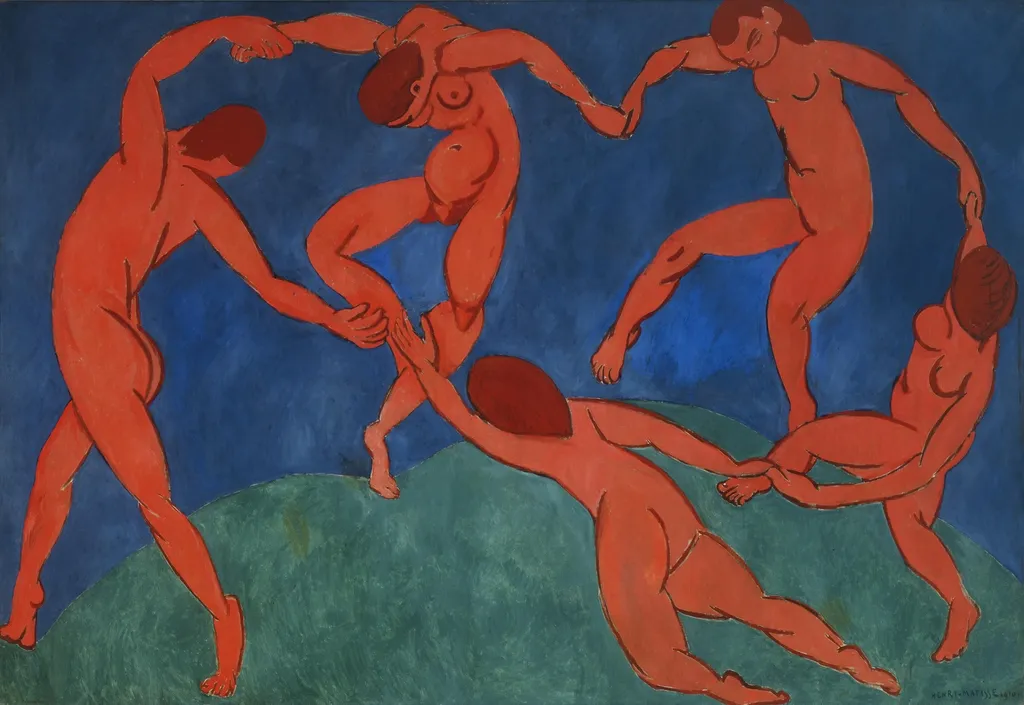
Dance II is an oil painting by the Fauvist artist Henri Matisse. It dates from 1910 and is held in the collection of the Hermitage Museum.
About this work
Subject & Meaning
The composition emphasizes movement and unity, with the figures arranged in a continuous loop that suggests perpetual motion and collective harmony.
Dance II depicts a circle of five nude figures holding hands, their bodies simplified into rhythmic, curvilinear forms. The composition emphasizes movement and unity, with the figures arranged in a continuous loop that suggests perpetual motion and collective harmony. The vivid, unmodulated colors and bold outlines align with Matisse’s Fauvist approach, stripping away descriptive detail to focus on emotional expression and decorative effect.
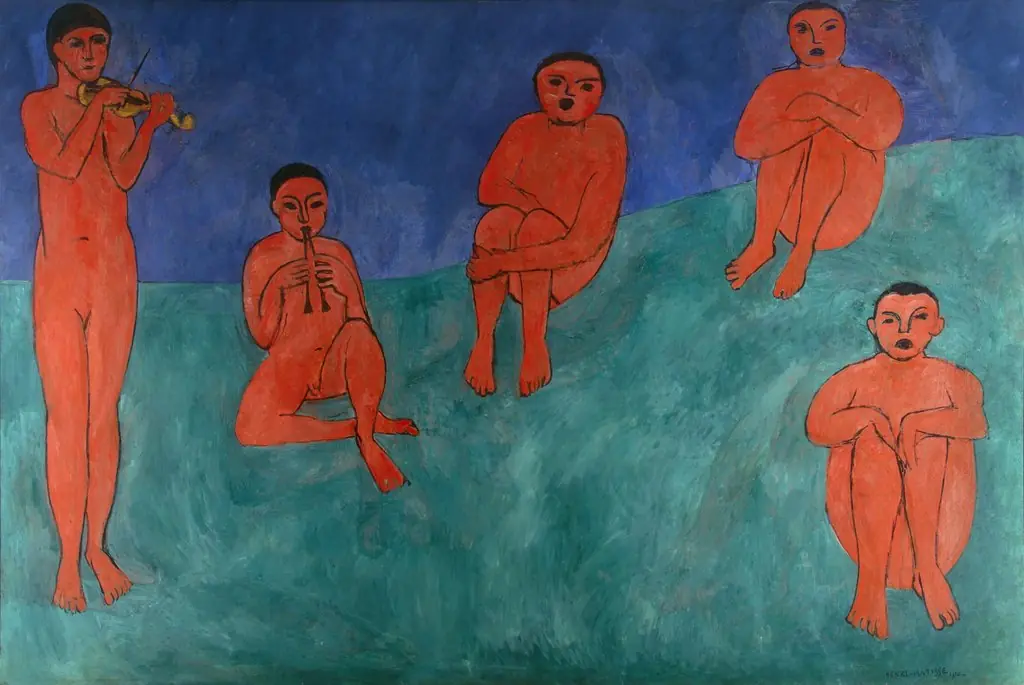
The work’s iconography centers on the archetype of the circle dance, a motif Matisse revisited across multiple versions. It evokes themes of joy, freedom, and primal energy, while the nudity underscores a return to essential humanity, unburdened by social artifice. Its pairing with La Musique in Shchukin’s home framed the two panels as complementary celebrations of rhythm and sound in visual form.
Technique & Style
Dance II is an oil painting on canvas executed by Henri Matisse in 1910. Measuring 260 cm in height and 391 cm in width, the work is a large-scale composition characteristic of the Fauvist movement. The painting depicts a circle of nude figures engaged in a dynamic dance, utilizing bold color and simplified forms typical of Matisse's style during this period.
It was created as a decorative commission for the collector Sergei Shchukin, intended to hang alongside a companion piece, The Music, in his Moscow residence.
History & Provenance
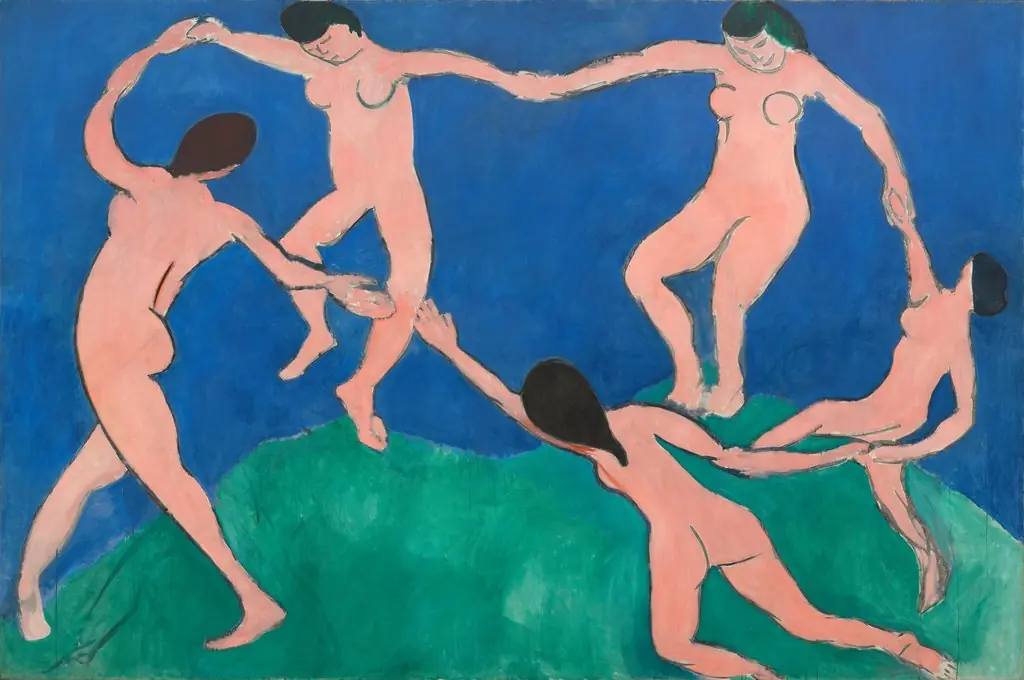
Dance II was created by Henri Matisse in 1910 as a direct commission from the Russian collector Sergei Shchukin. The work was intended to decorate Shchukin's Moscow residence, where it was installed alongside a second simultaneous commission, Music, which shares the same style and subject matter. Prior to the final oil on canvas, Matisse produced a preparatory study in 1909 known as Dance I, which is now held by the Museum of Modern Art in New York.
The completed painting, measuring 260 by 391 cm, was first exhibited at the Salon d'Automne in Paris in 1910 before entering the Shchukin Collection. Following the Russian Revolution, the painting was nationalized and eventually transferred to the Hermitage Museum in St. Petersburg, where it remains part of the institution's holdings today.
Dance II is held by the Hermitage Museum in St. Petersburg, where it forms part of the Shchukin Collection. The work was originally owned by the Russian collector Sergei Shchukin, who commissioned the piece in 1910. It was first exhibited at the Salon d'Automne in 1910 before entering the museum's holdings. The painting remains a central work within the Hermitage's collection of French modern art.
Legacy
Dance II is recognized as one of Henri Matisse's most celebrated works, originally commissioned by the Russian collector Sergei Shchukin. The painting's enduring legacy includes direct artistic appropriations, such as the logo for the logistics company GEODIS. Urban artist Jérôme Mesnager paid homage to the composition in a street fresco located on Rue de Ménilmontant.
Furthermore, Peruvian painter Herman Braun-Vega incorporated elements of the work into two separate paintings created in 2004 and 2010, having previously referenced the earlier study, Dance I, in a 1985 triptych. Matisse himself revisited the theme decades later, executing a triptych fresco titled Dance of Merion in 1932 for the collector Albert Barnes.
Overview
Created in 1910, this oil painting by Henri Matisse presents a group of five nude figures arranged in a circular dance. Rendered against a flat blue background, the composition is dominated by a vivid red that unifies the participants, while a muted green hill suggests a shallow landscape and adds spatial depth.
Artist & collection
Artist
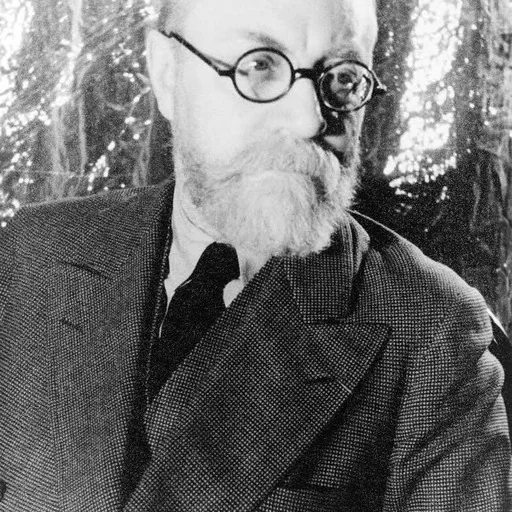
Henri Émile Benoît Matisse (French:; 31 December 1869 – 3 November 1954) was a French visual artist, known for both his use of colour and his fluid and original draughtsmanship.