Artwork
Wooded Landscape with Figures
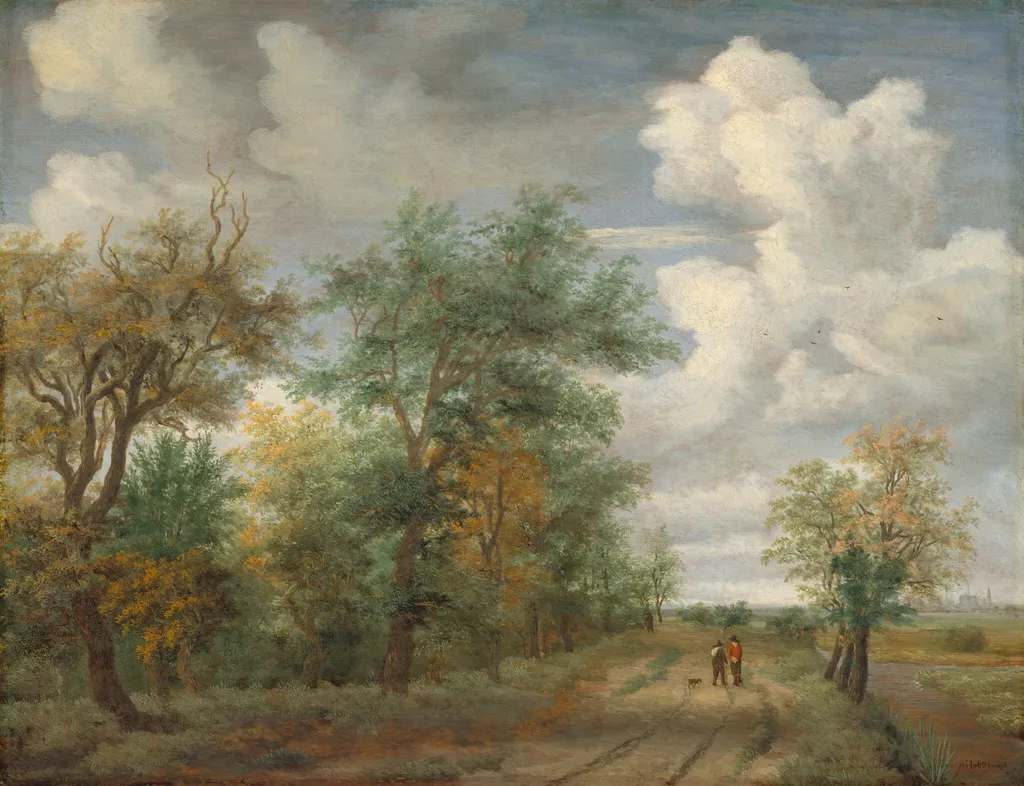
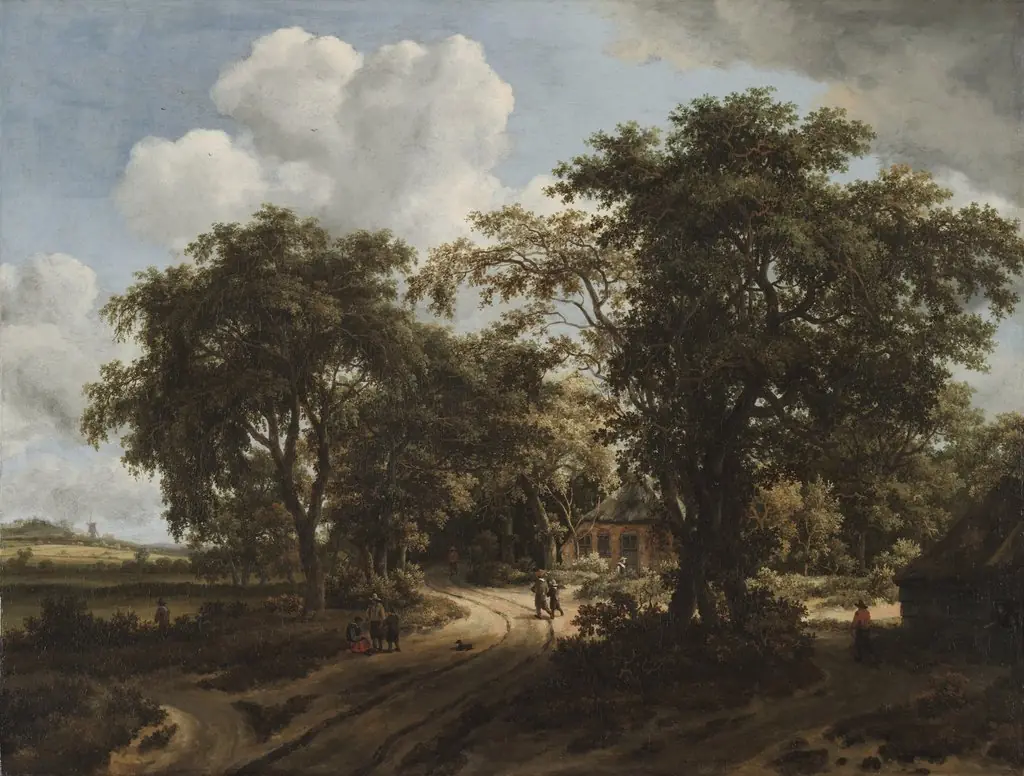
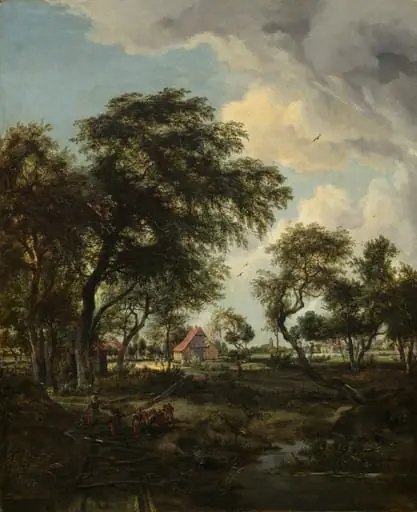
Wooded Landscape with Figures is an oil painting by the Baroque artist Meindert Hobbema. It dates from 1658 and is held in the collection of the National Gallery of Art.
- Inscription
- Inscribed:lower right, MH in monogram: MHobbema
About this work
Technique & Style
The underdrawing is visible in infrared reflectography, indicating a deliberate and methodical approach to compositional planning.
The painting is executed in oil on a vertically grained oak panel, measuring 53.34 cm in height and 67.31 cm in width, consistent with Dutch panel supports of the 17th century. Hobbema’s handling is characterized by crisp, luminous foliage rendered with fine, parallel hatching in the trees and softer, blended passages in the sky and figures, creating a sense of atmospheric depth. The underdrawing is visible in infrared reflectography, indicating a deliberate and methodical approach to compositional planning.
The condition is stable, with only minor retouching along the upper edge and no significant paint loss reported.
History & Provenance
Meindert Hobbema painted Wooded Landscape with Figures in 1658 using oil on panel. The work measures 53.34 cm by 67.31 cm. Its early ownership passed from the London collector Sir George Donaldson to the American industrialist William A. Clark, who acquired it in 1906. Clark later bequeathed the painting to the Corcoran Gallery of Art in April 1926.
The Corcoran retained the work until 2015, when the National Gallery of Art in Washington, D.C., acquired it.
The painting is held by the National Gallery of Art, Washington, D.C., where it entered the collection through the 2015 acquisition of the Corcoran Gallery of Art’s holdings. Its Corcoran accession record is not specified in the cited sources.
It has not been exhibited according to the records provided.
Overview
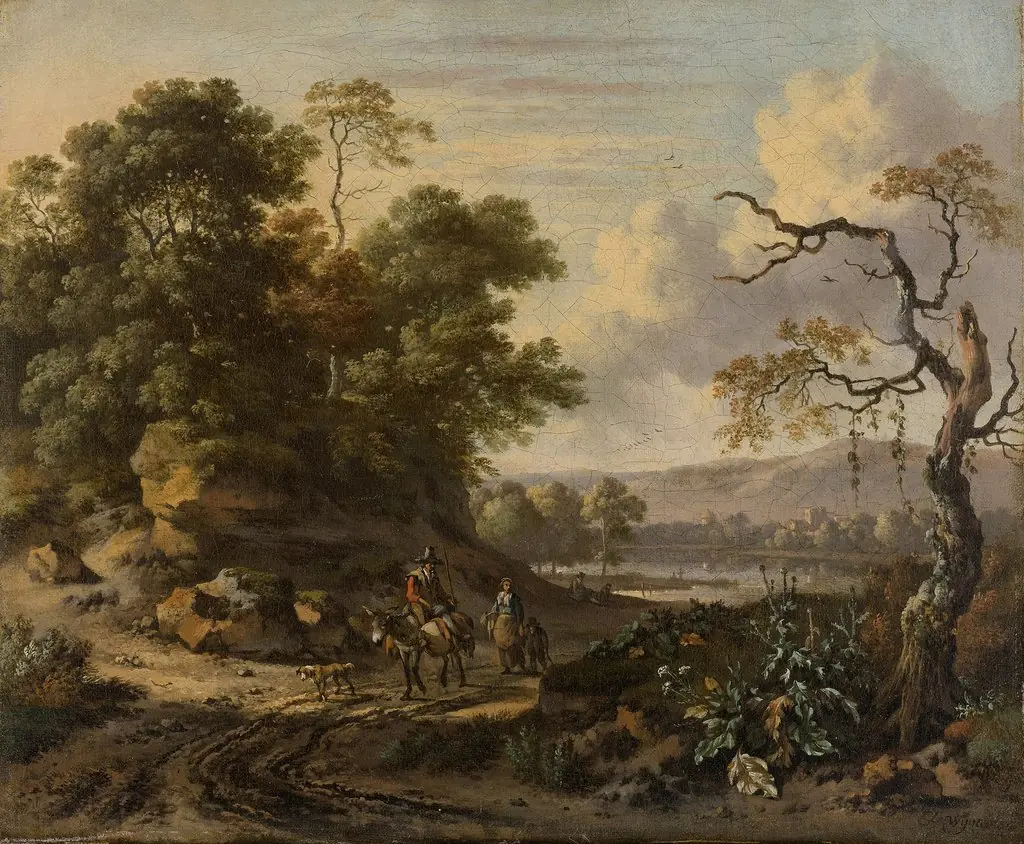
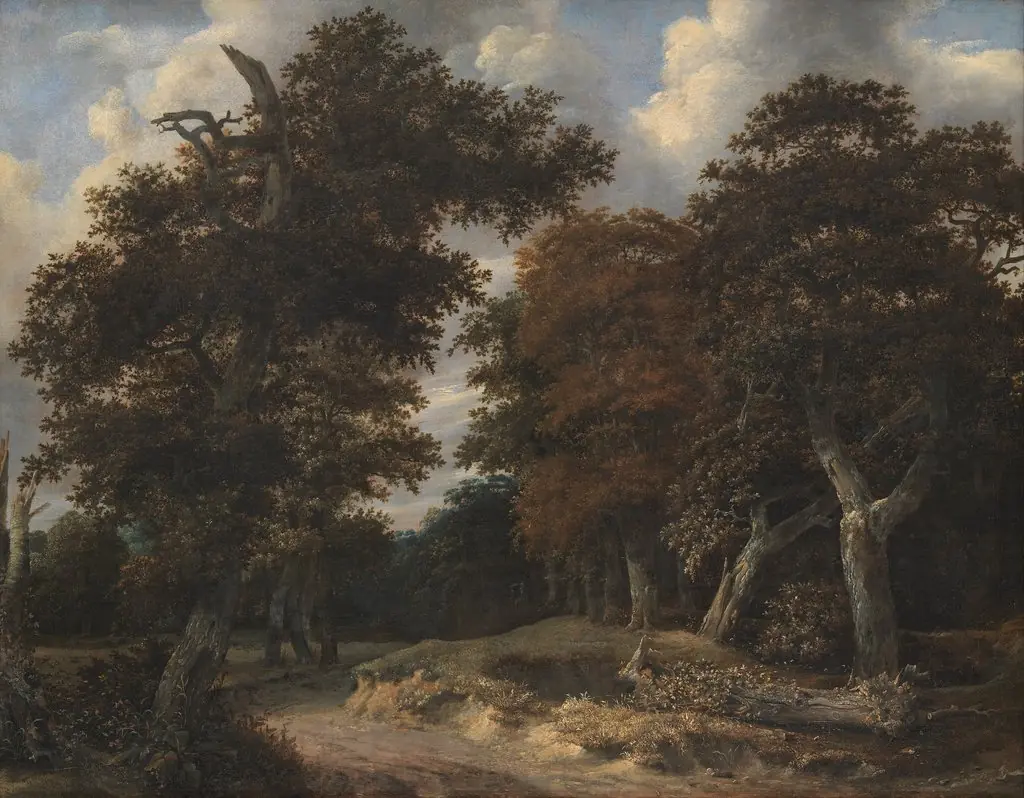
Meindert Hobbema's Wooded Landscape with Figures, painted around 1658, is an oil on panel work from the Dutch Golden Age. This painting showcases a tranquil forest interior, a subject for which Hobbema was well-regarded. It features a clearing bordered by tall trees, with a winding path and a few small figures integrated into the expansive natural setting. The composition reflects the artist's mature approach to depicting serene, yet dynamic, sylvan environments.
Subject & Meaning
The painting portrays a serene woodland scene, inviting quiet contemplation. A central clearing, defined by a winding path, leads the eye deeper into the composition, where small figures are visible in the distance. The foliage displays a range of greens, with hints of yellow and orange suggesting an autumnal transition.
Above, a cloudy, gray sky contributes to the overall subdued yet harmonious atmosphere, characteristic of Hobbema's depictions of nature.
Context
As a prominent landscape painter of the Dutch Golden Age, Meindert Hobbema developed his distinctive style after training with Jacob van Ruisdael, a leading figure in the genre. Hobbema specialized in capturing the specific qualities of forest interiors, often focusing on the interplay of light and shadow within dense arboreal settings. His works, including this piece, contributed significantly to the rich tradition of naturalistic landscape painting during this period, aligning with broader Baroque artistic trends.
Own this work as a print
Artist & collection
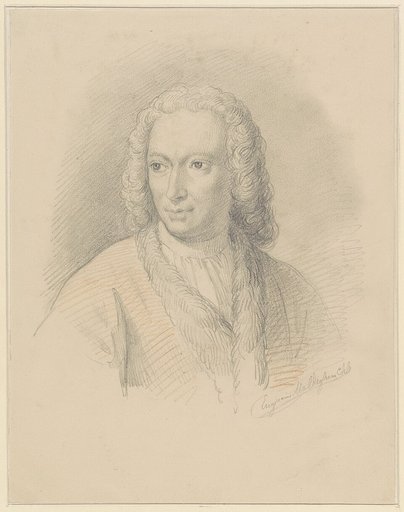
Artist
Meindert Lubbertszoon Hobbema (bapt. 31 October 1638 – 7 December 1709) was a Dutch Golden Age painter of landscapes, specializing in views of woodland, although his most famous painting, The Avenue at Middelharnis…