Artwork
Advance of the Skirmish Line
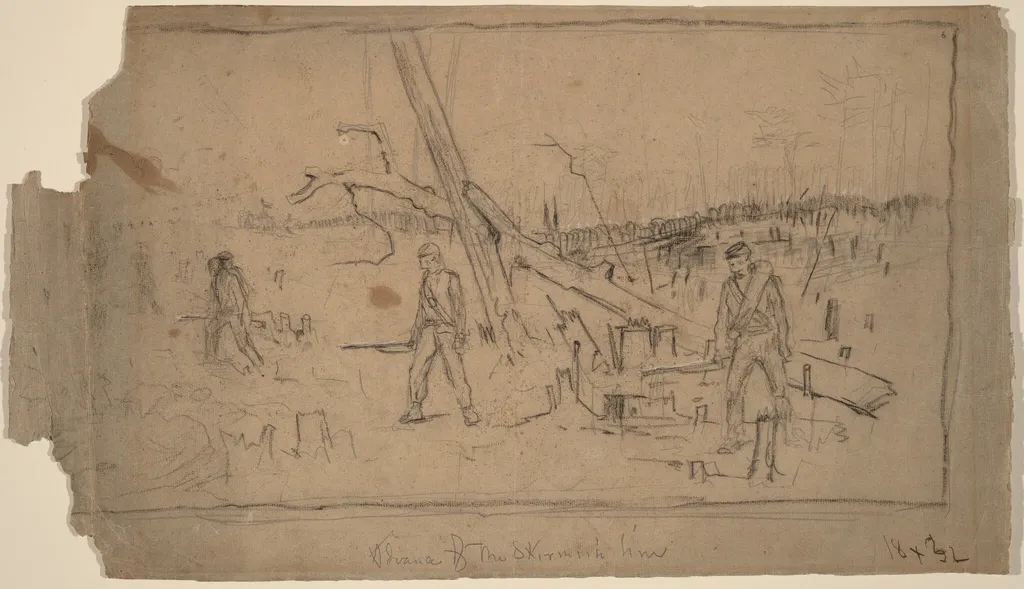
Advance of the Skirmish Line is a graphite drawing by the Impressionist artist Winslow Homer. It dates from 1864 and is held in the collection of the National Gallery of Art.
- Inscription
- Inscribed:upper right in graphite: 6; across bottom in graphite: Advance of the Skirmish Line; lower right in brown ink: 18 x 32 lower right verso in graphite by unknown hand: G
About this work
Overview
The medium’s immediacy suits the urgency of the scene, documenting infantry tactics with observational precision rather than romanticized grandeur.
Created in 1864, this drawing by Winslow Homer captures a moment of military movement during the American Civil War. Executed in graphite and black and white chalk on laid paper, it reflects Homer’s direct engagement with battlefield conditions as a correspondent for Harper’s Weekly. The medium’s immediacy suits the urgency of the scene, documenting infantry tactics with observational precision rather than romanticized grandeur.
Subject & Meaning
The drawing depicts Union soldiers advancing in a skirmish line, a tactical formation used to engage enemy forces with dispersed, flexible positioning. There is no central hero or dramatic climax, only disciplined motion under tension. The absence of identifiable figures emphasizes the collective nature of combat, underscoring the anonymity and routine of war for ordinary soldiers.
Technique & Style
Homer employed graphite for fine contours and chalk for tonal contrast, layering white highlights over darker washes to suggest depth and movement. The loose, rapid strokes convey a sense of urgency, mirroring the fleeting nature of battlefield action. The composition is unidealized, avoiding theatrical lighting or heroic poses, favoring instead a documentary clarity rooted in firsthand observation.
History & Provenance
Homer produced this work during his assignment with the Union Army in 1864, following the Army of the Potomac through Virginia. It was likely made on-site or based on rapid sketches, later refined in his studio. The drawing remained in private hands until acquired by a public collection in the 20th century, where it is now preserved as part of a broader archive of Civil War visual records.
Context
At the time, illustrated newspapers relied on artists like Homer to bring war to civilian audiences. Unlike studio-generated battle scenes, this drawing reflects the raw, unfiltered perspective of an embedded observer. Its modest scale and medium align with journalistic practice, distinguishing it from monumental war paintings of the era that sought to glorify conflict.
Legacy
This drawing contributes to a shift in 19th-century American art toward realism and direct observation. Homer’s unembellished approach influenced later generations of illustrators and war artists who prioritized authenticity over spectacle. It remains a key example of how drawing functioned as both record and commentary during a defining national conflict.
![Skirmish Involving a Wagon Train [verso]](https://artifactworldgallery.com/img/winslow-homer--skirmish-involving-a-wagon-train-verso--6ee57b18fcbda7d4-w320.webp)
Artist & collection
Artist
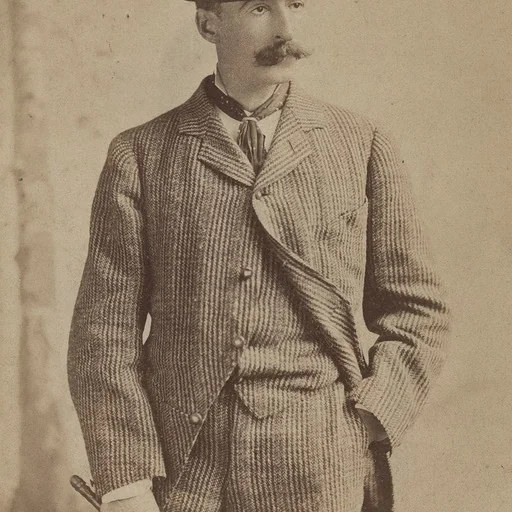
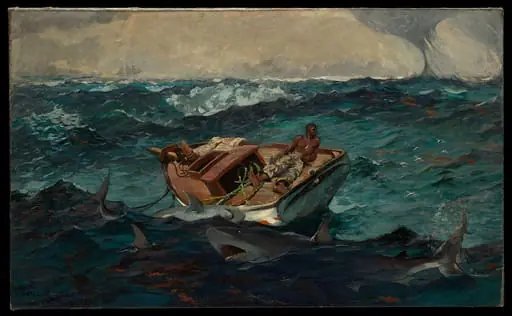
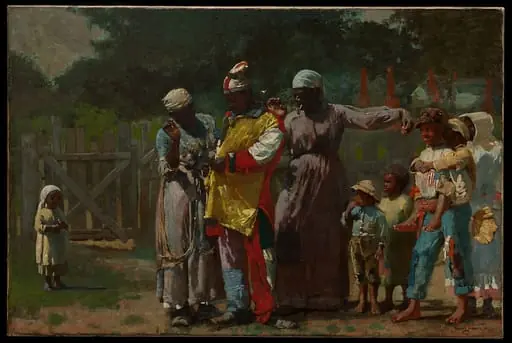
Winslow Homer (February 24, 1836 – September 29, 1910) was an American landscape painter and illustrator, best known for his marine subjects.

- Skirmish Involving a Wagon Train [verso]
![Line-ups and Trenches [recto], by Winslow Homer](https://artifactworldgallery.com/img/winslow-homer--line-ups-and-trenches-recto--73ce0ffd9d54aa43-w320.webp) Line-ups and Trenches [recto]
Line-ups and Trenches [recto]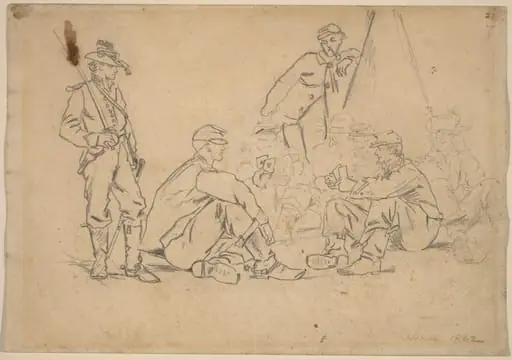 Playing Cards
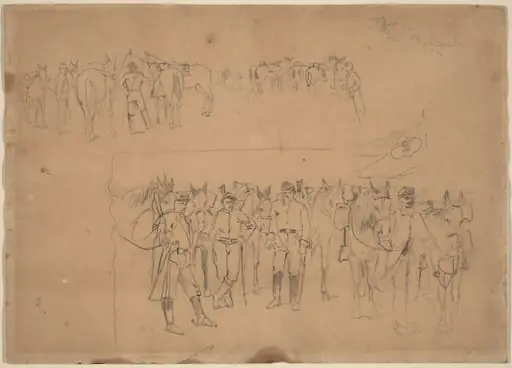 Officers and Horses at Rest
![Caravan with Covered Wagons Resting [recto], by Winslow Homer](https://artifactworldgallery.com/img/winslow-homer--caravan-with-covered-wagons-resting-recto--5a827c4a7f560cf2-w320.webp) Caravan with Covered Wagons Resting [recto]
Caravan with Covered Wagons Resting [recto]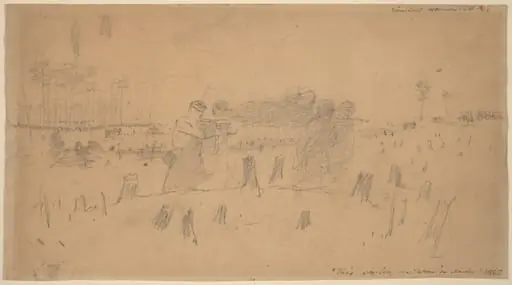 Carrying the Wounded
![Soldiers and Cannon [verso], by Winslow Homer](https://artifactworldgallery.com/img/winslow-homer--soldiers-and-cannon-verso--10871d9b29da5261-w320.webp) Soldiers and Cannon [verso]
Soldiers and Cannon [verso]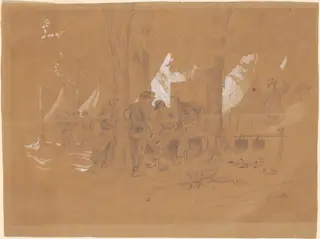 Camp Ellsworth, Near Alexandria—Five Zouaves
 Long Island, New York
![Two Soldiers Resting [verso], by Winslow Homer](https://artifactworldgallery.com/img/winslow-homer--two-soldiers-resting-verso--989d55e6cbbf0806-w320.webp) Two Soldiers Resting [verso]
Two Soldiers Resting [verso] Cottage by a River
 Montmorency Road