Artwork
Right and Left
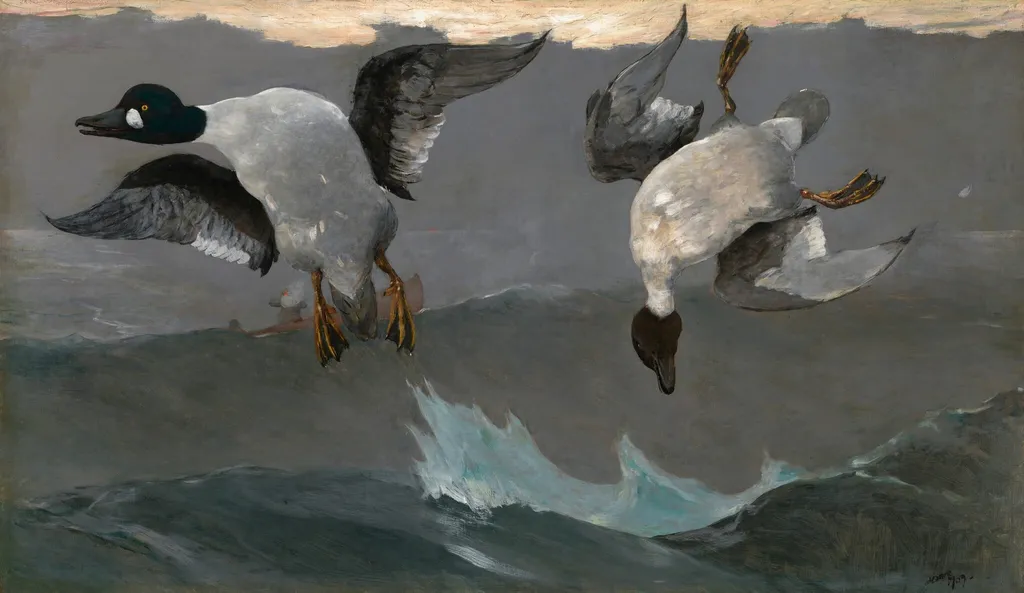
Right and Left is an oil painting by the American Impressionist artist Winslow Homer. It dates from 1909 and is held in the collection of the National Gallery of Art.
- Inscription
- Inscribed:lower right: HOMER / 1909
About this work
A duck floats on still water, head tucked back and tail up, one wing dipping while the other hides beneath its body. Homer painted it in 1909, near the end of a life spent on birds and the sea, with careful detail and no fuss.
Subject & Meaning
The design, characterized by horizontal bands of sea and sky and jagged contours, reflects Japanese artistic influences and resembles Audubon's engravings.
The painting depicts a pair of common goldeneye ducks at the precise instant they are struck by a hunter's shotgun blast while attempting to take flight. This subject marks Winslow Homer's final exploration of sporting and hunting themes, revisiting motifs from his earlier career. Iconographically, the work is unique for capturing the moment of death rather than presenting birds as static still-life objects.
The composition features a male duck struggling to ascend on the left while its partner falls limp on the right, frozen in a snapshot-like view from the hunter's perspective. Symbolically, the piece invites metaphysical interpretation due to its violent subject matter and creation shortly before the artist's death. The design, characterized by horizontal bands of sea and sky and jagged contours, reflects Japanese artistic influences and resembles Audubon's engravings.
A stray feather acts as a compositional exclamation point, emphasizing the sudden violence against a backdrop of abstract, detached beauty.
Technique & Style
Right and Left is executed in oil on canvas, a medium confirmed by the artist’s records and the work’s cataloguing (1,2). The painting measures 71.8 cm × 122.9 cm, a size documented in the National Gallery of Art’s collection data (2). Homer’s technique employs layered brushwork to render the birds frozen at the instant of a shotgun blast, with the composition organized into four horizontal bands of sea and sky intersected by vertical and diagonal forms that echo Japanese prints (3).
The restrained palette of cream, grey and subtle red highlights the snapshot‑like stillness, while the arrangement of the ducks’ bodies and webbed feet creates abstract, ornamental shapes. This formal detachment, noted by scholars as “oriental” in its balance, distinguishes the work from earlier sporting depictions (3).
History & Provenance
The work titled Right and Left was painted by Winslow Homer in 1909 (date supported by. It was consigned by the artist to M. Knoedler & Co. in January 1909 and subsequently sold on 3 August 1909 to Randal Morgan of Chestnut Hill, Pennsylvania. Morgan retained the painting by inheritance, later passing it to his wife, and the work was re‑consigned to Knoedler in 1950 before being purchased by the National Gallery of Art on 11 July 1951.
Historical records indicate that Homer, recovering from a mild stroke in late 1908, referred to the painting in a December 1808 letter and completed it as his final major piece. The commission history reflects a direct sale from the artist to the New York dealer, with no documented third‑party commission.
The work is held by the National Gallery of Art in Washington, D.C., where it has been part of the museum’s collection since its purchase on 11 July 1951. Its provenance traces from the artist’s January 1909 consignment to M. Knoedler & Co., sale to Randal Morgan in August 1909, inheritance to Morgan’s wife, a 1950 consignment back to Knoedler, and finally acquisition by the NGA. The painting was first exhibited at the Knoedler gallery in New York in early 1909, being described there as "The Golden Eye or Whistler Duck". The National Gallery of Art’s catalogue records the work as oil on canvas, 71.8 × 122.9 cm.
Context
Completed shortly before Winslow Homer's death, Right and Left is widely regarded by scholars as his final major work and a return to the sporting themes of his earlier career. Art historians frequently analyze its composition through the lens of Japonisme, noting its restrained palette and abstract arrangement of forms against horizontal bands, which recall prints by Hokusai and Hiroshige. The painting distinguishes itself from traditional still life by capturing the violent, frozen instant of the birds' death rather than their static aftermath.
Nicolai Cikovsky, Jr. described the work as a study in detached beauty, emphasizing its formal precision over narrative anecdote. While biographers offer conflicting accounts regarding the specific events inspiring the scene, the consensus places the painting within a metaphysical context, interpreting its depiction of mortality as a profound late-career statement. Its design also draws comparisons to John James Audubon's ornithological engravings.
Overview
Right and Left is an oil on canvas painting created by American artist Winslow Homer in 1909. This late work depicts two common goldeneye ducks caught mid-air as they are struck by a hunter's shotgun blast. Completed less than two years before Homer's death, it represents his final engagement with the sporting and hunting subjects that had appeared throughout his career. The artwork has prompted diverse interpretations regarding its composition and underlying meaning.
Artist & collection
Artist
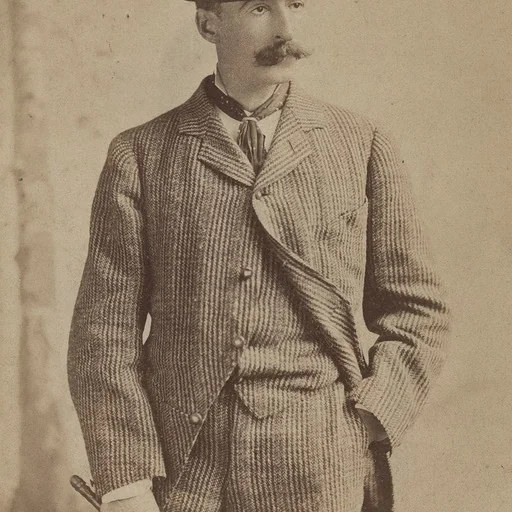
Winslow Homer (February 24, 1836 – September 29, 1910) was an American landscape painter and illustrator, best known for his marine subjects.