Artwork
The Fog Warning
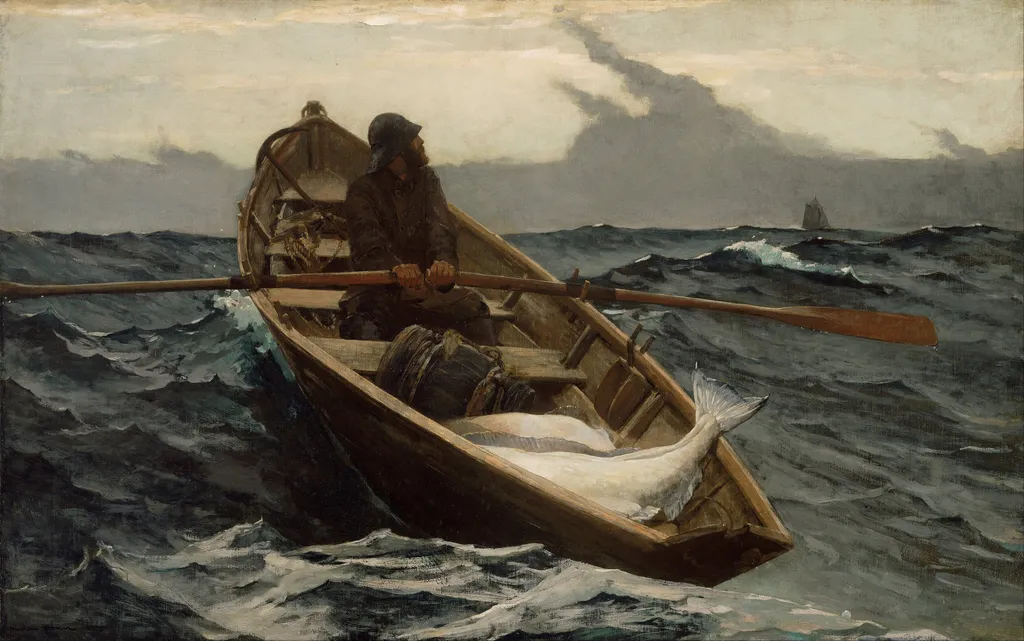
The Fog Warning is an oil painting by the American Impressionist artist Winslow Homer. It dates from 1893 and is held in the collection of the Museum of Fine Arts Boston.
About this work
Overview
The Fog Warning is an oil on canvas painting by the American artist Winslow Homer, created in 1885 during his mature period at Prout's Neck, Maine.
The Fog Warning is an oil on canvas painting by the American artist Winslow Homer, created in 1885 during his mature period at Prout's Neck, Maine. Measuring 76.83 by 123.19 cm, the work depicts a lone fisherman in a small dory, laden with halibut, as he rows through choppy waters while anxiously glancing over his shoulder at an approaching fog bank that threatens to cut him off from his mother ship on the horizon. The painting, originally exhibited under the title Halibut Fishing, is now held in the collection of the Museum of Fine Arts, Boston, to which it was donated anonymously in 1894. Together with The Herring Net and Breezing Up, also painted in 1885, it is considered among Homer's finest treatments of the perilous lives of Maine fishermen and represents a pivotal moment in his shift toward more serious, psychologically charged marine subjects.
Subject & Meaning
The painting presents a narrative of mortal risk rather than pastoral charm. A solitary fisherman, clad in dark clothing and cap, grips two long oars as his small wooden boat rocks high on white-capped waves. In the bow lies a large pale halibut, its tail extending over the edge, with coiled rope resting beside it. The fisherman turns in profile, looking over his shoulder toward the horizon where his mother ship sits low and distant, partially obscured by gathering dark clouds at the upper right. The approaching fog bank, with its streamers echoing the fisherman's own profile, serves as a menacing visual rhyme that threatens to swallow both ship and sailor. The scene captures an excruciating dilemma: the weight of the halibut slows his return, yet jettisoning his catch means forfeiting his wages. The psychological tension is heightened by uncertainty, the viewer cannot know whether this man will reach safety. Contemporary accounts of the New England fishing industry confirm that such sudden fogs and the consequent risk of losing sight of one's vessel were tragically commonplace experiences.
Technique & Style
Homer executed The Fog Warning in oil on canvas, employing a muted, cool palette of blue-gray and green for the sea, with pale yellow-gray tones in the sky and warm notes in the wooden boat and fish. The paint handling varies significantly across the surface, smooth in the sky where darker clouds gather, and more textured with visible brushwork in the churning water. Light falls from above, illuminating the halibut and the rower's hands while casting much of the boat into shadow, creating a dramatic chiaroscuro that focuses attention on the fisherman's predicament. The low viewpoint, slightly below and to the side of the dory, lends the small craft monumental presence and immerses the viewer in the vessel's precarious motion. This variation in surface treatment and the careful modulation of light and color demonstrate Homer's mature command of oil technique during his Prout's Neck period.
History & Provenance
The painting emerged from Homer's studio at Prout's Neck, completed in 1885, the year following the construction of his purpose-built studio there. Several preparatory studies survive, including a more intimate, less monumental version titled Halibut Fishing, in which the fisherman faced the viewer and focused on reeling in fish rather than confronting the fog. Homer's handyman, Henry Lee, posed for the painting in a dory supported on a pile of sand. Homer originally emphasized the act of fishing, with warm tones throughout suggesting calm, but subsequently transformed the work by adding the dark shadows of the fog, replacing the fishing line with two oars, and introducing an anchor in the bow. These alterations shifted the narrative from tranquil labor to existential danger. The painting was first exhibited in 1886 at Doll and Richards Gallery in Boston under the title Halibut Fishing, Homer later renamed it to emphasize the narrative of man against nature. The original sketch was discovered in Homer's studio after his death. The work was donated anonymously to the Museum of Fine Arts, Boston in 1894, where it remains today.
Context
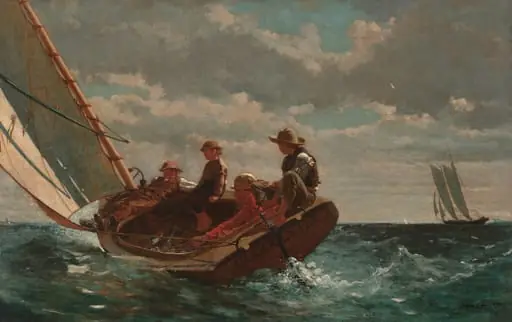
The Fog Warning belongs to a decisive phase in Homer's career. After establishing his reputation with Civil War subjects and then turning to scenes of leisure in the 1870s, Homer spent 1881-82 in Cullercoats, northeast England, where he painted local fishermen and women. Upon returning to the United States, he settled permanently at Prout's Neck, Maine, where his father and brother had purchased land, his brother had honeymooned there in 1875, and Homer himself had visited. In this isolated coastal environment, he returned to the sea with renewed seriousness, depicting what scholars have described as humankind's life-and-death struggles against the elemental power of nature. The 1885 trio of The Fog Warning, The Herring Net, and Lost on the Grand Banks represents the culmination of this thematic focus, with many of his late paintings featuring a single figure at sea. The work exemplifies Homer's broader exploration of the bounty of the sea and the perilous means by which it is won, a duality that defines his finest marine paintings.
Legacy
The Fog Warning has secured its place as one of Homer's most celebrated and frequently analyzed works. It has entered elementary-school curricula as a tool for teaching art interpretation and the realities of fishermen's lives. The painting's influence extends through reproductions and scholarly discussion that emphasize its narrative sophistication and emotional economy. Its kinship with other Homer masterworks, Breezing Up, The Herring Net, Lost on the Grand Banks, The Gulf Stream, and After the Hurricane, Bahamas, has made it central to understanding the artist's sustained meditation on mortality, labor, and nature's indifference. The work's afterlife includes its prominence in digital collections such as Google Arts & Culture and Smarthistory, ensuring continued public engagement. Critical reception, from contemporary accounts to modern analysis by scholars such as Sebastian Smee, has consistently recognized the painting's power to compress universal human experience into a single, suspended moment of decision and dread.
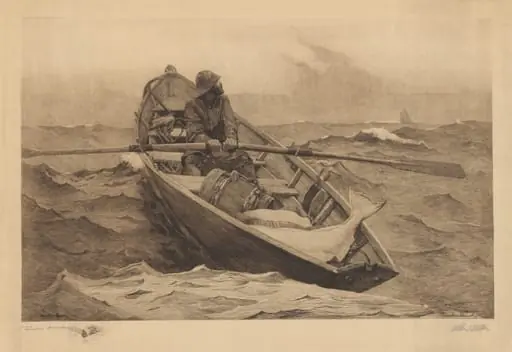
Own this work as a print
Artist & collection
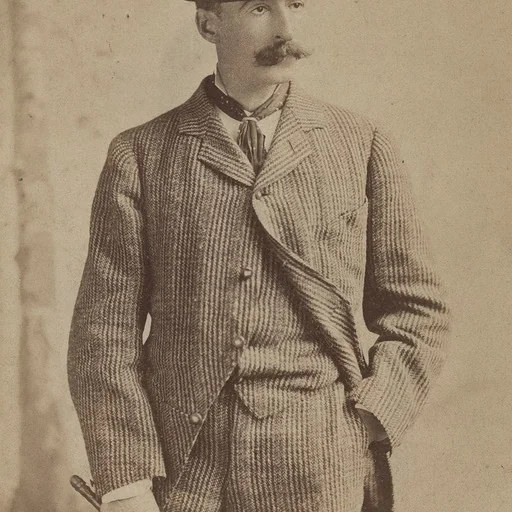
Artist
Winslow Homer (February 24, 1836 – September 29, 1910) was an American landscape painter and illustrator, best known for his marine subjects.