Artwork
The revolt of the pastry chefs
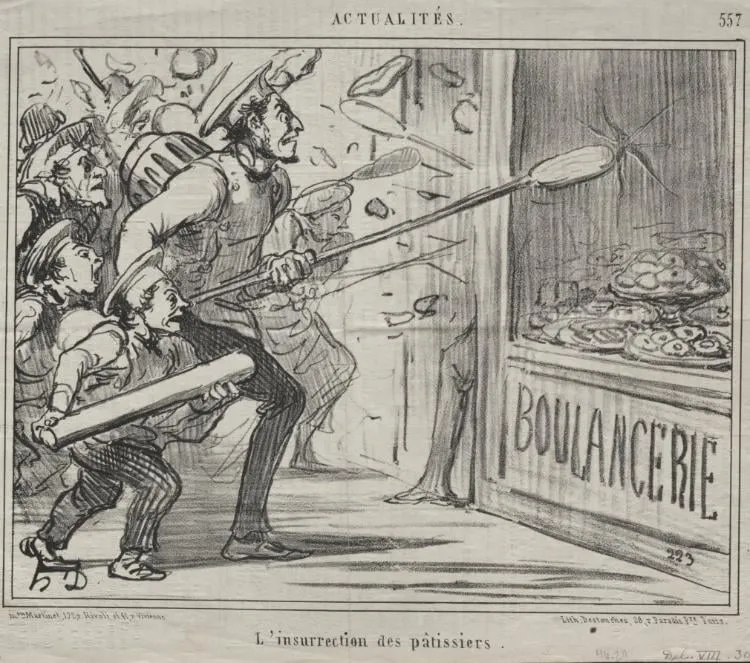
The revolt of the pastry chefs is a print by the Impressionist artist Honoré Daumier. It dates from 1858 and is held in the collection of the Cleveland Museum of Art.
- Accession no.
- 1946.211
- Credit line
- Gift of Mr. and Mrs. Theodore Spector
About this work
Overview
Its inclusion in a widely circulated periodical reflects the growing role of visual media in shaping public discourse during the mid-nineteenth century.
This lithograph, published in Le Charivari on September 23, 1858, is the 557th plate in a daily illustrated series documenting contemporary events. It depicts a fictional uprising of pastry chefs, blending satire with social commentary. Though presented as news, the scene is a humorous allegory rather than a factual report.
Its inclusion in a widely circulated periodical reflects the growing role of visual media in shaping public discourse during the mid-nineteenth century.
Subject & Meaning
The image portrays a group of pastry chefs in disarray, wielding rolling pins and tarts as weapons, suggesting a rebellion against authority or economic hardship. The absurdity of bakers in revolt serves as a metaphor for broader societal tensions, perhaps critiques of labor conditions, class friction, or government neglect. The exaggerated gestures and chaotic composition underscore the satirical intent, inviting viewers to reflect on power dynamics through irony.
Technique & Style
Executed in lithography, the print employs fine linework and tonal contrasts to render movement and expression with clarity. Figures are rendered with caricatured proportions and dynamic poses, typical of French satirical illustration of the era. The dense composition fills the frame, enhancing the sense of turmoil. Textual captions, common in Le Charivari, likely accompanied the image, reinforcing its topical message.
History & Provenance
Produced during the Second French Empire, the print was part of a daily series that offered visual commentary on politics and culture. Le Charivari, known for its sharp wit and censorship-skirting humor, frequently used absurd scenarios to circumvent restrictions on direct political critique. This plate entered the collection of the Cleveland Museum of Art through documented acquisition, preserving its role as a cultural artifact of 19th-century French media.
Context
In 1858, France experienced rising social unrest under Napoleon III’s regime, with growing discontent among artisans and laborers. While direct political satire was risky, publications like Le Charivari turned to allegory and farce to critique authority. Pastry chefs, as symbols of small-scale trade and domestic life, became convenient vessels for broader commentary on economic instability and the fragility of social order.
Legacy
The print exemplifies how illustrated journalism used humor to navigate political repression and engage the public. Its survival in museum collections underscores its value as a record of visual satire’s role in democratic discourse. Though obscure today, such images helped shape public perception through accessible, image-driven storytelling, influencing later forms of editorial cartooning and political illustration.
Artist & collection
Artist
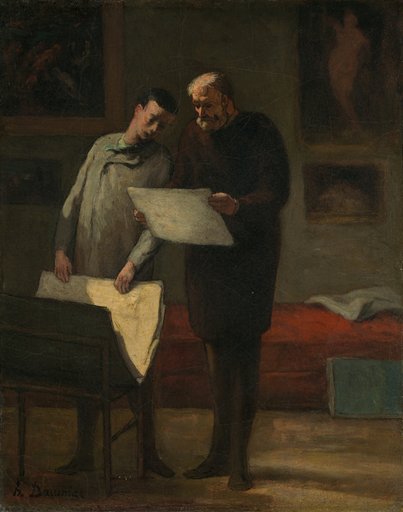
Honoré-Victorin Daumier (French: ; 26 February 1808 – 10 or 11 February 1879) was a French painter, sculptor, and printmaker, whose many works offer commentary on the social and political life in France, from the…

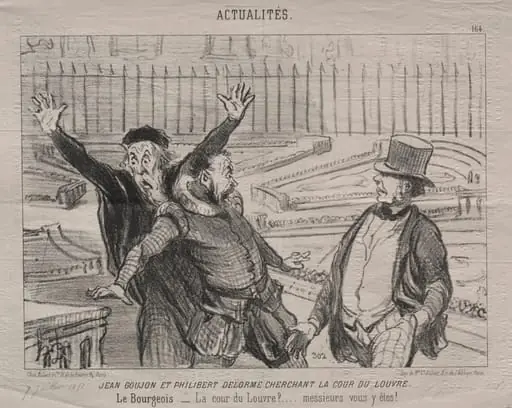 Jean Goujon and Philibert Delorme Looking for the Courtyard of the Louvre
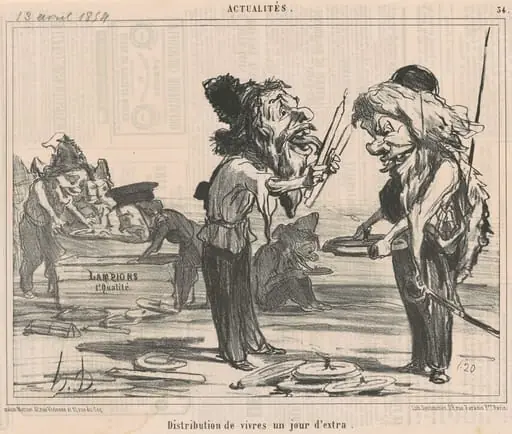 Distribution de vivres un jour d'extra
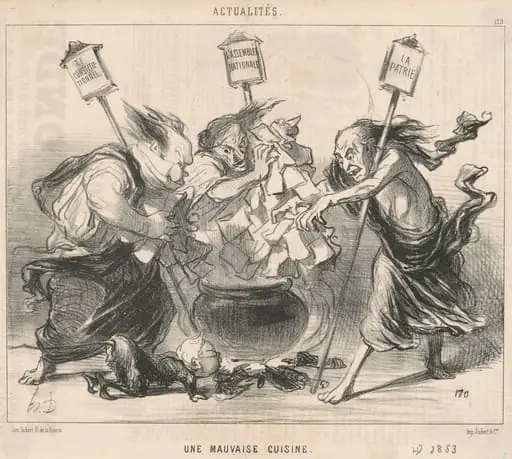 Une mauvaise cuisine
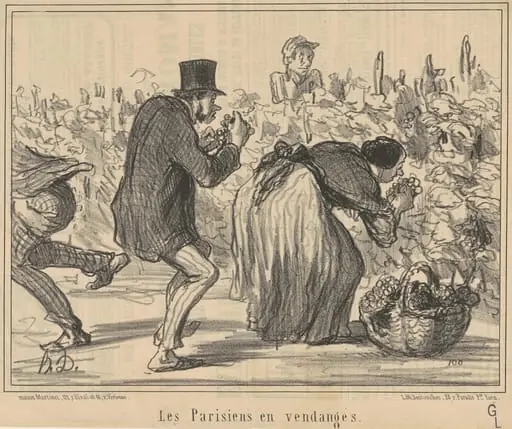 Les parisiens en vendages
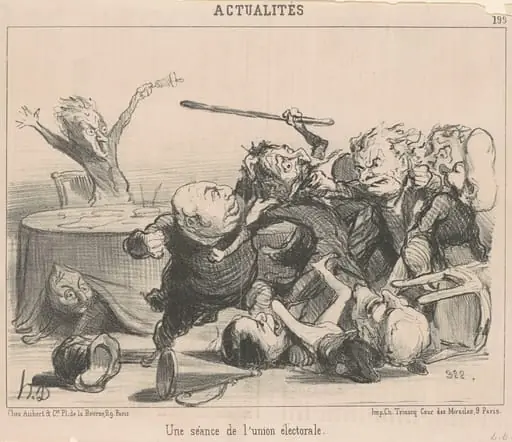 Une séance de l'union électorale
 Aspect d'une gare de chemin de fer...
 Membres de la société de secours du Dix-Décembre ...
 Tout est perdu! Fors la caisse
 I am a bird, see my wings..