Artwork
Trinity Altarpiece
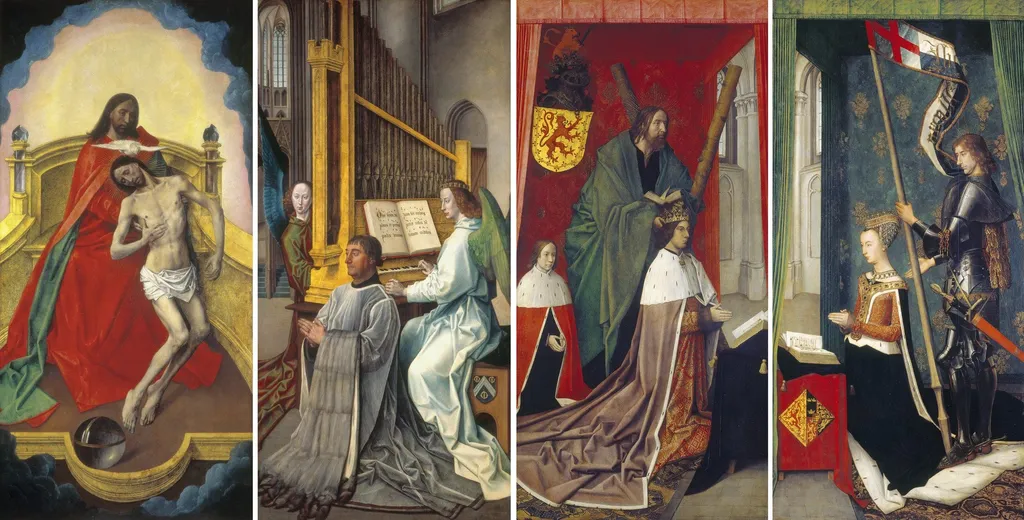
Trinity Altarpiece is an oil painting by the Northern Renaissance artist Hugo Van der Goes. It is held in the collection of the Royal Collection.
About this work
Subject & Meaning
The open book in Bonkil's panel displays the Ambrosian hymn "O lux, beata trinitas," underscoring the Trinitarian focus.
The Trinity Altarpiece depicts the Holy Trinity as a Throne of Grace, with God the Father supporting the body of Christ and the Holy Spirit represented as a dove between them. The panels also include donor and royal portraits: a praying cleric identified as Edward Bonkil, Provost of Trinity College Kirk, accompanied by two angels playing an organ; King James III of Scotland at prayer with Saint Andrew and a boy presumed to be the future James IV; and Queen Margaret of Denmark at prayer attended by Saint George. The work carries layered political and devotional symbolism. The inclusion of Scotland's royal family alongside its patron saints, Andrew for Scotland and George for England, may reflect Bonkil's efforts to strengthen ties with Margaret of Denmark and express her personal iconography. The open book in Bonkil's panel displays the Ambrosian hymn "O lux, beata trinitas," underscoring the Trinitarian focus. The presumed lost central panel likely contained a Virgin and Child, toward whom all figures would have directed their prayer, uniting heavenly and earthly realms in a single devotional program.
Technique & Style
The Trinity Altarpiece consists of four large panels, each measuring 202 cm by 100.5 cm, executed in oil paint on oak wood supports. The panels are constructed from four vertical oak planks joined with wooden pegs, which are visible in radiographs where the grain of the pegs runs perpendicular to the panel grain. Preparation involved fine layers of chalk and animal glue, smoothed to an ivory-like finish, over which the composition was sketched with diluted black paint or ink. Infrared reflectography reveals significant underdrawing and compositional changes, such as the repositioning of Queen Margaret's face and Edward Bonkil's initial placement. The artist employed gold, silver, and tin leaf for specific elements; the organ pipes retain well-preserved silver leaf, while the throne base, originally gilded, was repainted in the mid-nineteenth century. The saint Andrew's halo was formed using thick oil mordant lines to adhere gold leaf. The king's golden drapery features a base of ochre and white, overlaid with vermillion and red glazes to model the folds.
History & Provenance
The Trinity Altarpiece is dated to 1478 (Source 1) or circa 1478-1479 (Source 5) and is attributed to Hugo van der Goes with studio assistance (Source 3). It was probably commissioned by Edward Bonkil, Provost of Trinity College Kirk in Edinburgh, who is depicted on one panel and whose family had commercial ties to Bruges (Sources 3, 4, 5). The altarpiece was made for the Collegiate Church of the Holy Trinity in Edinburgh, founded around 1460 by Maria of Guelders (Source 5). The presumed central panel, likely a Virgin and Child, is lost, possibly destroyed during the Scottish Reformation of 1560 (Sources 3, 4, 5). The painting was recorded in the church on 17 May 1516 as a "burd" at the high altar (Source 3). After the Union of the Crowns it was taken to England, and in 1617 it appeared in Anne of Denmark's collection at Oatlands; in 1618 she reportedly gave it to Prince Charles, who may have presented it to the Duke of Buckingham (Source 3). It was at Hampton Court by 1650, and Queen Victoria had it installed at the Palace of Holyroodhouse in 1857 (Source 3). The panels are now part of the British Royal Collection and are on loan to the Scottish National Gallery (Sources 2, 3, 5). The Trinity Altarpiece is held in the Scottish National Gallery as part of the Royal Collection, with inventory status recorded under the Royal Collection's holdings. It was originally created for the Trinity College Kirk in Edinburgh around 1478 and later came into the possession of the British royal family following the Union of the Crowns, being documented in the collection of Anne of Denmark at Oatlands in 1617. Queen Victoria reinstalled the work at Holyroodhouse in 1857, and it has been displayed in various royal palaces before being placed on long-term loan to the Scottish National Gallery. The four panels depict the Holy Trinity, a donor portrait of Edward Bonkil with attendant angels, King James III of Scotland in prayer with Saint Andrew and a boy believed to be the future James IV, and Queen Margaret of Scotland in prayer with Saint George. The altarpiece survived the Scottish Reformation and was later restored and reframed in 1935, with technical analysis revealing underdrawings and gold leaf applications characteristic of Hugo van der Goes's technique.
Context
The Trinity Altarpiece is universally attributed to the Netherlandish painter Hugo van der Goes, with studio assistance, and is dated stylistically to around 1478-1479, close to or shortly after his Portinari Altarpiece and around the time he entered the Rooklooster monastery. Erwin Panofsky once proposed that the panels were originally organ shutters commissioned in Flanders around 1466-1467, but most art historians consider them the wings of a large altarpiece whose central panel, likely a Virgin and Child, possibly never completed by Van der Goes himself, is lost. Max J. Friedländer and Panofsky regarded the Saint George panel as the work of a different, possibly Bruges, artist, and the faces of the king and queen are judged to be of lesser quality and probably added in Scotland. The altarpiece is a rare survivor of the iconoclasm of the Scottish Reformation of 1560, the central panel perhaps destroyed at that point. Scholarship on the work has focused on its Scottish patron, Edward Bonkil, with Lorne Campbell publishing two studies in The Burlington Magazine (1984 and 2001) and Elisabeth Dhanens contributing a monograph on Van der Goes (1998). Jill Harrison's 2019 and forthcoming research has re-examined the portrait of Margaret of Denmark and proposed connections to Anselm Adornes.
Legacy
The Trinity Altarpiece is recognized as a rare survivor of Scottish Reformation iconoclasm, its survival contributing to its subsequent reputation as a key witness to late-fifteenth-century Netherlandish religious art in Scotland.
After the Union of the Crowns in 1603, the panels entered Stuart collections, first recorded in 1617 with Anne of Denmark at Oatlands and later at Hampton Court, before returning to Scotland in the nineteenth century. Queen Victoria installed the work at Holyroodhouse in 1857, aligning it with Scottish royal portraiture and reinforcing its cultural significance as a dynastic artifact.
Its technical and iconographic complexity has sustained scholarly interest, with analyses noting Hugo van der Goes’s compositional innovations and the panel’s layered underdrawing and metalpoint techniques as formative for later Netherlandish painting.
Artist & collection
Artist
Hugo van der Goes (c. 1430/1440 – 1482) was a Flemish painter who was one of the most significant and original Early Netherlandish painters of the late 15th century. Van der Goes was an important painter of altarpieces…

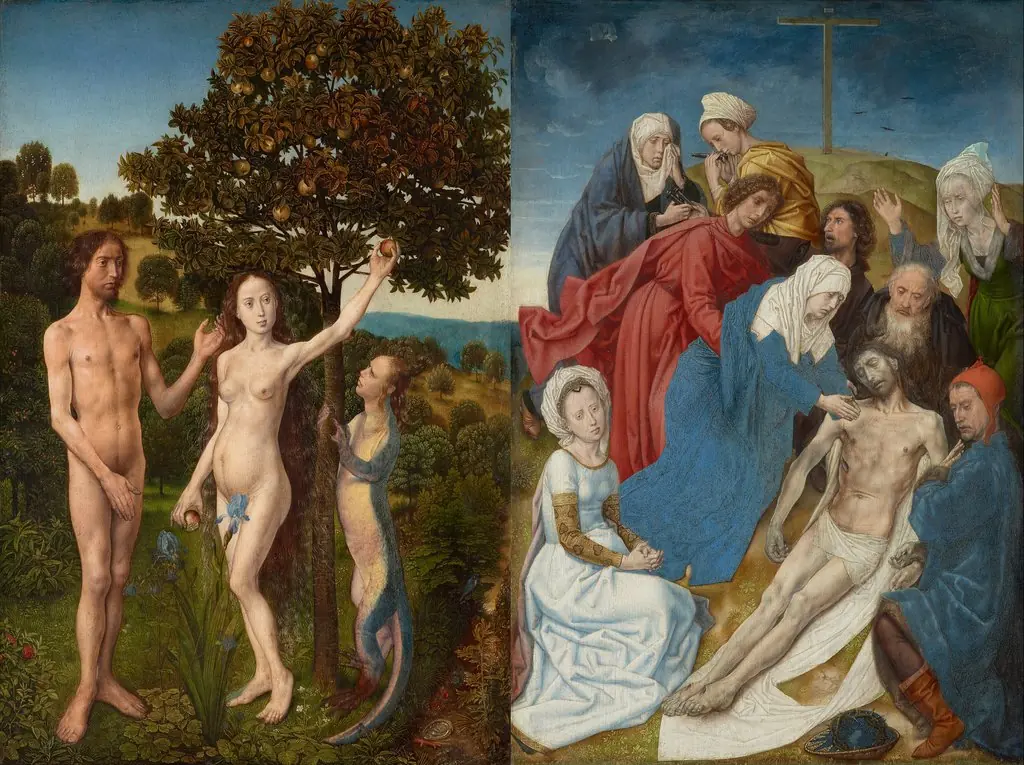 Vienna Diptych
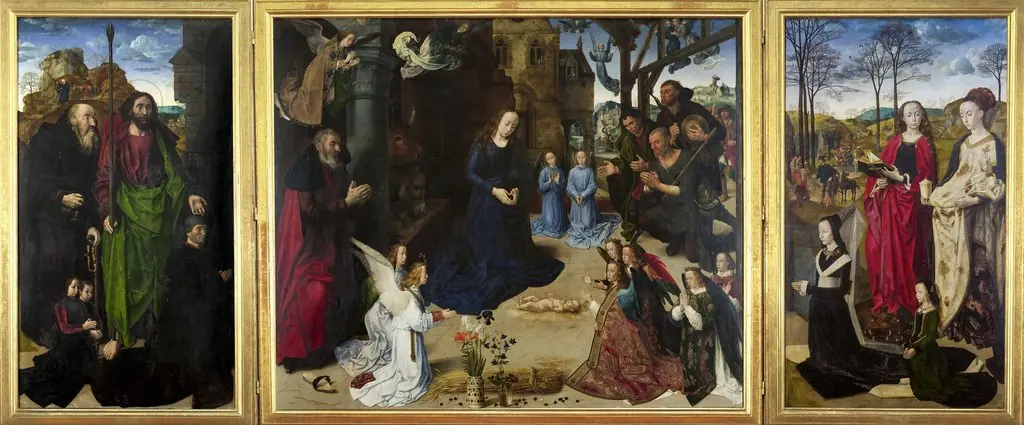 Portinari Triptych
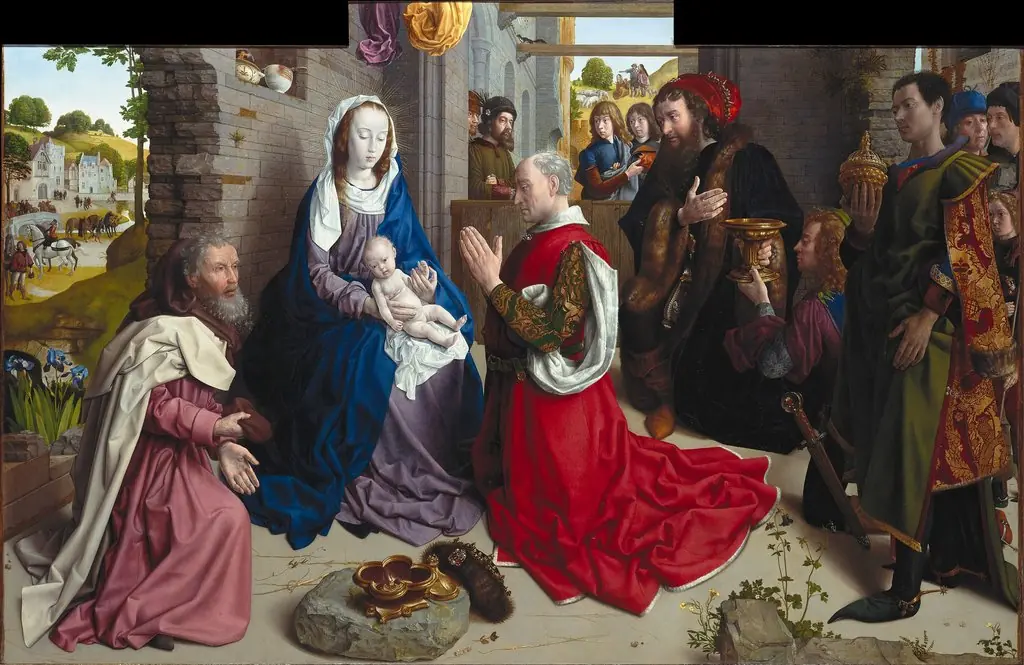 Monforte Altarpiece
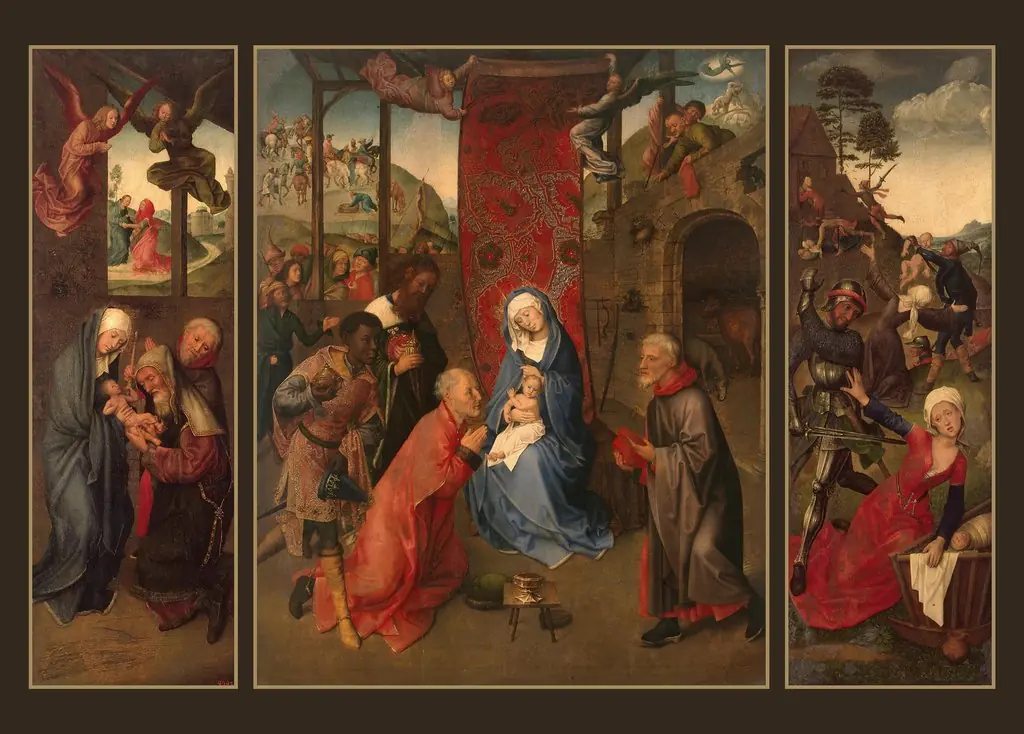 Adoration of the Magi (Triptych)
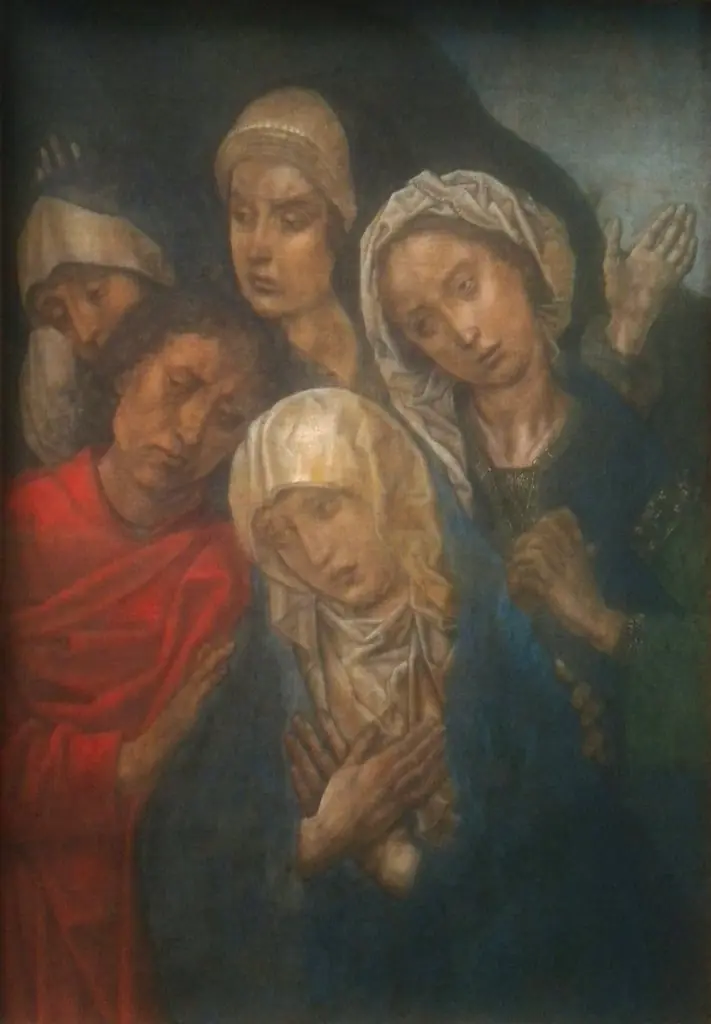 The Mourning of Christ
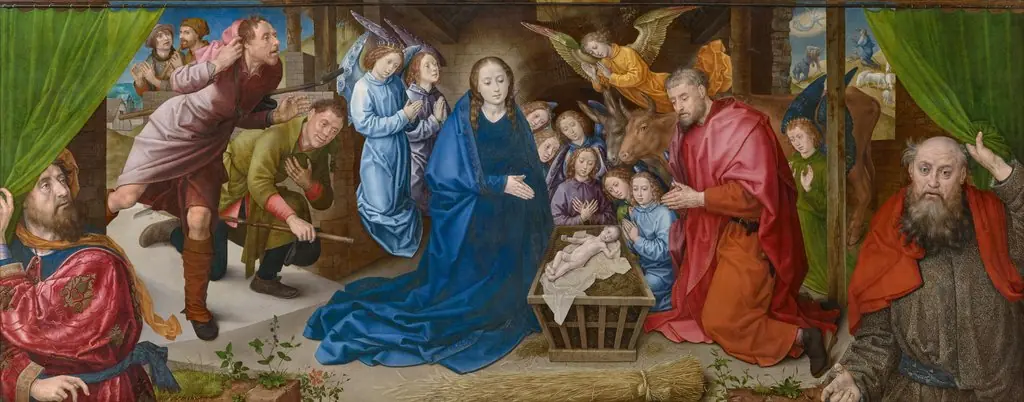 Adoration of the Shepherds
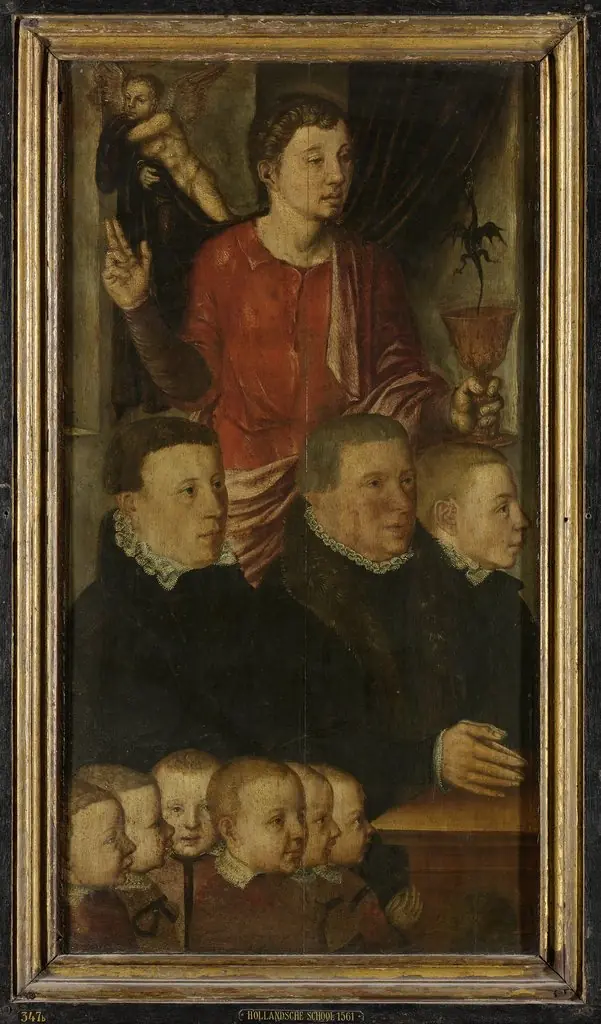 Left wing of a Memorial Triptych, formerly called the Gertz Memorial Triptych, with nine male Donor Portraits with Saint John the Evangelist (inner), and Saint Peter (outer)
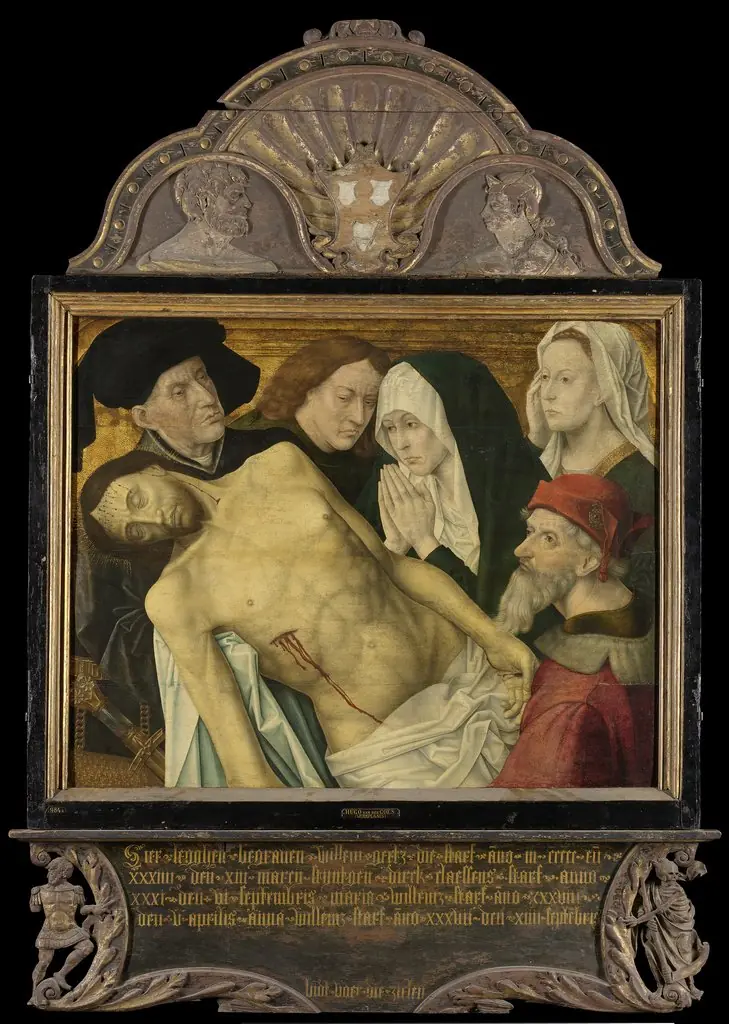 Central panel of a Memorial Triptych, formerly called the Gertz Memorial Triptych, with the Lamentation
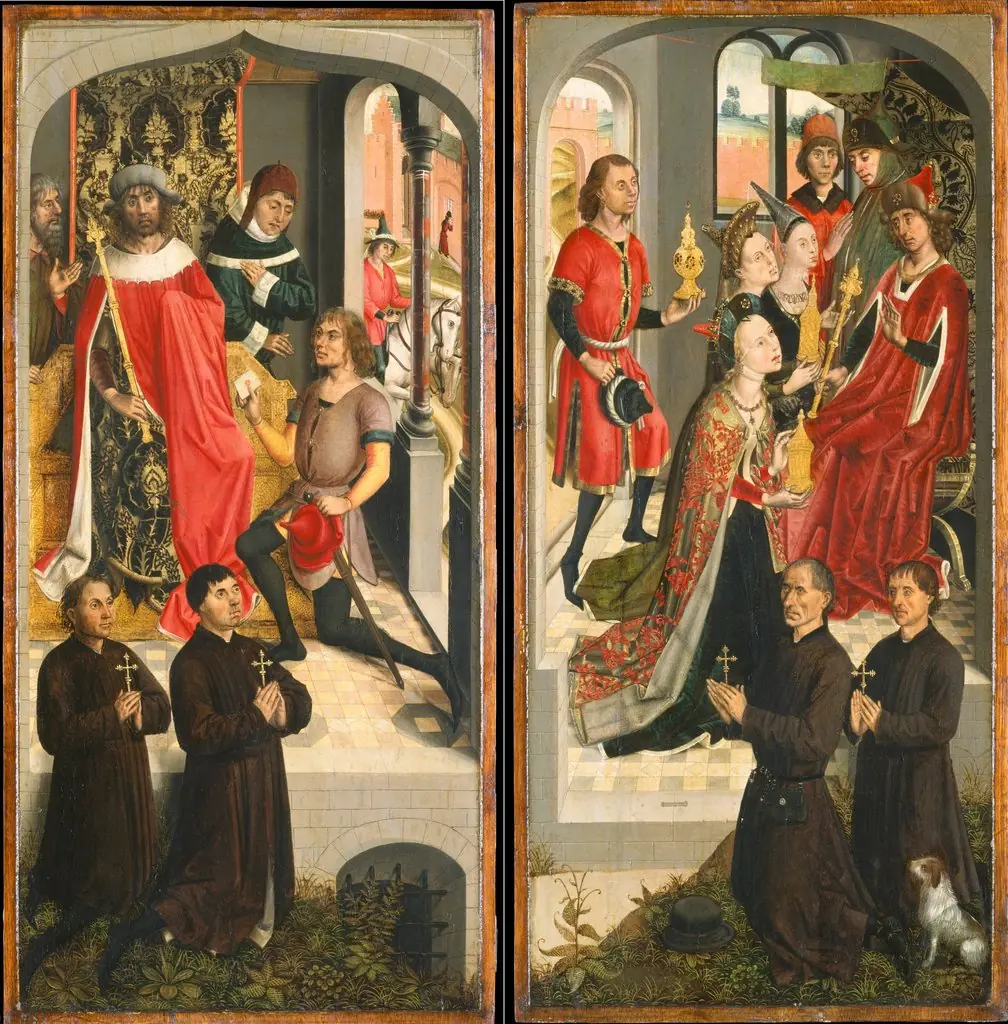
- Abner's Messenger before David (?); The Queen of Sheba Bringing Gifts to Solomon; (The Annunciation, on the reverse)
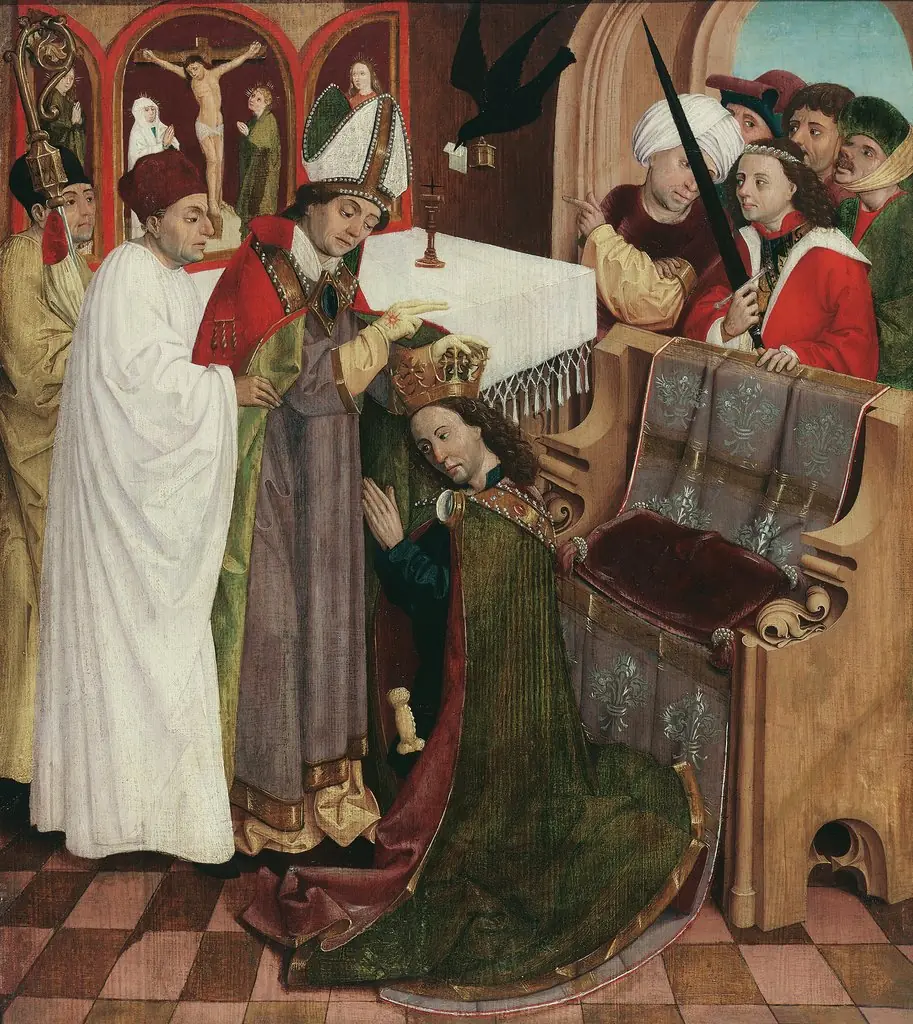 The coronation of St. Oswald
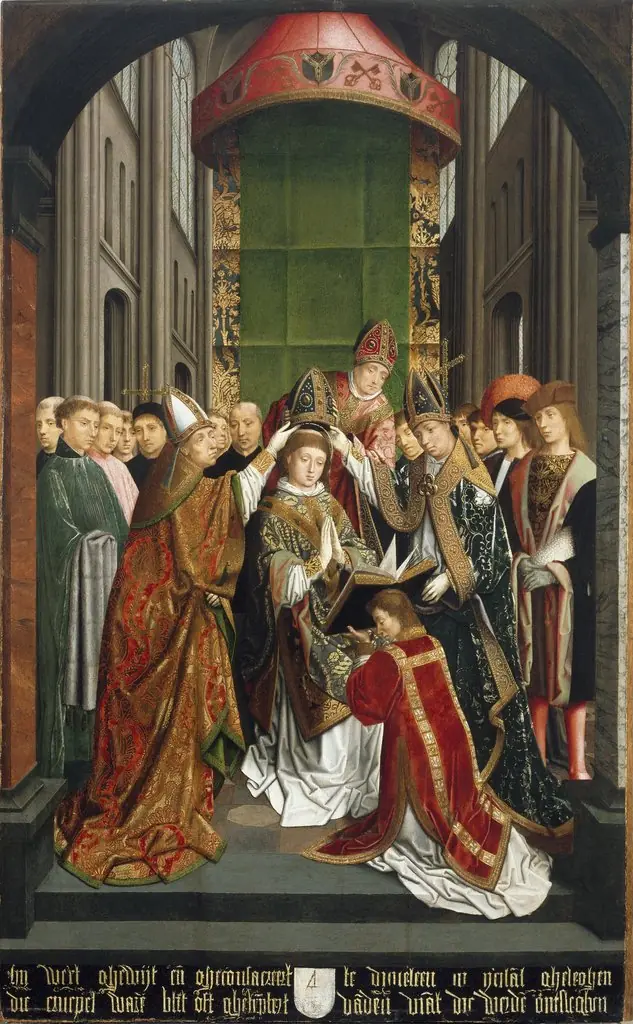 The Enthronement of Saint Romold as Bishop of Dublin
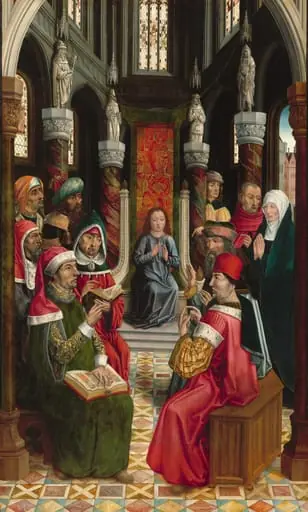 Christ among the Doctors
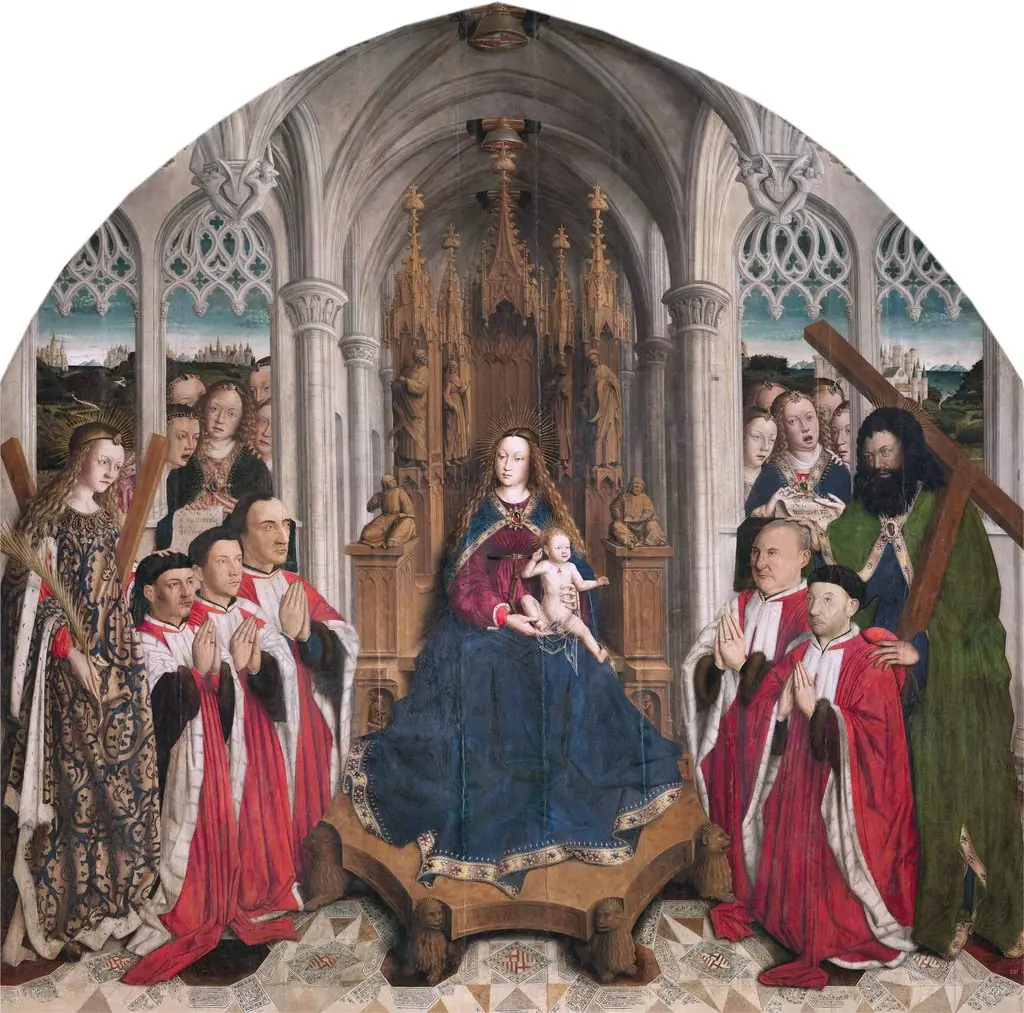 Virgin of the Councillors
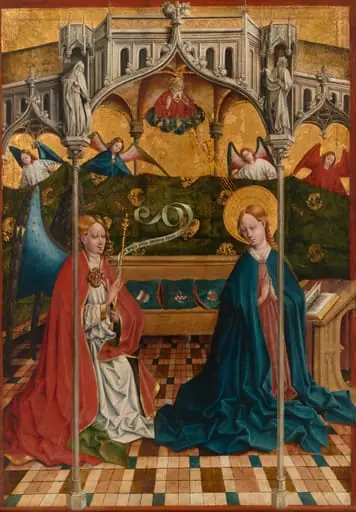 The Annunciation
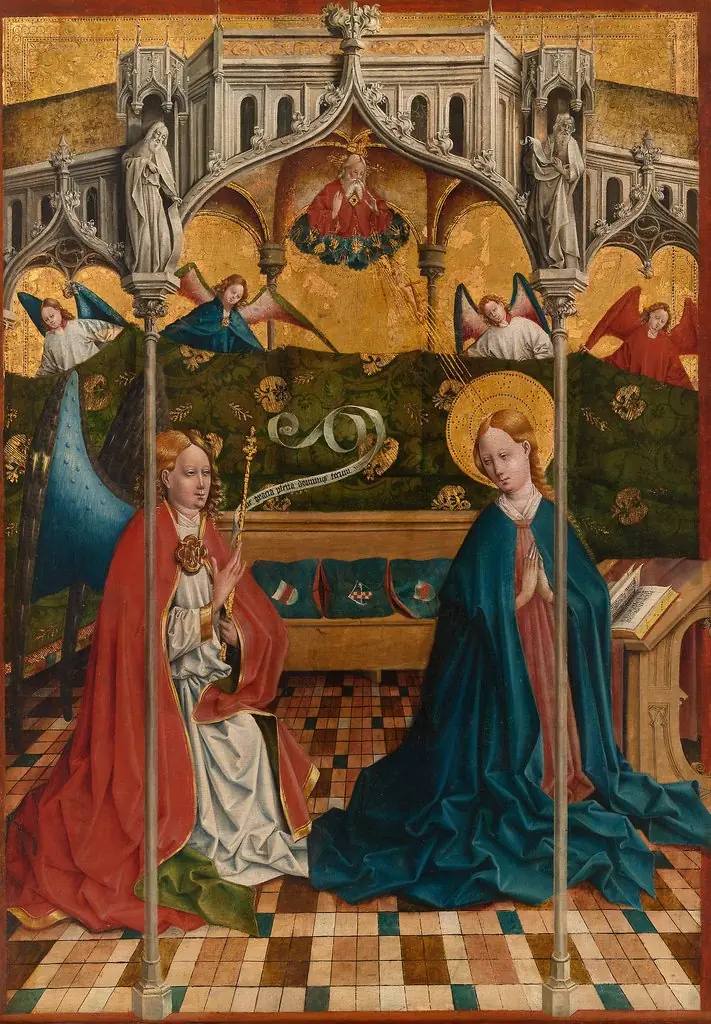 The Annunciation
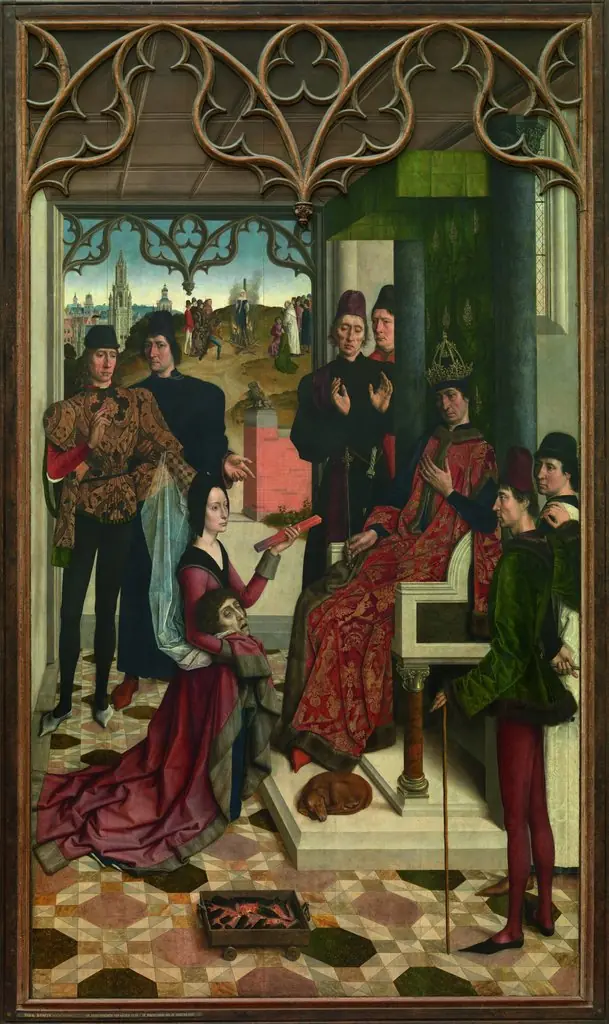 Justice of Emperor Otto III: The Trial by Fire
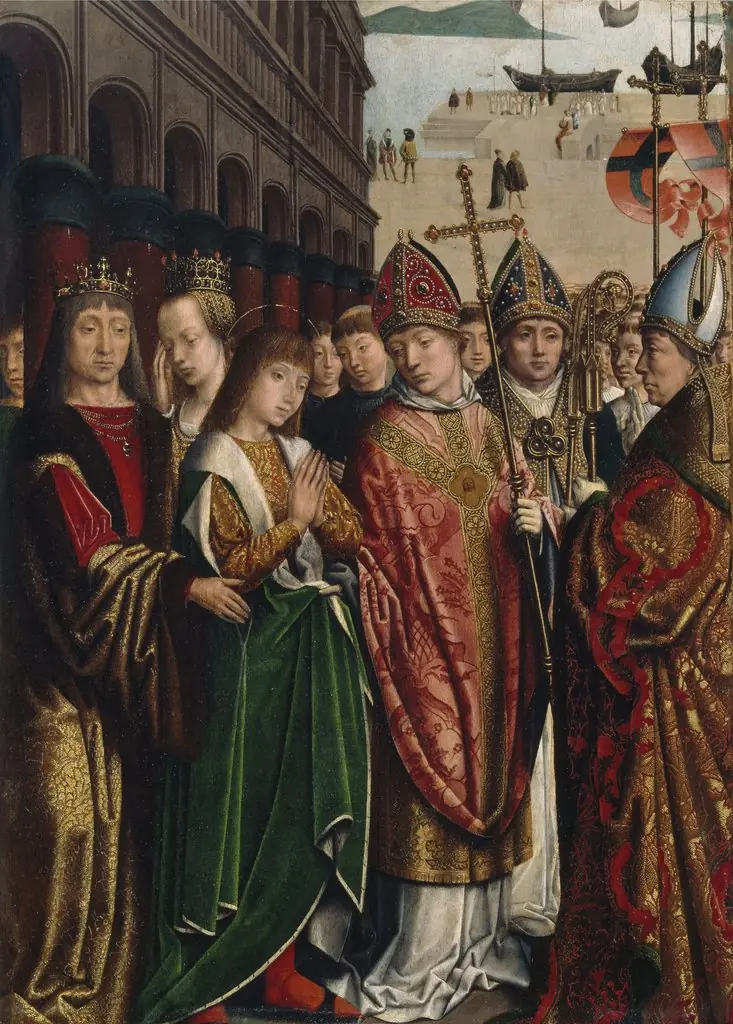 Saint Rumbold Taking Leave of his Parents
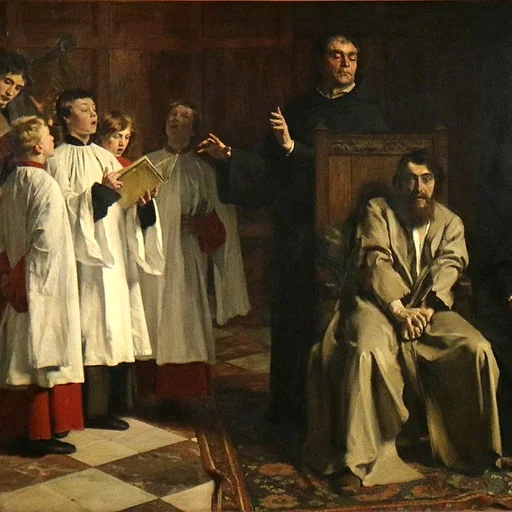
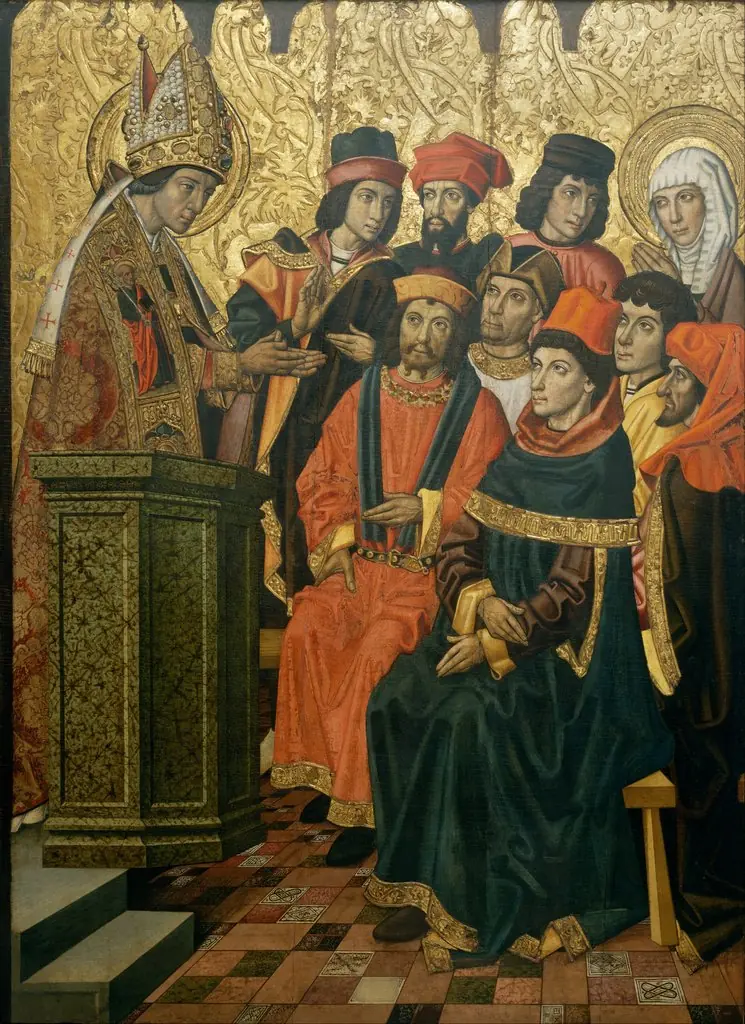 Saint Augustine and Saint Monica in a Sermon by Saint Ambrose
 The veneration and dedication of the Holy Cross to the church by Emperor Constantine and his mother Helena
 Altarpiece of Saint Peter