Artwork
Adoration of the Shepherds
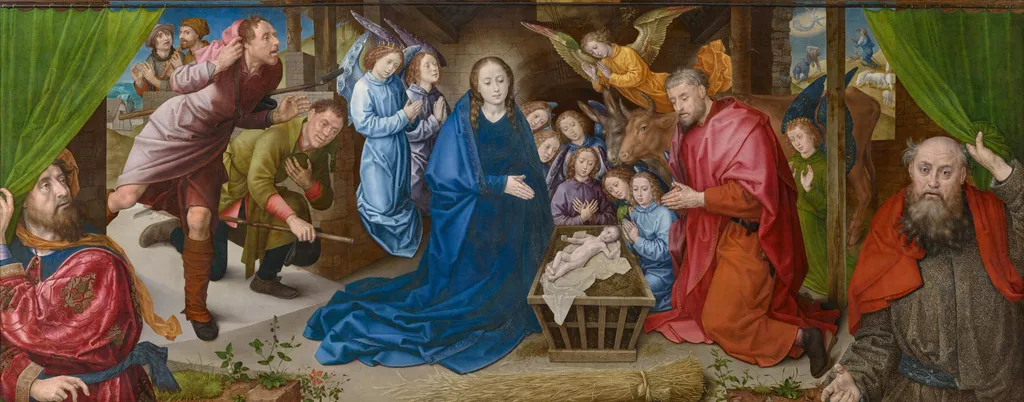
Adoration of the Shepherds is an oil painting by the Northern Renaissance artist Hugo Van der Goes. It is held in the collection of the Gemäldegalerie Berlin.
About this work
Technique & Style
A continuous curtain rod across the top unifies the scene, while the prophets’ parted green drapery frames the central action as a theatrical tableau.
Hugo van der Goes’s Adoration of the Shepherds is executed in oil paint on an oak panel measuring 97 × 245 cm. The support consists of a single, horizontally grained plank, prepared with a white ground typical of Early Netherlandish practice. Brushwork ranges from translucent glazes in the angels’ wings to thick impasto in the shepherds’ woollen garments, creating tactile contrasts that heighten the illusion of depth. The artist’s handling of flesh, particularly the Christ Child’s delicate modelling, relies on successive thin glazes that allow underlying underdrawing to remain subtly visible.
Stylistically, the panel juxtaposes hyper-realistic details, such as the gold-brocaded sleeves of the prophets and the botanically precise weeds in the foreground, with an almost stage-like spatial compression. A continuous curtain rod across the top unifies the scene, while the prophets’ parted green drapery frames the central action as a theatrical tableau. Color harmonies are carefully orchestrated: warm and cool reds cascade from the right-hand prophet’s mantle to Joseph’s robe, while blues modulate from deep ultramarine in the angels’ wings to violet in the distant landscape.
Recent restoration has revealed that the original palette was brighter and more saturated than previously assumed, dispelling earlier interpretations of somber tonality.
History & Provenance
The work is dated circa 1480 and is considered a late production by Hugo van der Goes, created before he entered Rouge-Cloître Abbey near Brussels as a lay brother in the Windesheim Congregation linked to the devotio moderna movement.
No documented commission or early provenance is recorded. The painting entered the public record only when it was purchased in 1903 by the Gemäldegalerie, Berlin, from the collection of Infanta Maria Cristina of Spain in Madrid.
Context
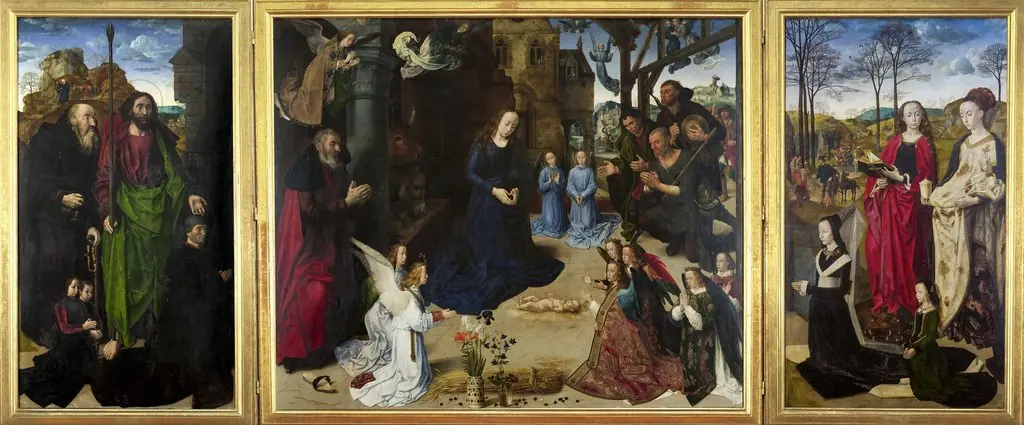
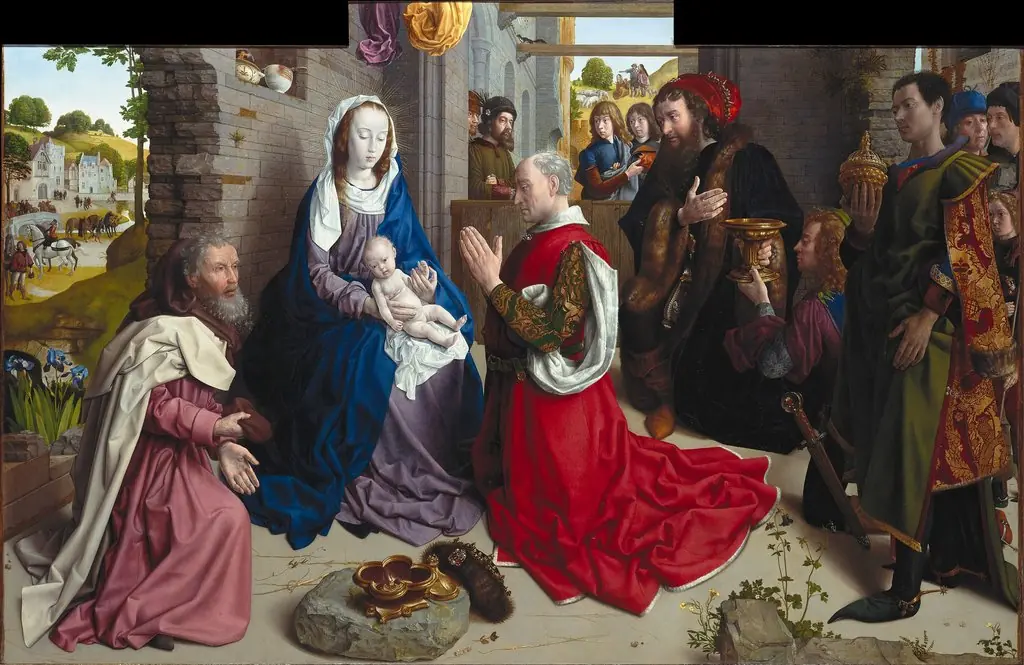
Hugo van der Goes's Adoration of the Shepherds (c. 1480) is a seminal work of Early Netherlandish painting, though it remains less renowned than his Portinari Triptych or Monforte Altarpiece. Created during the artist's final creative period after he entered the Rouge-Cloître Abbey, the panel reflects the spiritual intensity of the devotio moderna movement. Art historians, including Erwin Panofsky, have interpreted the painting's dynamic composition and the rushing figures of the shepherds as a reflection of the artist's own mental instability, describing the scene as a "mad gallop."
Conversely, scholar Hans Belting emphasizes the work's theatricality, noting how Old Testament prophets part a green curtain to reveal the Nativity as if opening a stage play. Technical analysis in the early 21st century confirmed the work dates to the late 1470s or later, correcting earlier theories that placed it at the beginning of his career. The painting's unique format and intense expressiveness continue to be analyzed in relation to contemporary mystery plays and the artist's personal search for healing.
Legacy
The Adoration of the Shepherds exerted influence through its theatrical composition and symbolic depth, particularly noted for its use of stage-like framing and intermediary prophets. Art historian Hans Belting described it as a scene unfolding theatrically, with curtains parting to reveal the Nativity, a technique that prefigured modern narrative staging. The work’s late date, created during Hugo van der Goes’s monastic life at Rouge-Cloître Abbey, linked it to the devotio moderna movement’s spiritual intensity, contrasting with earlier works like the Portinari Triptych in its psychological immediacy.
Later scholarship connected its dynamic figures and unresolved emotional tone to van der Goes’s personal crisis, with 20th-century analyses associating its ‘storm’ of movement with his mental state. Restorations in 2013 revealed vibrant underlayers, reinforcing its technical innovation. The painting’s legacy lies in redefining religious narrative through spatial drama and symbolic detail, influencing interpretations of Northern Renaissance devotional art.
The work’s unconventional scale and staging, featuring prophets parting a green curtain to expose the stable scene, created a meta-theatrical effect, positioning viewers as witnesses to a divine drama. This compositional device, noted by Belting, transformed the panel into a ‘scene within a scene,’ blending scriptural narrative with performative immediacy. Van der Goes’s monastic context further shaped its reception, as his retreat from civic life infused the work with ascetic gravity.
Though initially overshadowed by contemporary masterpieces, its symbolic precision, such as botanical motifs tied to Christ’s dual nature and the Eucharistic wheat sheaf, became a reference point for later scholars examining the intersection of piety and artistic innovation. Modern restorations confirmed its layered execution, validating historical accounts of its creation during a period of spiritual and psychological transformation.
Overview
The work titled Adoration of the Shepherds is an oil painting executed by the Flemish artist Hugo van der Goes during the later phase of his career. It is currently housed in the Gemäldegalerie in Berlin and stands out for its comparatively large dimensions relative to the artist’s usual output.
Subject & Meaning
The composition depicts the biblical scene of the shepherds’ visit to the infant Christ, a theme frequently treated in Northern Renaissance devotional art. Van der Goes presents the figures with a quiet reverence that aligns with the spiritual introspection promoted by the devotio moderna movement.
Artist & collection
Artist
Hugo van der Goes (c. 1430/1440 – 1482) was a Flemish painter who was one of the most significant and original Early Netherlandish painters of the late 15th century. Van der Goes was an important painter of altarpieces…

- Adoration of the Shepherds
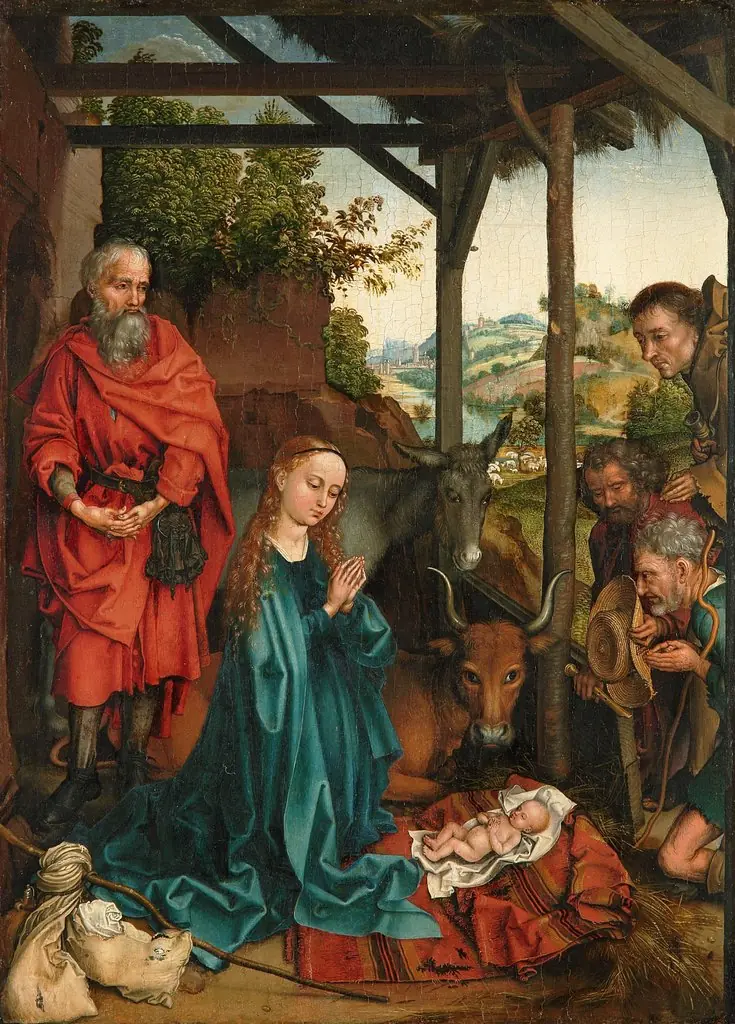 Adoration of the Shepherds
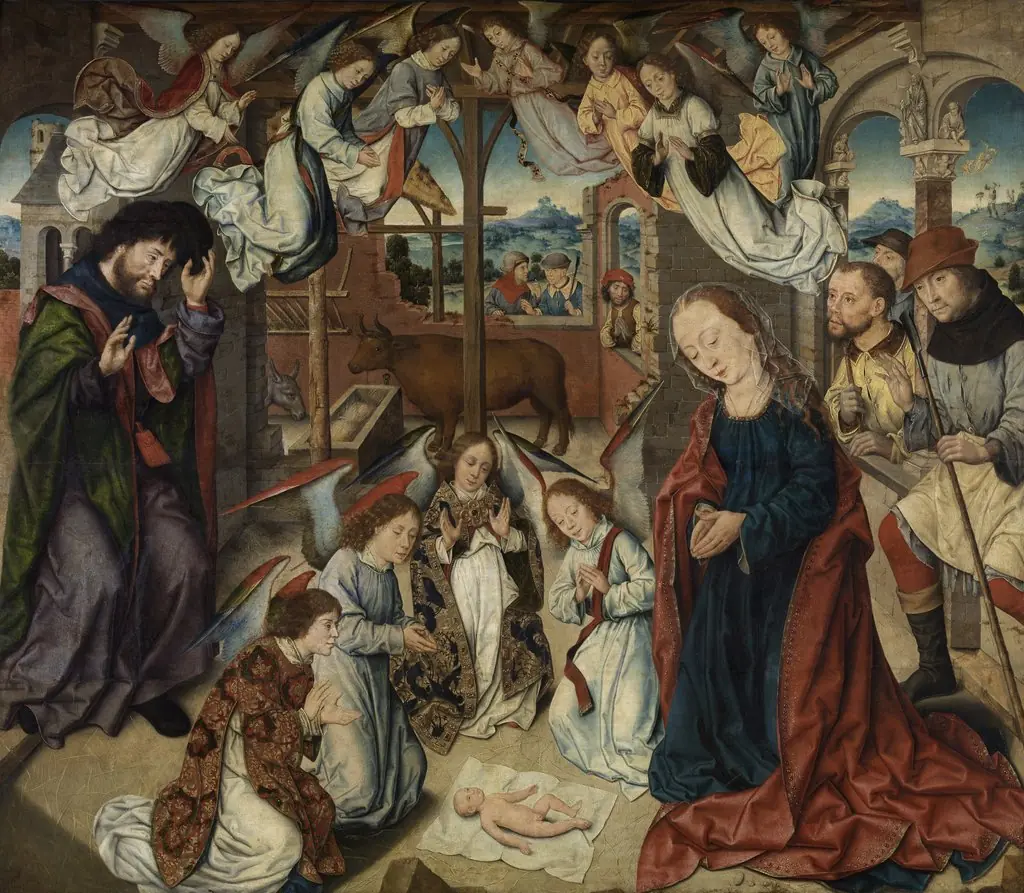 The Adoration of the Shepherds
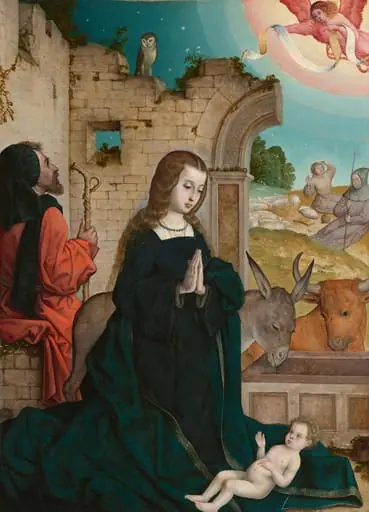 The Nativity
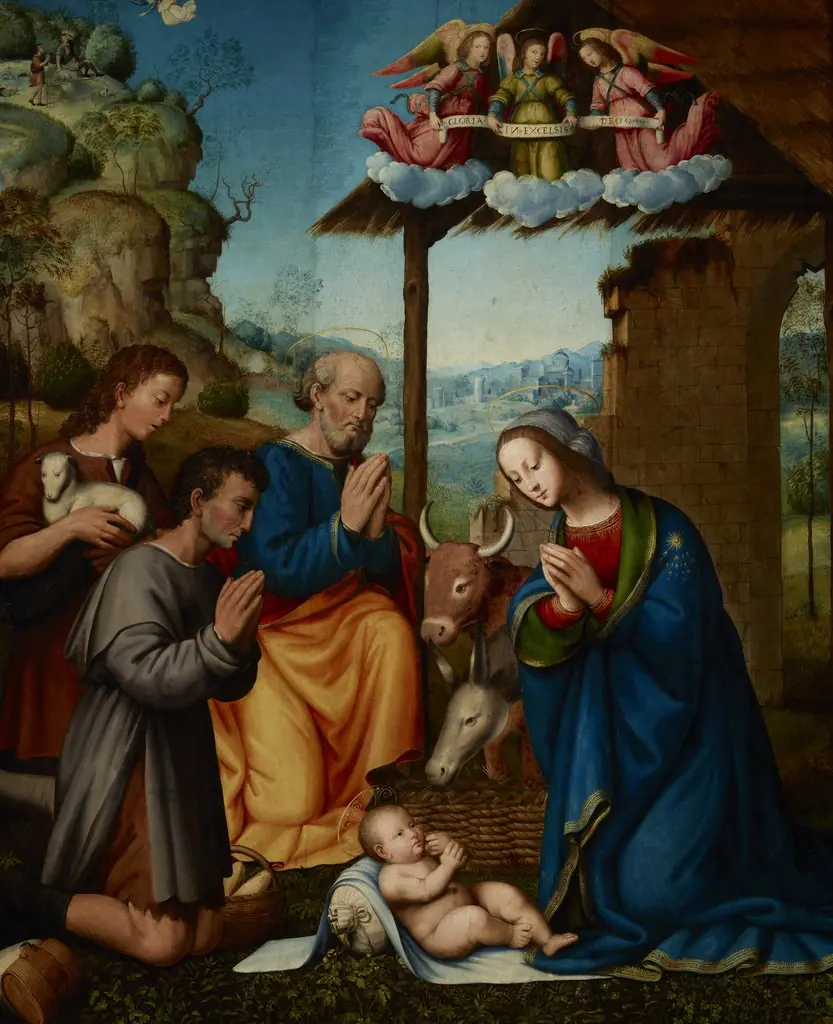 Adoration of the Shepherds (Adoration of the Child by Mary, St Joseph and Shepherds)
 Birth of Christ
 Madonna and Child
 The Nativity
 The adoration of the Child
 Adoration of the Magi
 The Adoration of the Christ Child