Artwork
The Adoration of the Kings
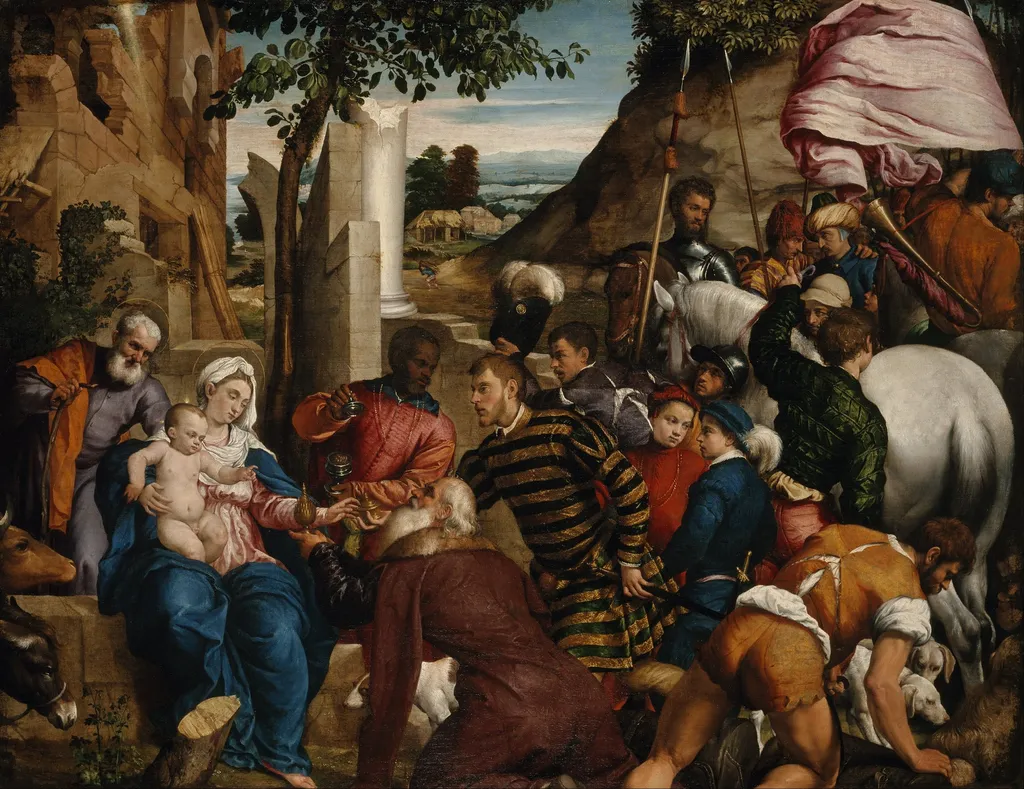
The Adoration of the Kings is an oil painting by the Mannerist artist Jacopo Bassano. It dates from 1540 and is held in the collection of the National Galleries Scotland.
About this work
Overview
The Adoration of the Kings is a large oil on canvas painting by the Italian Renaissance artist Jacopo Bassano, dated to 1540 or the early 1540s.
The Adoration of the Kings is a large oil on canvas painting by the Italian Renaissance artist Jacopo Bassano, dated to 1540 or the early 1540s. Measuring 183 by 235 cm, the work depicts the biblical scene of the three Magi presenting gifts to the infant Jesus. It is held in the collection of the Scottish National Gallery in Edinburgh, where it is on display, under accession number NG 100. The painting is notable for its synthesis of Venetian coloristic brilliance with Bassano's distinctive attention to naturalistic detail, animals, and everyday life, all organized within a formally ambitious composition. It stands as one of the artist's most significant early mature works and a key example of the expansion of Venetian painting into grander formats for reception rooms during the sixteenth century.
Subject & Meaning
The painting illustrates the Adoration of the Magi, the episode from the Gospel of Matthew in which three kings from different lands journey to pay homage to the newborn Christ. On the left side of the composition, the Virgin Mary, clad in deep blue and rose, sits with the naked infant Jesus on her lap; behind her stands the bearded Saint Joseph, both figures marked by gold halos. Before them, the three Magi present their traditional gifts of gold, frankincense, and myrrh, each carrying symbolic weight: gold signifying Christ's kingship, frankincense his divinity, and myrrh the suffering and death to come. The eldest king, white-haired and kneeling, offers a golden vessel, while another figure in red and orange holds a covered cup. The central and most prominent king wears a striking black and gold striped garment and stands turned toward the Holy Family, his posture one of courtly deference rather than kneeling adoration. To the right, a large retinue of attendants, soldiers, and onlookers gathers around a white horse and beneath a billowing pink and white striped canopy, many appearing indifferent to the sacred event. The composition thus creates a visual division between the realm of faith on the left and worldly indifference on the right, with the central figure awkwardly straddling both worlds. Symbolic elements permeate the scene: ruined stone architecture and a broken column allude to the decay of pagan antiquity with the coming of Christ; a freshly cut tree stump beneath the child prefigures the Passion; a fig tree may signify the fruit of Mary's womb; and delicate columbine at Mary's feet evokes the Holy Spirit. A beam of light from the star above the Holy Family provides the only explicit supernatural element in an otherwise naturalistic treatment.
Technique & Style
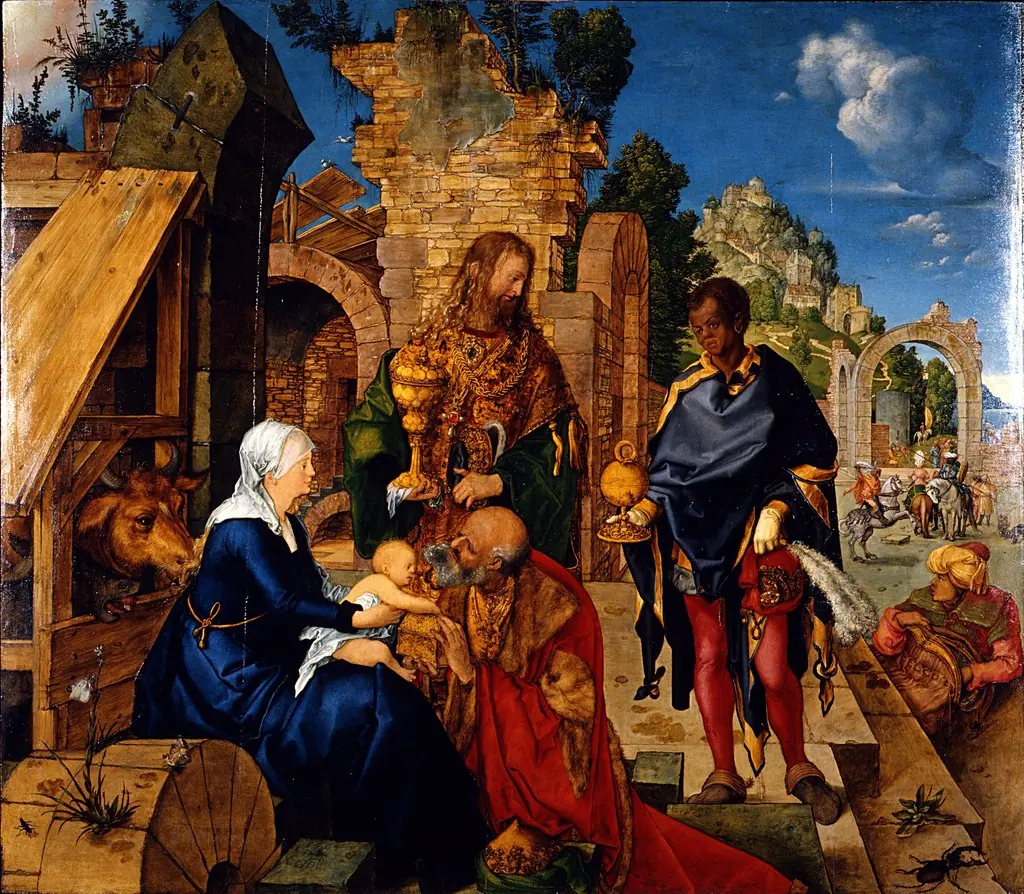
Bassano executed the work in oil on canvas, a medium that allowed for the rich color saturation and layered glazes characteristic of Venetian painting. The palette is dominated by ultramarine blue, crimson, gold, green, and warm earth tones, with light falling from the upper left to illuminate faces, fabrics, and the infant. The brushwork varies across the surface: smooth and meticulous on skin and in the rendering of textiles and armor, more painterly and free in the foliage and distant landscape. This differential handling demonstrates Bassano's technical range and his ability to modulate focus across the composition. The overall arrangement follows a semi-circular sweep that imposes formal order on the bustling scene, with decoratively repeating patches of intense color creating rhythmic cohesion. The artist's celebrated skill in depicting animals, unsurpassed among his contemporaries, is evident in the carefully observed ox and ass at the far left and the dogs near the kneeling servant. Bassano integrates these naturalistic details and slices of everyday life, such as the man removing a stocking and chatting boys, without allowing them to detract from the religious narrative. The ruined architecture on the left, partly adapted from a woodcut by Albrecht Dürer, contributes both symbolic meaning and spatial depth, while the distant landscape with its hills, buildings, and pale sky anchors the scene in a recognizable Veneto setting.
History & Provenance
The painting was commissioned in 1542 by the Venetian patrician Jacopo Ghisi, as recorded in a recently discovered ledger from the Bassani workshop that documents a down-payment for the work. Ghisi would have been approximately twenty-seven years old at the time, an age consistent with the youthful central figure, whom scholars have identified as a portrait of the patron. Curiously, the same ledger records that the sum was returned to Ghisi later that year; the reason for this remains unknown, though the painting was evidently completed. The work dates to a pivotal moment in Bassano's career, when at age thirty-two he had returned from training in Venice to work in the family business at Bassano del Grappa. In 1856, the painting was purchased by the Royal Scottish Academy, and in 1910 it was transferred to the National Gallery of Scotland, now National Galleries Scotland. It bears accession number NG 100 and is currently displayed in the Scottish National Gallery.
Context
The Adoration of the Kings emerges from the broader transformation of Venetian painting in the sixteenth century, when works grew increasingly large to suit the grander surroundings of reception rooms rather than private domestic spaces. Bassano, though based in the modest market town of Bassano del Grappa rather than Venice itself, was one of the greatest representatives of the Venetian pictorial tradition, and this painting exemplifies his synthesis of Venetian colorism with influences from northern European print culture. The ruined architecture derives partly from a popular woodcut by Albrecht Dürer, while the crowd on the right closely resembles an engraving by Agostino Veneziano after Raphael's depiction of Christ carrying the cross. Bassano also copied but reversed the overall composition from a fresco by Pordenone in the Malchiostro Chapel of Treviso Cathedral, painted in 1520. The painting reflects the Counter-Reformation context, in which religious art served to inspire faith and convey spiritual narratives with emotional immediacy. Critical attention has focused on the unusual characterization of the central king, whose portrait-like presence, courtly posture, and ambiguous spiritual engagement have prompted debate about whether the painting encodes a subtle critique of worldly pretension or rather accommodates the social aspirations of its patron.
Legacy
The Adoration of the Kings has secured recognition as a major work in Bassano's oeuvre and in the broader history of Venetian Renaissance painting. Its innovative integration of sacred narrative with naturalistic detail, animal painting, and portraiture influenced subsequent generations and contributed to Bassano's reputation as a painter who merged everyday life with religious themes. The work's emotional depth and compositional dynamism anticipated directions later explored by Baroque artists. The painting's provenance through the Royal Scottish Academy to National Galleries Scotland has ensured its preservation and public accessibility, with its display in the Scottish National Gallery allowing continued engagement with its complex interplay of devotion and worldliness. Scholarly interest persists in the painting's patron portrait, its sources in northern and central Italian art, and its place within Bassano's developing style of the early 1540s, a period that also saw related treatments of the Holy Family in works such as the Flight into Egypt of 1544.
Own this work as a print
Artist & collection
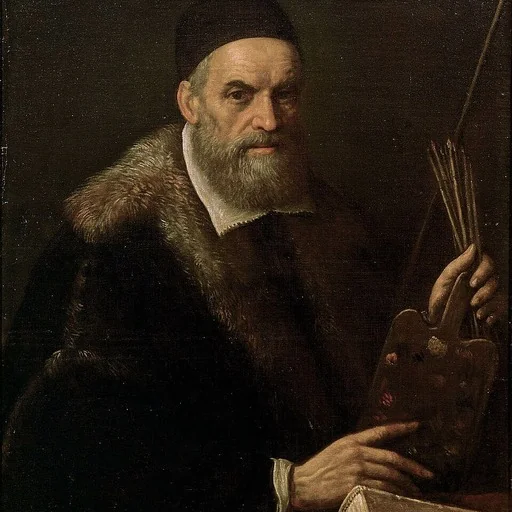
Artist
Jacopo Bassano was an Italian Renaissance painter of the Venetian school. He was born and died in Bassano del Grappa, and took the village as his surname. Having trained in the workshop of his father, Francesco the…