Artwork
Harmony in Yellow and Gold: The Gold Girl—Connie Gilchrist
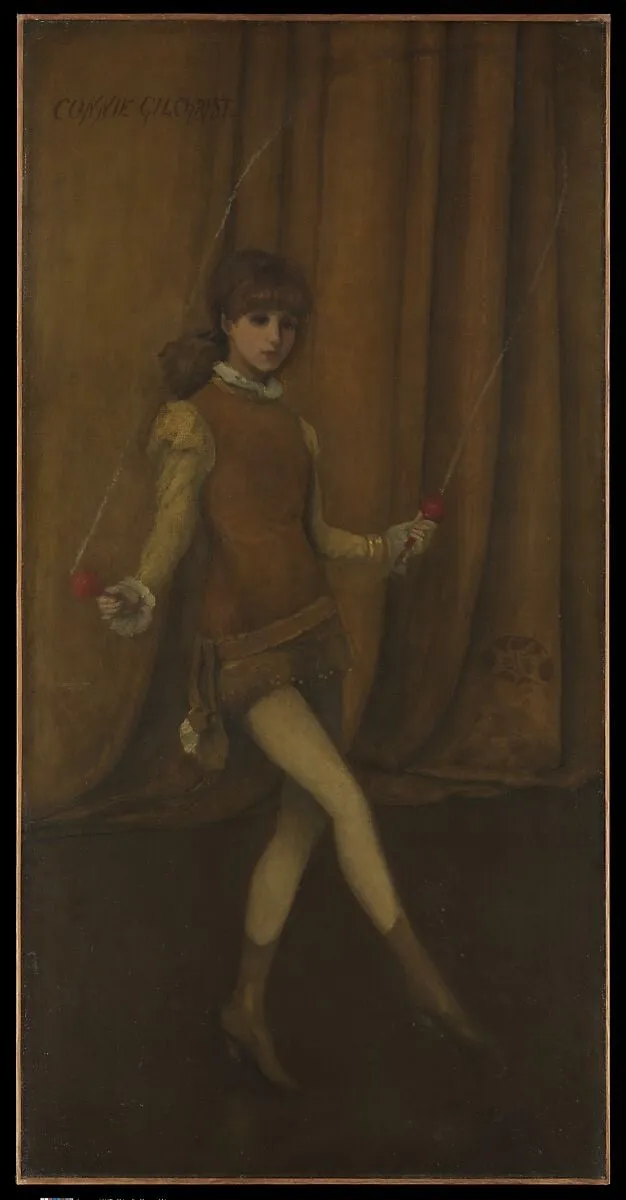
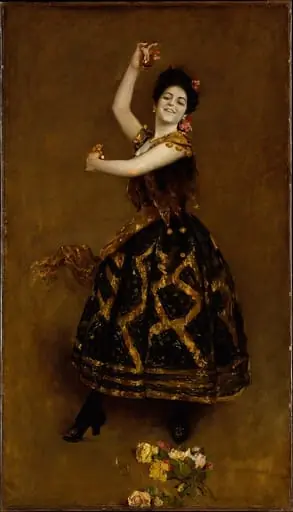
Harmony in Yellow and Gold: The Gold Girl—Connie Gilchrist is an oil painting by the American Impressionist artist James McNeill Whistler. It dates from 1876 and is held in the collection of the Metropolitan Museum of Art.
About this work
Subject & Meaning
The painting portrays Connie Gilchrist, Countess of Orkney, depicted as a young girl in performance attire.
The painting portrays Connie Gilchrist, Countess of Orkney, depicted as a young girl in performance attire. The title's emphasis on "The Gold Girl" reflects Whistler's Aestheticist focus on tonal harmony and decorative effect, with the figure rendered in shimmering yellow and gold tones that integrate the sitter into a unified color scheme rather than a conventional narrative portrait. By naming the subject directly in the title alongside her aristocratic title, Whistler links the individual's identity to the visual experience of gold, suggesting that the work represents both a likeness and an aesthetic arrangement.
The depiction of a girl in performance situates the subject within the theatrical world, a recurring subject in Whistler's oeuvre, while the elongated canvas format lends the figure a stately, iconic presence.
Technique & Style
Painted in oil on a vertically oriented canvas, the work measures 217.8 cm in height by 109.5 cm in width. Whistler employed a narrow, elongated format that concentrates attention on the single figure. The handling emphasizes fluid, calligraphic brushwork and a mosaic-like application of thin, translucent glazes, particularly in the shimmering gold costume and background.
The palette is dominated by a restricted range of ochres, golds, and muted yellows, articulated through delicate tonal modulations rather than sharp contrasts. Stylistically, the composition aligns with Aestheticism, rejecting descriptive detail in favor of rhythmic pattern and decorative harmony. The sitter’s pose and the stylized drapery contribute to a studied elegance that supersedes naturalistic representation.
History & Provenance
James McNeill Whistler created the oil-on-canvas portrait Harmony in Yellow and Gold: The Gold Girl, Connie Gilchrist in 1876. The work depicts the performer Connie Gilchrist, who later became the Countess of Orkney. Executed during the height of the Aestheticism movement, the painting measures 217.8 by 109.5 centimeters.
While the specific details of the initial commission are not elaborated in the provided records, the work dates definitively to 1876. The painting is currently part of the collection of the Metropolitan Museum of Art, where it is housed within the American Wing. The artwork remains a significant example of Whistler's portraiture from that period, characterized by its focus on color harmony and the depiction of the sitter in a performance context.
Harmony in Yellow and Gold: The Gold Girl, Connie Gilchrist is held in the collection of the Metropolitan Museum of Art, New York, with the accession number 29.100.72. The painting was executed in 1876 and depicts Connie Gilchrist, Countess of Orkney. Its dimensions are 217.8 cm in height and 109.5 cm in width. The work has not been documented in any subsequent exhibitions in the provided sources.
Overview
Harmony in Yellow and Gold: The Gold Girl, Connie Gilchrist is an 1876 oil on canvas portrait by James McNeill Whistler. The work depicts Connie Gilchrist, a twelve-year-old music hall performer known for her rope-skipping act, standing against a flat, gilded background. She wears a bright yellow dress and holds a fan, her pose and attire emphasizing the rhythmic movement associated with her stage persona.
Whistler composed the image to prioritize tonal harmony over narrative detail, treating the figure as an arrangement of color and form. The title reflects the artist's signature practice of naming works after musical concepts, focusing on the interplay of yellow and gold hues. Executed during Whistler's mature period in London, the painting exemplifies his Aesthetic Movement philosophy, where the visual arrangement supersedes the subject's biographical identity.
While the sitter was a specific public figure, Whistler elevates her to a decorative ideal, integrating her into a unified composition that balances the figure with the ornamental backdrop. This work stands as a significant example of Whistler's portraiture, merging the realism of a contemporary celebrity with the abstract principles of color theory that defined his career.
Artist & collection

Artist
James Abbott McNeill Whistler (; July 10, 1834 – July 17, 1903) was an American painter in oils and watercolor, and printmaker, active during the American Gilded Age and based primarily in the United Kingdom.

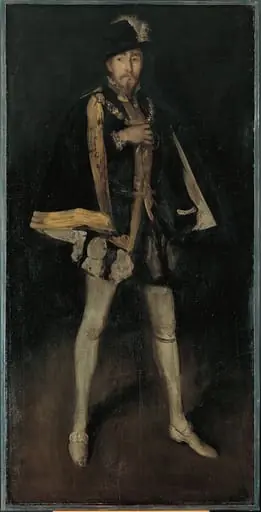 Arrangement in Black, No. 3: Sir Henry Irving as Philip II of Spain
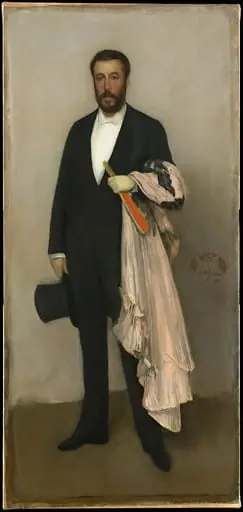 Arrangement in Flesh Colour and Black: Portrait of Theodore Duret
 Gold and Brown: Self-Portrait
 Edward Guthrie Kennedy
 George W. Vanderbilt
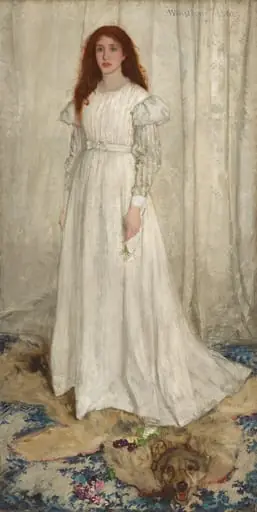 Symphony in White, No. 1: The White Girl
 Henry Irving as Philip II of Spain
 ‘Arrangement in Yellow and Gray’: Effie Deans