Artwork
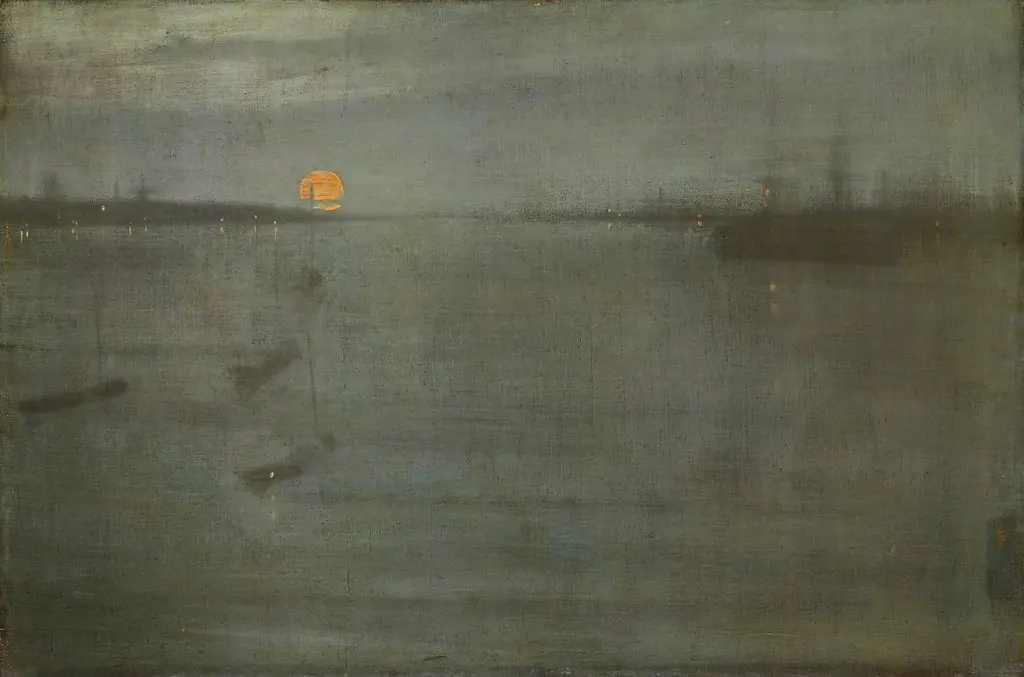
Nocturne in Black and Gold – The Falling Rocket
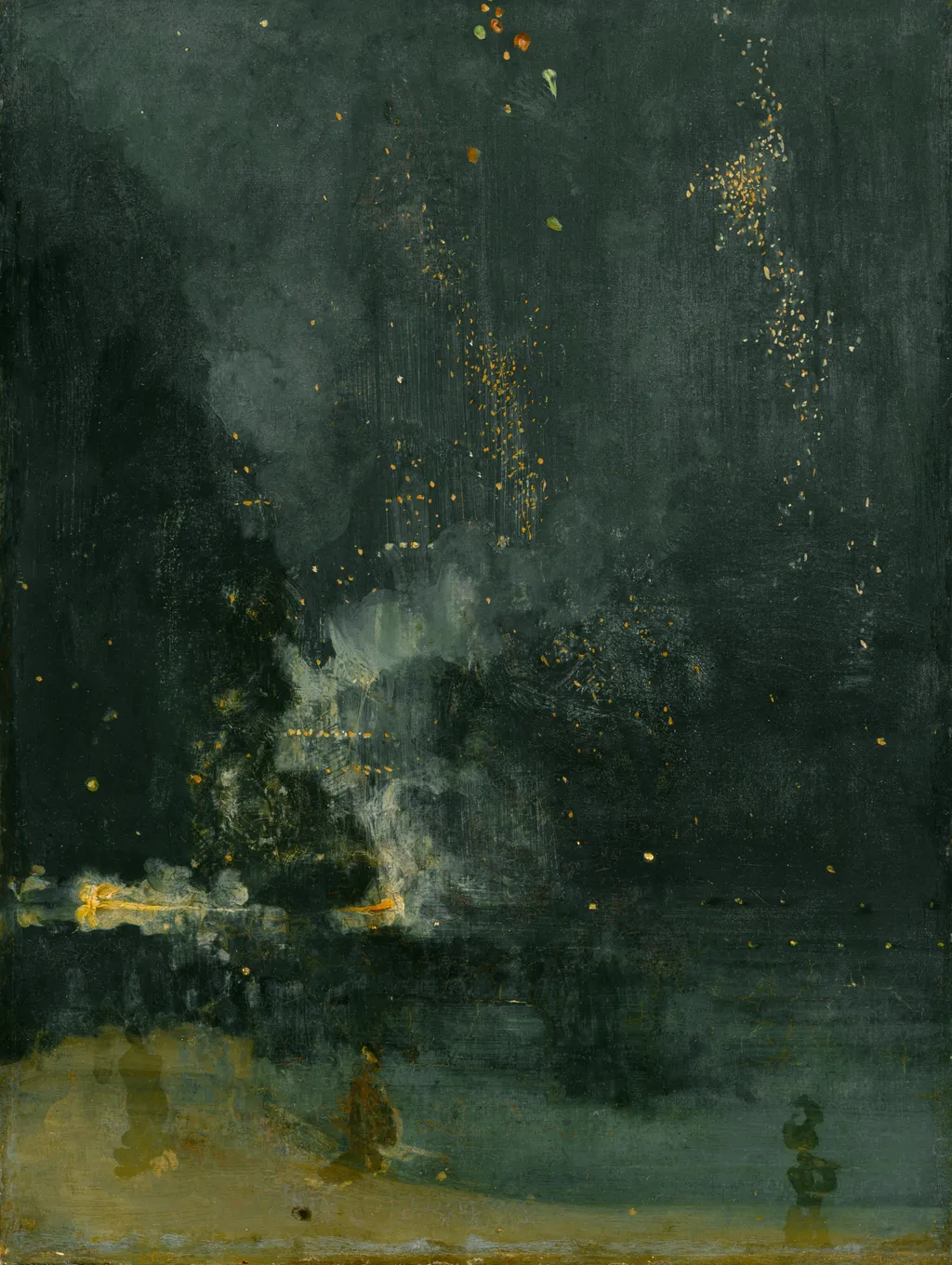
Nocturne in Black and Gold – The Falling Rocket is an oil painting by the American Impressionist artist James McNeill Whistler. It dates from 1875 and is held in the collection of the Detroit Institute of Arts.
About this work
The painting is associated with the concept of art for art's sake, which was formulated by Pierre Jules Théophile Gautier and Charles Baudelaire.
Nocturne in Black and Gold – The Falling Rocket is a painting by James McNeill Whistler. It was created in 1875 using oil paint.
The painting is associated with the concept of art for art's sake, which was formulated by Pierre Jules Théophile Gautier and Charles Baudelaire. This concept emphasizes the importance of art as an end in itself.
You can learn more about the artist who created this painting, artist: James McNeill Whistler (American, 1834–1903).
Technique & Style
Executed in oil on panel in 1875, the work measures 60.3 cm in height and 46.4 cm in width. Whistler’s handling emphasizes fluid, layered glazes that merge into a unified, misty atmosphere, while flick-like dabs of yellow and green punctuate the dark ground to suggest exploding fireworks. The composition arranges the scene in flattened, tonal planes, dissolving detail into atmospheric effect; the few figures and structures are rendered as generalized silhouettes barely emerging from the enveloping fog.
The artist’s signature, applied in thick, abbreviated strokes along the lower edge, echoes Japanese print conventions, reinforcing the work’s stylistic debt to ukiyo-e sources.
The palette is deliberately restricted, predominantly muted blues, greens, and blacks, creating a somber, harmonious nocturne that privileges sensation over descriptive accuracy.
History & Provenance
James McNeill Whistler created Nocturne in Black and Gold – The Falling Rocket in 1875 using oil paint on a panel. The work depicts a fireworks display at London's Cremorne Gardens and represents the culmination of his series of London Nocturnes. Whistler first exhibited the painting at the Grosvenor Gallery in London in 1877.
Following a harsh critique by John Ruskin, the artist sued for libel in 1878, a trial that resulted in a nominal award and contributed to his subsequent bankruptcy. The painting is currently held in the collection of the Detroit Institute of Arts.
Nocturne in Black and Gold – The Falling Rocket is held by the Detroit Institute of Arts in Detroit. The painting is an oil on panel measuring 60.3 by 46.4 cm, with the Dutch-language source giving the width as 46.7 cm.
The work was first publicly exhibited at the Grosvenor Gallery in London in 1877. also notes that the painting was shown in America in 1883–1884, an exhibition that was accompanied by a public controversy. In more recent times, the painting was featured in the 1980 BBC Two television series 100 Great Paintings.
No specific accession number is provided in the available sources.
Context
Whistler’s Nocturne in Black and Gold – The Falling Rocket crystallizes the Tonalist and Aestheticist ambitions of his middle period and stands as a flashpoint in Victorian art discourse. First exhibited in 1877 at the Grosvenor Gallery, the work’s evocation of Cremorne Gardens’ fireworks scandalized critics who expected narrative clarity rather than tonal harmony. John Ruskin’s notorious dismissal, calling it a ‘pot of paint flung in the public’s face’, sparked the 1878 libel suit that, despite Whistler’s victory, bankrupted him and exposed the widening rift between academic realism and autonomous art.
Later scholarship, notably David Park Curry, recast The Falling Rocket as a modernist breakthrough: its reduced palette, spatial ambiguity, and emphasis on sensation over description prefigure abstraction. The painting’s place in art history is secured not by its documentary accuracy but by its insistence that painting could evoke mood and atmosphere without illustrative obligation, aligning it with Whistler’s broader project of art for art’s sake.
Legacy
Nocturne in Black and Gold – The Falling Rocket became a pivotal touchstone in the reception of Whistler’s oeuvre and a defining episode in the history of modern art’s autonomy. Initially met with outrage by John Ruskin’s condemnation in 1877, the painting’s notoriety only amplified its subsequent stature as a manifesto of art-for-art’s-sake principles. By the late nineteenth century its radical reduction of form to sensation had begun to be recognized as a precursor to abstract tendencies in twentieth-century art.
The Detroit Institute of Arts, which acquired the work, later featured it in the 1980 BBC series 100 Great Paintings, consolidating its place in the canon of modernist milestones.
Critics such as David Park Curry have since described the work as one of the most advanced of its time, aligning its orchestration of color and void with an almost musical abstraction. Whistler’s insistence that the painting be judged as an arrangement rather than a mimetic view has been retrospectively validated, marking The Falling Rocket as an early assertion of painting’s independence from narrative and moralizing imperatives.
Overview
James McNeill Whistler’s oil painting Nocturne in Black and Gold – The Falling Rocket, executed around 1875, is part of the Detroit Institute of Arts collection. The work belongs to Whistler’s series of nocturnes, portraying a night scene illuminated by fireworks over a mist‑shrouded London park. Its muted palette of blacks and golds emphasizes atmosphere over narrative detail.
Subject & Meaning
The canvas captures a fleeting fireworks display above the fog‑laden expanse of Cremorne Gardens, a popular Victorian leisure venue. By focusing on light, color, and the evanescent quality of the burst, Whistler foregrounds visual sensation rather than a literal story, aligning the image with the aesthetic principle that art need not serve moral or didactic purposes.
Own this work as a print
Artist & collection

Artist
James Abbott McNeill Whistler (; July 10, 1834 – July 17, 1903) was an American painter in oils and watercolor, and printmaker, active during the American Gilded Age and based primarily in the United Kingdom.

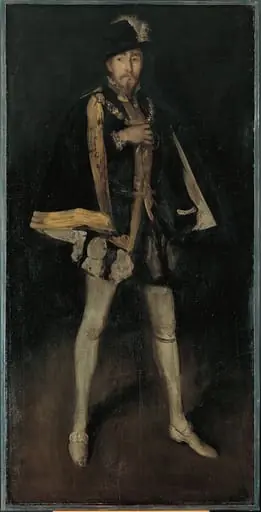 Arrangement in Black, No. 3: Sir Henry Irving as Philip II of Spain
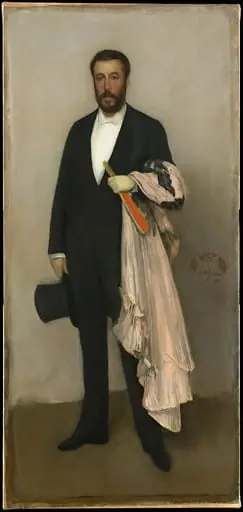 Arrangement in Flesh Colour and Black: Portrait of Theodore Duret
 Gold and Brown: Self-Portrait
 Edward Guthrie Kennedy
 Harmony in Yellow and Gold: The Gold Girl—Connie Gilchrist
 George W. Vanderbilt
 Symphony in White, No. 1: The White Girl
 Henry Irving as Philip II of Spain