Artwork
Wernyhora
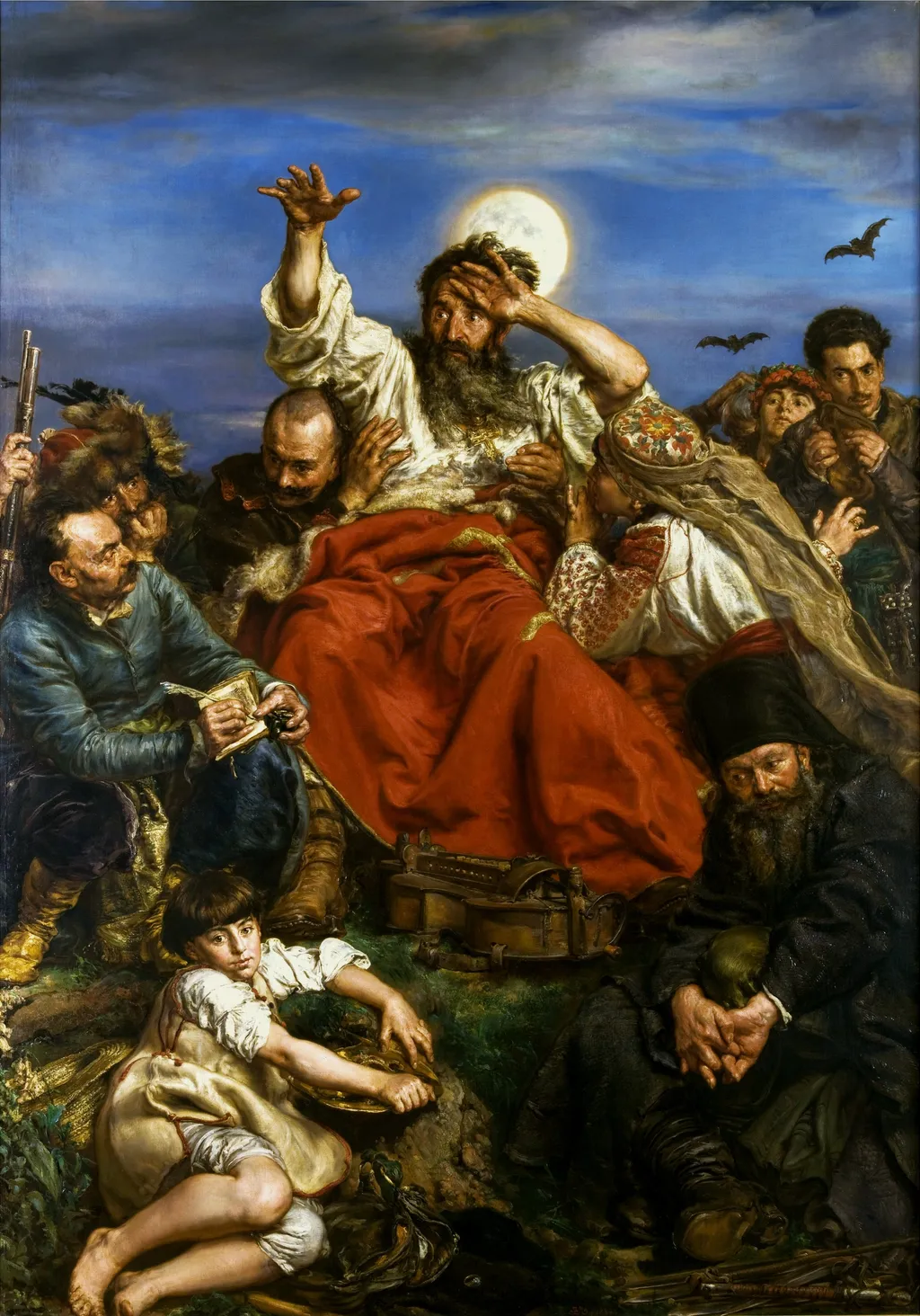
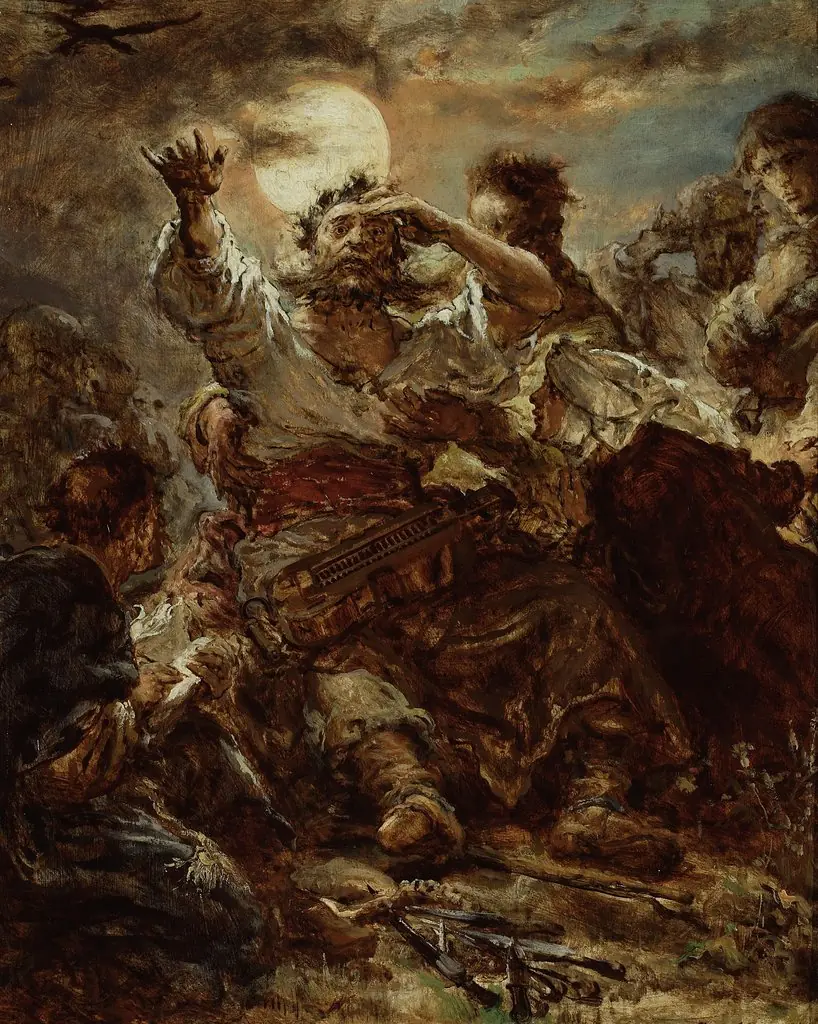
Wernyhora is an oil painting by Jan Matejko. It dates from 1892 and is held in the collection of the National Museum in Kraków.
About this work
Overview
It is one of Matejko's most politically charged compositions, depicting the legendary Ukrainian seer and bard Wernyhora in a moment of prophetic vision.
Wernyhora is an oil-on-canvas painting by the Polish artist Jan Matejko, completed in 1884. Measuring 292 by 206 centimetres, the work is held in the collection of the National Museum in Kraków, specifically in the Gallery of 19th-Century Polish Art at the Sukiennice. It is one of Matejko's most politically charged compositions, depicting the legendary Ukrainian seer and bard Wernyhora in a moment of prophetic vision. The painting emerged during a period of heightened Russo-Polish tension and stands as a complex allegory of Polish national fate, combining romantic nationalism with layered references to Polish-Ukrainian relations.
Subject & Meaning
The central figure is the Ukrainian bard and prophet Wernyhora, a semi-legendary figure believed to have lived in the second half of the 18th century during the Koliyivshchyna uprising. According to tradition, he prophesied the partitions of Poland, failed national uprisings, and the eventual rebirth of Polish statehood. Matejko portrays him at the moment of prophetic inspiration, wearing a white shirt and red robe with an Orthodox cross on his chest, his right arm raised with palm open in a blessing gesture and his left hand pressed to his forehead. He is supported by a young Ukrainian woman in national dress and a young Cossack. To his left, the Polish nobleman Nikodem Suchodolski records the prophecy with pen and book, while behind him a haidamak holds a rifle. To the right, an Orthodox priest sits with clasped hands near a pile of knives, and in the foreground a child in white kneels holding a metal dish containing a pilgrim's ring. A hurdy-gurdy lies at Wernyhora's feet, symbolising the songs preserving Polish national memory. The full moon rises behind him like a golden halo, indicating his status as a chosen, spiritual figure. The ensemble carries allegorical weight: Wernyhora's white-and-red costume stands for the pre-partition Commonwealth, the child with the pilgrim's ring and rucksack symbolises resurgent Poland, and the priest's knives represent tsarist violence. The ring held by the child and its twin on the Ukrainian woman's finger suggest future reconciliation between the nations.
Technique & Style
Matejko executed Wernyhora in oil paint on canvas, working on a monumental scale typical of his history paintings. The composition is organised around a strong central axis with the seated prophet as its fulcrum. Directional light emanates from the full moon in the deep blue night sky, casting dramatic shadows and highlights across faces, hands, and fabrics. The palette is dominated by deep blues, vivid reds, and warm earth tones. The brushwork shows deliberate variation: faces and hands are rendered with smooth, detailed precision, while the sky and darker passages are handled more loosely. Two bats fly against the scattered clouds, adding to the nocturnal, visionary atmosphere. The grassy ground, wooden chest at the prophet's feet, and the careful differentiation of textiles, from the woman's embroidered dress and headscarf to the robes of the attendant figures, demonstrate Matejko's attention to material specificity within a symbolic framework.
History & Provenance
The painting was created in 1884, a year of intensified Russo-Polish tensions driven by hostile tsarist policies toward Poles. It entered the collection of the National Museum in Kraków, where it remains today in the Gallery of 19th-Century Polish Art at the Sukiennice. The work was painted without a documented commission, arising instead from Matejko's own engagement with contemporary political circumstances and his longstanding interest in Polish historical subjects.
Context
Matejko's depiction of Wernyhora drew inspiration from the literary output of the so-called Ukrainian School, particularly the works of Juliusz Słowacki, rather than from direct knowledge of conditions in eastern Galicia. The romanticised vision of Ukraine shared by Polish literary circles, which treated these lands as an inseparable part of the Commonwealth, shaped Matejko's approach. Scholars including Pencakowski and Słoczyński have analysed the painting's elaborate political context. The work must be understood against the backdrop of 19th-century Slavophile ideology, which promoted notions of general unity between Slavic peoples even as Polish and Ukrainian national aspirations increasingly diverged. The partitions had placed Ukrainian territories under Russian and Austrian rule, creating fundamentally different trajectories for Ukrainians in each empire and complicating any simple Polish-Ukrainian solidarity. Matejko, who taught both Polish and Ukrainian students at the Kraków School of Fine Arts, operated within this complex cultural field. The first printed version of Wernyhora's prophecy had appeared in December 1830 in the Warsaw periodical Patriota, during the November Uprising, and the figure had since become entrenched in Polish national consciousness through the writings of Michał Czajkowski, Seweryn Goszczyński, and eventually Stanisław Wyspiański, who immortalised Wernyhora in The Wedding.
Legacy
Matejko's Wernyhora became the most famous visual representation of the Ukrainian seer, eclipsing other painted interpretations such as Wacław Pawliszak's 1898 works and Tadeusz Styka's 1925 Wernyhora During Prophecy. The painting reinforced and disseminated the romantic-nationalist conception of Wernyhora that had developed in Polish culture since the 1830s, when the figure was first pressed into service as a symbol of Poland's inevitable resurrection. The prophecy tradition itself, though claiming 18th-century origins, was largely a product of anonymous noble manuscript culture and early 19th-century political literature advocating Polish-Ukrainian alliance. Matejko's canvas gave durable visual form to this myth at a moment when the political realities of the partition era made such visions increasingly distant. The work continues to serve as a focal point for discussions of Polish romantic nationalism, the politics of memory in Polish-Ukrainian relations, and the nineteenth-century construction of historical prophecy as national allegory.
Own this work as a print
Artist & collection
Artist
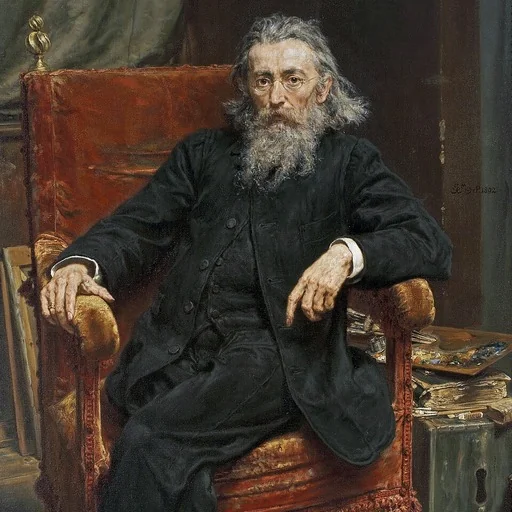
Jan Alojzy Matejko (Polish pronunciation:; also known as Jan Mateyko; 24 June 1838 – 1 November 1893) was a Polish painter, a leading 19th-century exponent of history painting, known for depicting nodal events from Polish history.