Artwork
Dunelandscape
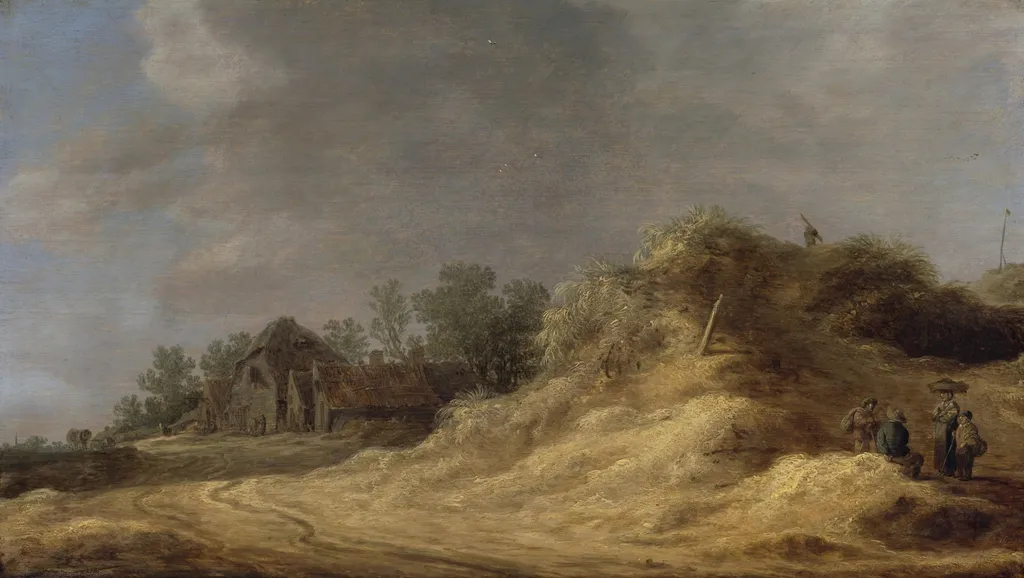
Dunelandscape is an oil painting by the Dutch Golden Age artist Jan van Goyen. It dates from 1629 and is held in the collection of the Gemäldegalerie Berlin.
About this work
Overview
Dunelandscape is an oil painting on oak panel created by the Dutch artist Jan van Goyen in 1629.
Dunelandscape is an oil painting on oak panel created by the Dutch artist Jan van Goyen in 1629. Measuring 29 cm in height and 51 cm in width, the work is held in the collection of the Gemäldegalerie in Berlin, where it is displayed among Flemish and Dutch paintings from the 17th century. The painting exemplifies Van Goyen's pioneering role in the development of "tonal" landscape painting, a style that introduced new standards of atmospheric unity and naturalism to Dutch art. Signed and dated "vG 1629" in the lower right corner, the work stands as a characteristic product of Van Goyen's mature period, when he systematically refined his approach to dune landscapes during the late 1620s.
Subject & Meaning
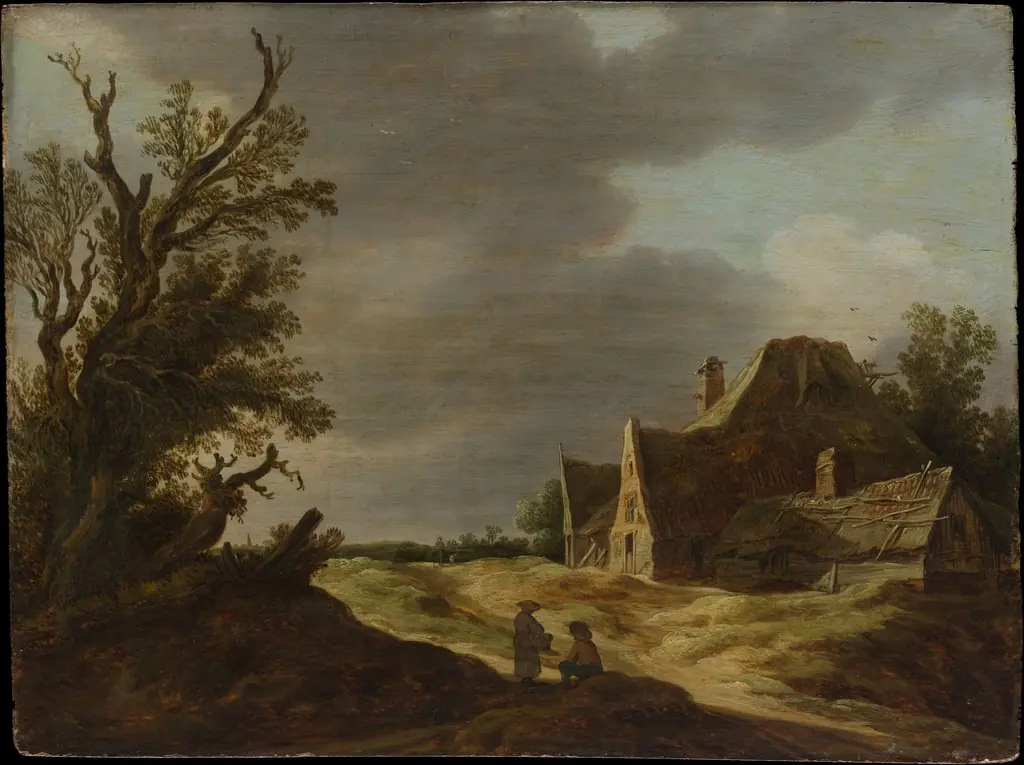
The painting depicts a sandy dune landscape rising from left to right, covered with patches of dry grass and low vegetation. To the left sits a thatched farmhouse with a steep roof, near whose doorway a few small figures stand. A dirt path curves in front of the building toward the foreground. On the right side of the dune, four figures gather: one sits on the sand, another carries a basket on the head, and two smaller figures stand nearby. A single figure with a long tool appears on the crest of the dune. The sky occupies more than half the canvas, filled with heavy gray-brown clouds with a strip of lighter blue at the left edge. A thin pole with a small flag stands at the far right horizon, while a few birds appear as tiny white specks in the sky. The scene presents an unpretentious view of rural life, with peasants engaged in everyday activities within a natural setting that would have been familiar to Dutch viewers as coastal terrain protecting the land from the sea.
Technique & Style
Van Goyen executed the work in oil on oak panel, employing the loose and visible brushwork characteristic of his mature tonal manner. The palette is dominated by browns, tans, dull greens, and grayed blues, with light falling evenly without strong shadows. The brushwork is particularly evident in the sky and sandy ground, producing a textured, matte finish throughout. This simplicity of palette and handling reflects the broader tonal aesthetic that Van Goyen helped codify, in which a restrained range of earth colors and effects of moist air create unified atmospheric effects. The composition employs a diagonal movement across the dune, with a powerful band of shadow in the immediate foreground that throws the lighted cottage and trees into sharp spatial relief. The artist's interest in irregular shapes, such as fences and natural forms, and his silhouetting of figures against the landscape, demonstrate his sophisticated approach to spatial organization within apparently simple scenes.
History & Provenance
The painting was acquired by the Gemäldegalerie, Berlin from a private collection in 1821, having previously been held in Berlin and London. It bears the signature and date "vG 1629" in the lower right. Van Goyen dated at least seven other dune landscapes with roads and cottages in 1629, indicating a concentrated period of production in this genre. A closely related design is the dunescape with lighted cottage dated 1628, formerly with the dealer Ehrhardt & Co., Berlin in 1929. Another comparable work dated 1629 is held in the Alte Pinakothek, Munich, as no. 6398. The silhouetted figures on the hilltop, a recurring motif in Van Goyen's works from these years, demonstrate the artist's systematic exploration of this compositional type during the late 1620s.
Context
Jan van Goyen was born in Leiden and trained by Esaias van de Velde, among others. He spent most of his life in his native country, with excursions documented in his drawings to the Southern Netherlands, Westphalia, and Cleves. His early manner employed the colorful and additive approach favored by Van de Velde, but from the early 1620s he explored greater unification of space in his drawings, making his most significant breakthroughs in tonal landscape painting in Leiden during 1625-1627. He was preceded in these experiments by the seascapist Jan Porcellis and the landscape painters Pieter van Santvoert and Pieter de Molijn. However, Van Goyen and Salomon van Ruysdael are credited with truly codifying the tonal style, painting simple scenes of dunes, rivers, and canals with restrained palettes and heightened appreciation of atmospheric effects. Between 1626 and 1629, Van Goyen systematically reduced the number of motifs in his designs, increasingly employed diagonal compositions, and sought unifying color schemes of earth colors and moist air effects. This painting thus represents the culmination of a concentrated period of artistic development.
Legacy
Van Goyen's loose and rapid manner of painting, applying a few colors in a single layer, was both virtuosic and speedy, allowing him to produce hundreds of works that were collected by both casual and knowledgeable art lovers. His dune landscapes, produced primarily in concentrated periods, established a visual vocabulary for Dutch landscape painting that influenced subsequent generations. The type of terrain depicted, familiar to inhabitants of Holland as a place for relaxing walks or amusing outings, provided city dwellers with comforting images of simple country life. Because the dunes protected the land against the sea, such works might also have conjured associations with divine benevolence and grace. The painting remains a significant example of the tonal phase of Dutch landscape painting, demonstrating how Van Goyen's reduction of compositional elements and unified color treatment achieved a new standard of naturalism that would inform the broader development of the Dutch Golden Age landscape tradition.
Artist & collection

Artist
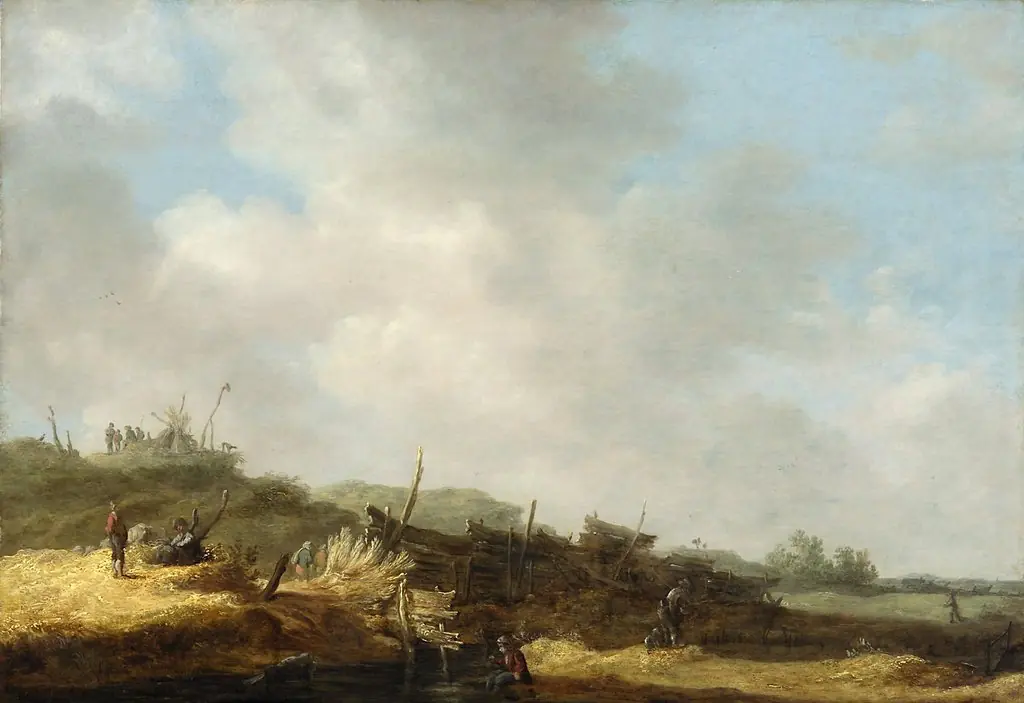
Jan Josephszoon van Goyen (Dutch pronunciation: ; 13 January 1596 – 27 April 1656) was a Dutch landscape painter.