Artwork
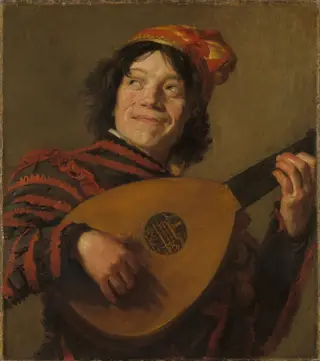
Soldier Playing the Theorbo
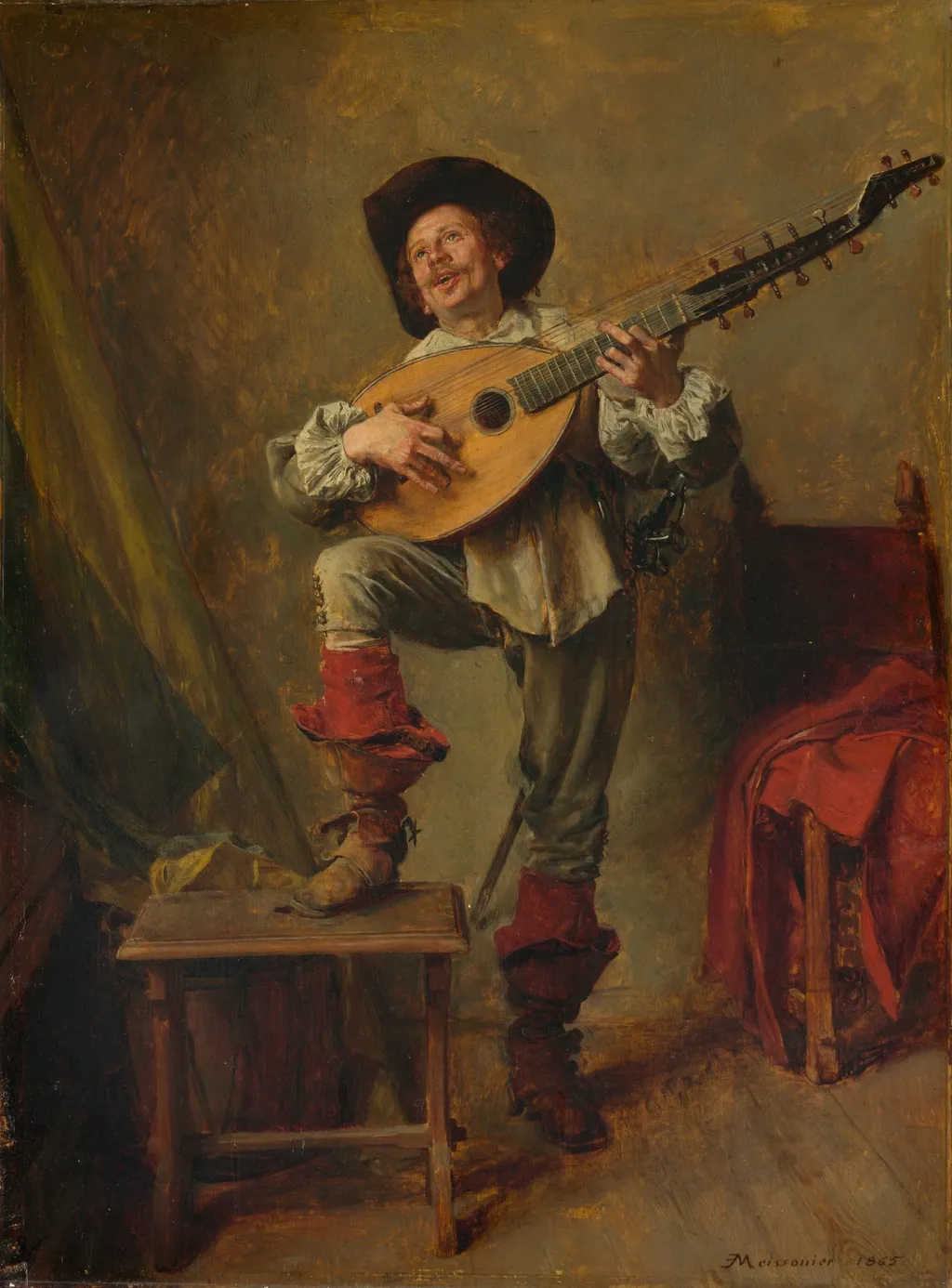
Soldier Playing the Theorbo is an oil painting by the Realist artist Ernest Meissonier. It dates from 1865 and is held in the collection of the Metropolitan Museum of Art.
About this work
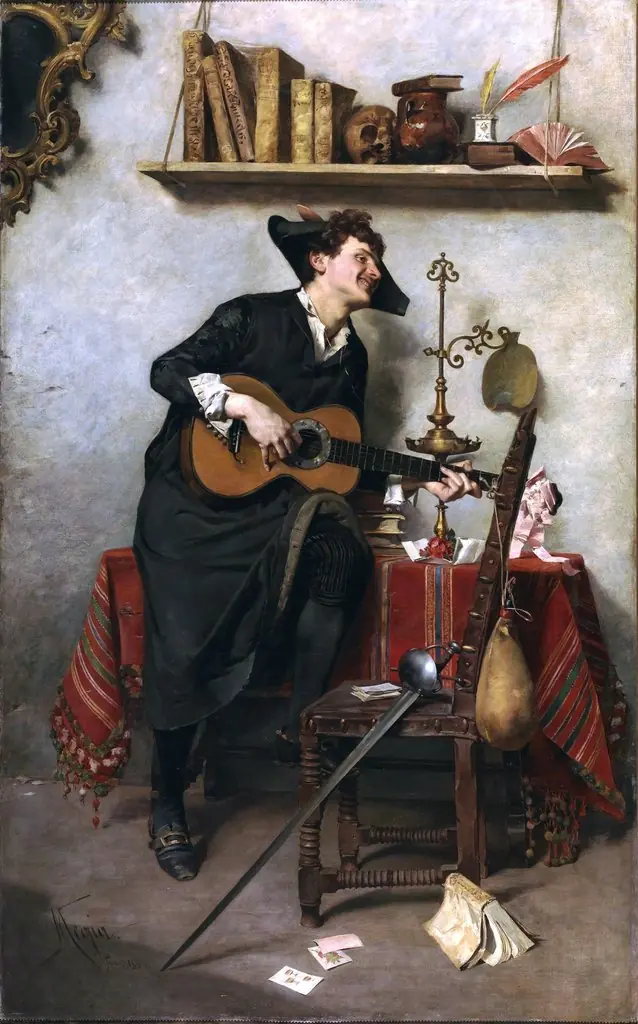
A soldier sits lost in a quiet moment, playing a theorbo, a large old lute. Meissonier, who favored tiny detail and military subjects, often paused the action to catch a small human touch. The work is oil on canvas, small and precise, painted around 1865.
Subject & Meaning
Executed in oil on canvas in 1865, the piece exemplifies Meissonier’s meticulous historical detail and his use of past eras to comment on timeless leisure.
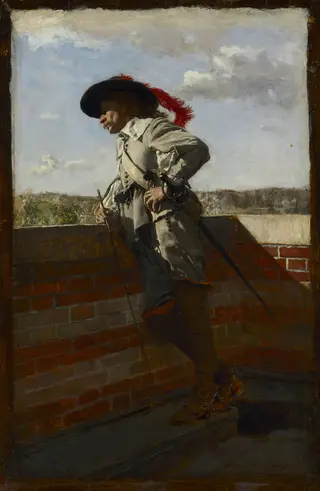
The painting shows a jovial infantryman of the Eighty Years’ War strumming a theorbo, a Baroque stringed instrument, while dressed in costume accurately researched by Meissonier. The soldier’s attire and the instrument reference 17th‑century Dutch masters and the musical culture celebrated in the works of Alexandre Dumas, linking contemporary 19th‑century French art to earlier European traditions. Originally conceived as “The Lute Player” for Baron Auguste Goethals, the work was bequeathed to the Metropolitan Museum of Art in 1908.
Executed in oil on canvas in 1865, the piece exemplifies Meissonier’s meticulous historical detail and his use of past eras to comment on timeless leisure.
Technique & Style
Executed in oil on panel, the work measures 29.2 × 21.9 cm and displays a tightly controlled handling typical of Meissonier’s practice. The soldier’s costume, a meticulously rendered infantry uniform from the Eighty Years’ War, is painted with fine, layered brushwork to capture the textures of linen, leather, and metal accoutrements. The theorbo itself is rendered with similar precision, its pear-shaped body and long neck delineated through smooth, blended glazes that convey both the instrument’s polished wood and the taut strings.
The handling combines smooth transitions in the figure’s flesh and garment with crisp edges around the instrument and accessories, producing a crisp, almost enamel-like finish. No losses or significant abrasions are recorded, and the panel support remains structurally sound, indicating stable condition.
History & Provenance
Created in 1865, Soldier Playing the Theorbo is an oil painting by Jean-Louis-Ernest Meissonier depicting a 17th-century infantryman. The work was commissioned by Baron Auguste Goethals, a general in the service of the Kingdom of Belgium. Although originally intended to be titled The Lute Player, Meissonier finalized the piece with its current subject matter, drawing on the popularity of Alexandre Dumas and Dutch masters.
The painting entered the collection of the Metropolitan Museum of Art in New York in 1908, arriving as part of a bequest. While some records describe the support as a panel, others identify it as canvas, though the date of 1865 remains consistent across documentation.
Context
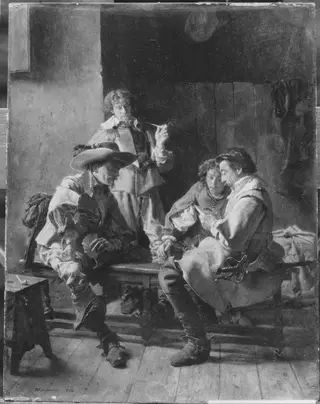
Created in 1865, Soldier Playing the Theorbo reflects Jean-Louis-Ernest Meissonier's broader scholarly dedication to 17th-century historical accuracy and genre painting. The work intentionally evokes Dutch Golden Age masters through its depiction of an infantryman from the Eighty Years' War and a theorbo, a period-specific instrument. This thematic approach aligns with Meissonier's wider oeuvre, including his 1863 painting The Card Players, which similarly features 17th-century soldiers.
The artist's reputation rests on his meticulous research into historical attire and material culture, evident in the precise rendering of the soldier's garb. Originally commissioned by Baron Auguste Goethals and initially titled The Lute Player, the painting entered the Metropolitan Museum of Art in 1908 via bequest, securing its place within the canon of French academic art that romanticized historical military life.
Overview
This oil on canvas painting, Soldier Playing the Theorbo, was created by the French artist Jean Louis Ernest Meissonier around 1865. The work depicts a lone military figure absorbed in playing a theorbo, a large stringed instrument resembling a lute. Meissonier, known for his meticulous detail and often small-scale compositions, presents a scene that contrasts the soldier's profession with a moment of quiet introspection and musical engagement.
Own this work as a print
Artist & collection
Artist
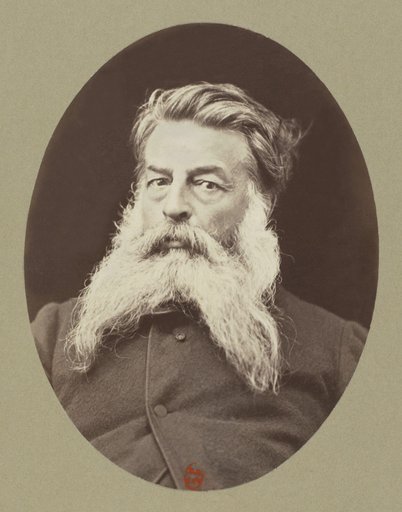
Jean-Louis-Ernest Meissonier was a French academic painter and sculptor. He became famous for his depictions of Napoleon and his military sieges and manoeuvres in paintings acclaimed both for the artist's mastery of…