Artwork
The Stolen Kiss
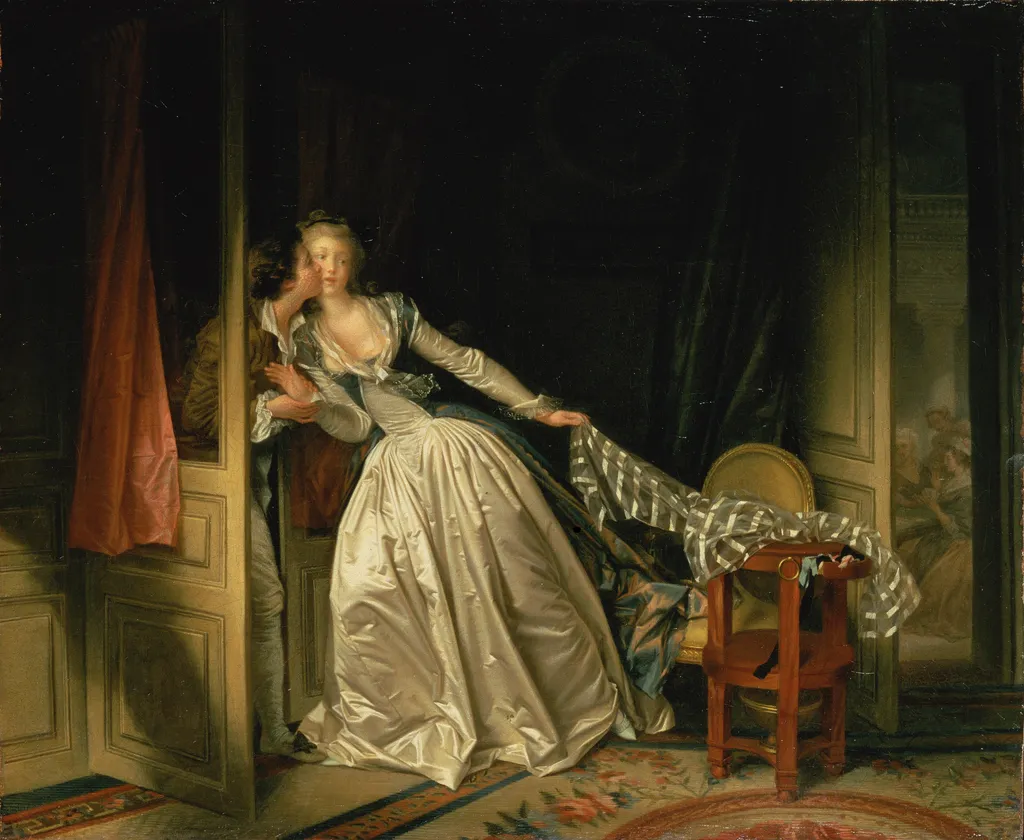
The Stolen Kiss is an oil painting by the Rococo painting artist Jean Honoré Fragonard. It dates from 1794 and is held in the collection of the Hermitage Museum.
About this work
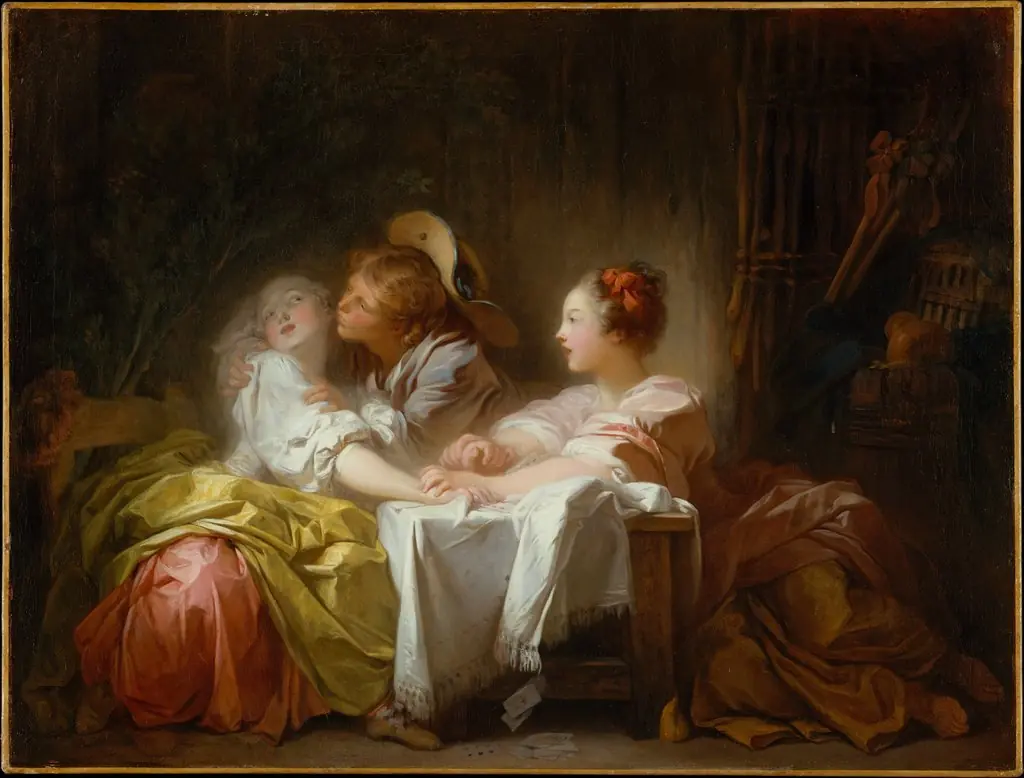
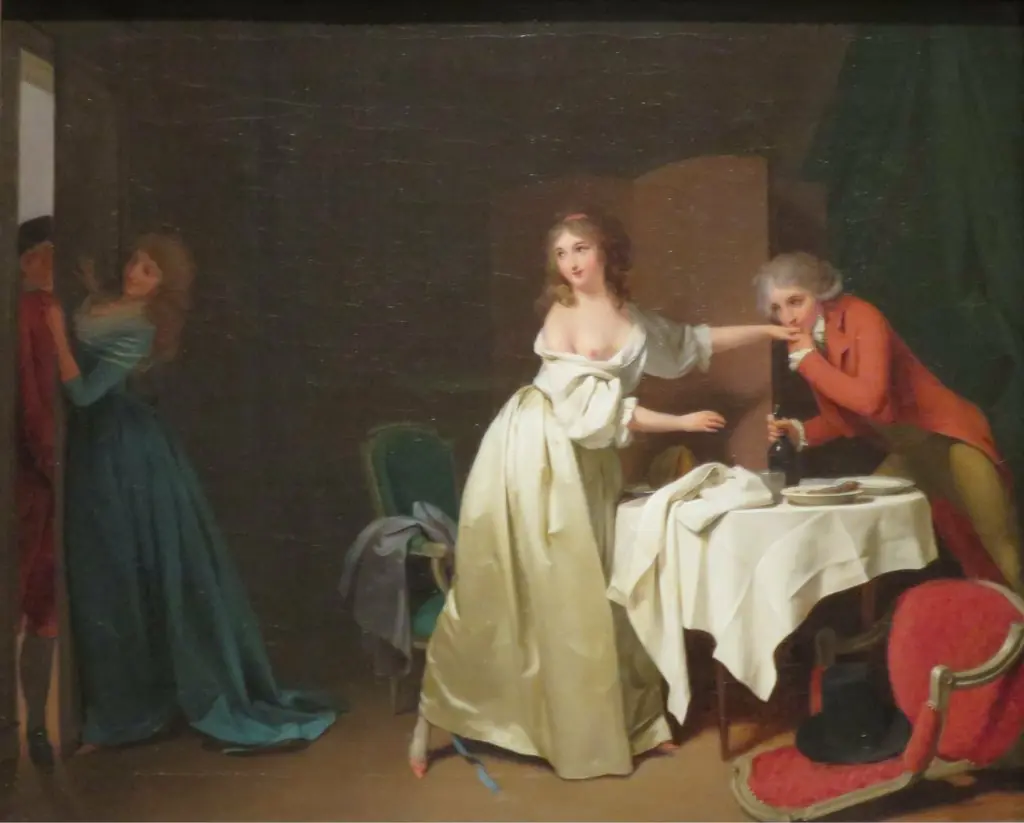
This painting shows a young couple stealing a kiss. It’s small, just 45 by 55 cm, and painted in oils. The scene feels secret and playful, like something out of a private joke.
Fragonard painted it in 1787, right before big changes shook France. Aristocrats loved scenes like this back then, small, pretty, and full of quiet romance.
Want to see more like it? Look up Jean Honoré Fragonard.
Overview
The Stolen Kiss is an oil on canvas painting measuring 45 by 55 centimetres, executed in 1787 and now held in the Hermitage Museum, Saint Petersburg.
The Stolen Kiss is an oil on canvas painting measuring 45 by 55 centimetres, executed in 1787 and now held in the Hermitage Museum, Saint Petersburg. The work occupies a significant place in late eighteenth-century French art as a genre scene that captures the intimate, erotic spirit of the Rococo period on the eve of the French Revolution. Its attribution has been the subject of scholarly debate: traditionally assigned to Jean-Honoré Fragonard, the painting has more recently been reconsidered as a possible collaboration between Fragonard and his sister-in-law and pupil Marguerite Gérard, or even as solely by Gérard. The painting's small scale, polished technique, and clandestine subject matter exemplify the private, pleasure-oriented art commissioned by and for the French aristocracy in the final decades of the ancien régime.
Subject & Meaning
The painting depicts a moment of illicit intimacy: a young woman in a voluminous cream-coloured silk gown with blue accents leans backward through a partially open door, her body angled away from a male figure who embraces her from behind. Only his hands and part of his head are visible, his identity concealed. She extends her left arm to grasp a striped fabric that trails onto a small wooden table beside a yellow upholstered chair. Through the open door, indistinct figures of elegantly clad ladies can be seen, unaware of the encounter. The scene unfolds in a lavish interior with paneled walls, a patterned carpet, dark heavy curtains, and a mirror or framed painting reflecting the distant company. A pink draped cloth hangs near the door frame. The iconography of the stolen kiss draws upon a long tradition of erotic genre painting, with the doorway serving as a threshold between public propriety and private desire. The woman's backward lean suggests both surprise and complicity, while the luxurious surroundings, silk draperies, and floral rug frame the transgression as an aristocratic pastime. The voyeuristic quality of the scene, with its suggestion of secrecy and risk, aligns with Fragonard's known interest in erotic narrative, though the more restrained handling has prompted reconsideration of Gérard's possible authorship.
Technique & Style
The painting is executed in oil on canvas with dimensions of 45 by 55 centimetres, though the French Wikipedia gives a slightly more precise measurement of 45.1 by 54.8 centimetres. The composition is organised along a strong diagonal axis, created by the woman's leaning figure, the trailing shawl, the open balcony door, and the table upon which the fabric rests. This diagonal movement from left to right generates dynamic tension and spatial complexity. The palette centres on creamy whites, deep blues, warm wood tones, and muted reds, with strong chiaroscuro illuminating the figures against a shadowy background. The brushwork displays a smooth, polished finish in the rendering of silk, wood, and fabric, while looser handling appears in the darker areas of the composition. The spatial intersections are notably complex, with contrasts between colours and shadows creating depth. If the hand is Gérard's, the technique may reflect her particular skill in textile and interior detail, learned during her apprenticeship with Fragonard.
History & Provenance
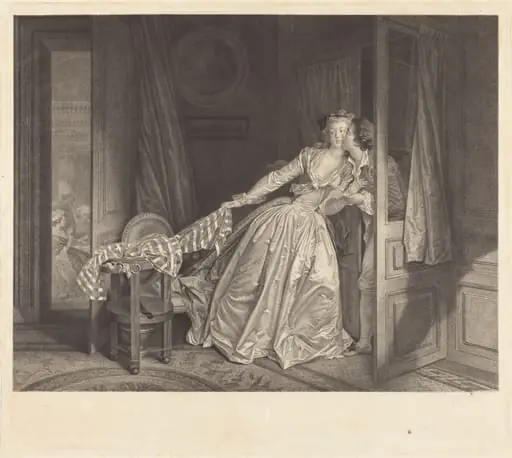
The earliest dated mention of The Stolen Kiss appears in the June 1788 issue of the Mercure de France, where an engraving by Nicolas François Regnault was advertised as a pendant to The Bolt, confirming the painting's existence and attribution to Fragonard by that date. In the 1790s, the work was purchased by Stanisław August Poniatowski, the last monarch of the Polish-Lithuanian Commonwealth, and appeared in the catalogue of the Royal Picture Gallery at the Lazienki Palace in Warsaw in 1795. The circumstances of acquisition remain unclear; it may have been bought at auction selling goods of the French aristocracy following the Revolution of 1789, which would explain both the silence of sources and its thematic divergence from other works in Poniatowski's collection. The king valued the painting highly and wished to take it to Saint Petersburg upon his abdication in 1795, though this shipment never occurred. After Poniatowski's death in 1798, his collection passed to his nephew Józef Poniatowski, then to Józef's sister Maria Teresa, who sold the Lazienki Palace to Tsar Alexander I in 1817, effectively transferring The Stolen Kiss to the Russian imperial collection. The painting remained at the Lazienki Palace until 1895, when imperial collection curator Andrei Somov recommended its transfer to the Hermitage, along with four other paintings from Stanisław August's collection, on grounds of conservation and accessibility. Following Polish independence in 1918, the Polish government pursued diplomatic efforts to recover the painting as national treasure, but Soviet authorities refused, instead compensating Poland with several works of lesser value; in 1922, The Stolen Kiss was specifically exchanged for the smaller Polish Woman, attributed to Jean-Antoine Watteau, now in the National Museum in Warsaw.
Context
The Stolen Kiss emerges from the final phase of Fragonard's career, a period when he produced a series of works dedicated to the theme of the kiss, subjects that appealed to the pleasure-seeking French nobility during the reign of Louis XVI. The painting's genre scene format and its emphasis on domestic intimacy reflect the influence of Dutch Golden Age painting, which Fragonard had studied during a European tour undertaken shortly before this period. The work also participates in the broader Rococo culture of eroticism and romantic folly that dominated French aristocratic taste before the Revolution. In the late nineteenth century, the Goncourt brothers rediscovered Fragonard under a resolutely romantic light, characterising him as a free storyteller, a gallant lover, and a spirit of French wit and almost Italian genius. Yet as the French Wikipedia notes, his career cannot be reduced to such amorous scenes, however much they established his reputation. The attribution debate surrounding The Stolen Kiss reflects larger questions about workshop practice, collaboration, and the status of women artists in the eighteenth century. Marguerite Gérard's possible role, whether as collaborator or sole author, challenges traditional assumptions about the boundaries of Fragonard's oeuvre and invites reconsideration of her own artistic contribution.
Legacy
The Stolen Kiss has endured as a defining image of Rococo eroticism, its small scale and private subject matter emblematic of an art form destined for intimate aristocratic consumption. The painting's afterlife has been shaped by its displacement from Poland to Russia, its role in post-revolutionary restitution disputes, and its continued residence in the Hermitage, where it remains accessible to international audiences. The 1922 exchange for Watteau's Polish Woman represents an early episode in the politics of cultural patrimony, with the Soviet authorities' arbitrary compensation establishing a precedent for contested ownership. Scholarly attention has increasingly focused on the attribution question, with the possible involvement of Marguerite Gérard serving as a case study for recovering the contributions of women artists historically subsumed under male masters' names. The 1788 engraving by Regnault ensured the composition's wider circulation, while the painting itself has become a touchstone for discussions of Rococo sexuality, aristocratic culture, and the fragility of attribution in eighteenth-century French painting.
Own this work as a print
Artist & collection

Artist
Jean-Honoré Fragonard was born on 5 April 1732 in Grasse, the son of a glover, and moved with his family to Paris in 1738.