Artwork
The Snake Charmer
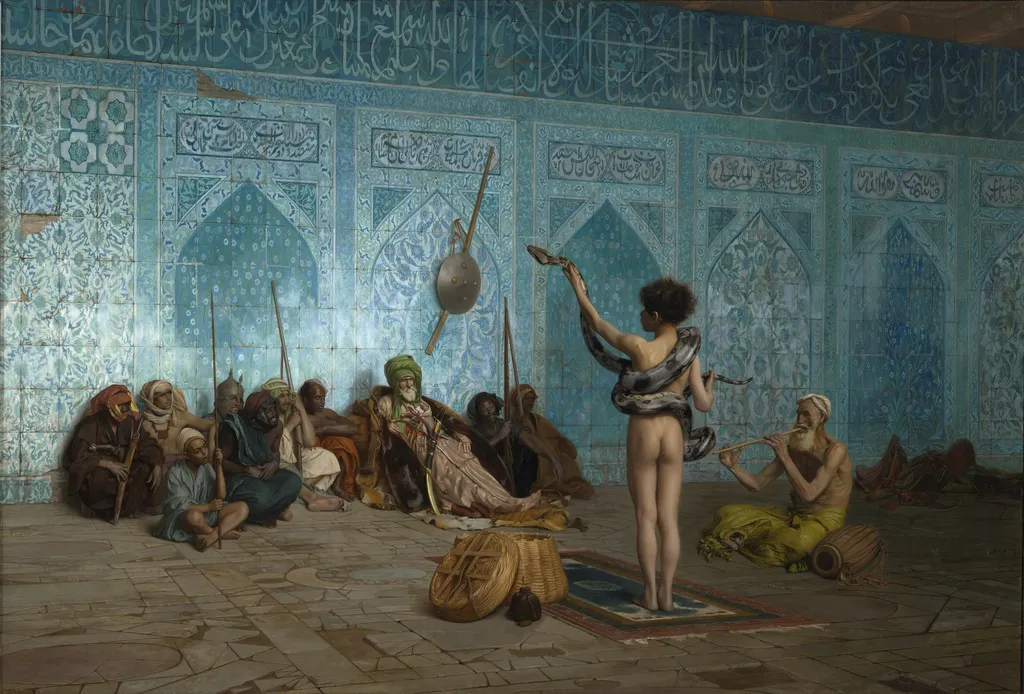
The Snake Charmer is an oil painting by the Academic Art artist Jean Léon Gérôme. It dates from 1890 and is held in the collection of the Clark Art Institute.
About this work
Subject & Meaning
To his right, an older man sits cross-legged playing a fipple flute, while a diverse group of armed men from various Islamic tribes watches the performance.
The painting centers on a nude boy standing on a small carpet, his back to the viewer, holding a python coiled around his waist and over his shoulder. To his right, an older man sits cross-legged playing a fipple flute, while a diverse group of armed men from various Islamic tribes watches the performance. According to Sarah Lees' catalogue essay, the boy's nudity is not an erotic display but a practical measure to forestall accusations of fraud in the act.
The setting is a deliberately hybrid, fictional space blending Ottoman Turkish and Egyptian sources. The blue-tiled walls derive from İznik panels in the Altınyol (Golden Passage) and Baghdad Kiosk of Topkapı Palace in Ottoman Constantinople. A legible frieze across the top bears Qur'anic verse 256 from Surah al-Baqara in thuluth script: "There is no compulsion in religion," followed by a truncated inscription likely dedicated to a caliph.
Herpetologist Richard G. Zweifel noted that the snake resembles a South American boa constrictor, a species Gérôme could have studied at the Jardin des Plantes in Paris, adding another layer of composite invention.
The work has come to embody Western Orientalist fantasy, its shimmering Islamic tiles framing a scene critics describe as a voyeuristic and exploitative vision of "the East," with the python reading as a phallic symbol draped across the youthful performer.
Technique & Style
Executed around 1879, The Snake Charmer is an oil painting on canvas measuring 83.8 by 122.1 centimeters. The work exemplifies the Academic style through its highly finished surface and precise rendering of textures, particularly the shimmering blue İznik tiles that line the background walls. These tiles, inspired by Ottoman architecture, are depicted with intricate calligraphic friezes written in thuluth script.
The composition centers on a nude boy standing with his back to the viewer, holding a large snake that coils around his body; herpetological analysis suggests the reptile resembles a South American boa constrictor more than a local species, highlighting the artist's fabrication of the scene. The figure's nudity is presented not as erotic display but as a practical measure to prove the absence of hidden charms. The surrounding environment combines disparate Egyptian and Turkish elements into a fictional hybrid space, populated by armed men in varied tribal attire watching a flute player.
History & Provenance
Jean Léon Gérôme produced The Snake Charmer as an oil on canvas around 1879. The painting entered the market in 1880, when the artist's dealer Goupil et Cie sold it to the American collector Albert Spencer for 75,000 francs. Spencer disposed of it to Alfred Corning Clark in 1888 for $19,500, and Clark loaned it for display at the 1893 World's Columbian Exposition in Chicago.
After Clark's death, his wife and heir Elizabeth Scriven Clark loaned the work to the Metropolitan Museum of Art before selling it in 1899 to Schaus Art Galleries for $10,000 or $12,000, a transaction that may also have involved an exchange of another artwork. August Heckscher acquired the painting in 1902 for an unknown price. Robert Sterling Clark, son of Alfred Corning Clark, repurchased it in 1942 for just $500, a figure that reflected Gérôme's diminished standing among collectors at mid-century.
Since 1955 the painting has belonged to the Sterling and Francine Clark Art Institute in Williamstown, Massachusetts. It was later included in The Spectacular Art of Jean-Léon Gérôme (1824–1904) at the J. Paul Getty Museum in 2010 and at the Musée d'Orsay in 2010–2011.
The Snake Charmer has been held in the collection of the Sterling and Francine Clark Art Institute in Williamstown, Massachusetts, since 1955. Its ownership history includes sales from the artist's dealer Goupil et Cie to Albert Spencer in 1880, then to Alfred Corning Clark in 1888, and a repurchase by Robert Sterling Clark in 1942. During its time with the Clark family, the work was loaned to the World's Columbian Exposition in Chicago in 1893 and exhibited at the Metropolitan Museum of Art prior to its sale in 1899.
In modern times, the painting was featured in the exhibition The Spectacular Art of Jean-Léon Gérôme (1824–1904), which opened at the J. Paul Getty Museum in 2010 before traveling to the Musée d'Orsay for the 2010–2011 season.
Context
The Snake Charmer (1879) exemplifies Jean‑Léon Gérôme’s academic orientalist practice, combining meticulous draftsmanship with a fabricated Near Eastern setting drawn from Ottoman and Egyptian sources. Its depiction of a nude boy beside a coiled python, framed by blue Iznik‑style tiles inscribed with a legible Qur’anic verse, reflects scholarly analyses of the work’s hybrid geography and the model’s nudity as a stratagem to pre‑empt accusations of fraud;. The painting entered the Clark collection in 1955 after a tumultuous provenance that includes a sale from Goupil et Cie in 1880 and a 1978 use as the cover of Edward Said’s Orientalism, a moment that elevated its status as an emblem of Western Orientalist critique.
Critics such as Jonathan Jones have condemned it as a “sleazy imperialist vision,” while art historians continue to discuss its role in the historiography of Orientalist art.
Legacy
Following its use on the cover of Edward Said's 1978 book Orientalism, The Snake Charmer achieved a level of notoriety rare among Orientalist paintings. Although Said focused on textual representations and did not explicitly discuss the work, the image became a primary focal point for subsequent critiques of Orientalist art and the broader concept of Orientalism. Critics such as Jonathan Jones have characterized the painting as a pernicious, exploitative Western fantasy that exemplifies the imperialist vision Said analyzed, effectively making Gérôme a poster boy for the movement's controversies.
The work's reputation shifted dramatically alongside market trends; once sold for a mere $500 in 1942 due to the artist's fall from favor, it later regained prominence through major exhibitions at the Getty Museum and Musée d'Orsay in 2010.
Overview
Jean-Léon Gérôme's The Snake Charmer, an oil-on-canvas painting from around 1879, depicts a performance in a dimly lit, tiled room. This work, now housed at the Sterling and Francine Clark Art Institute, gained significant attention decades after its creation. It later became a prominent visual reference in discussions surrounding Western representations of the Middle East, particularly within the context of Orientalism.

Own this work as a print
Artist & collection

Artist
Jean-Léon Gérôme was a French painter and sculptor in the style now known as academicism.