Artwork
The Slave Market
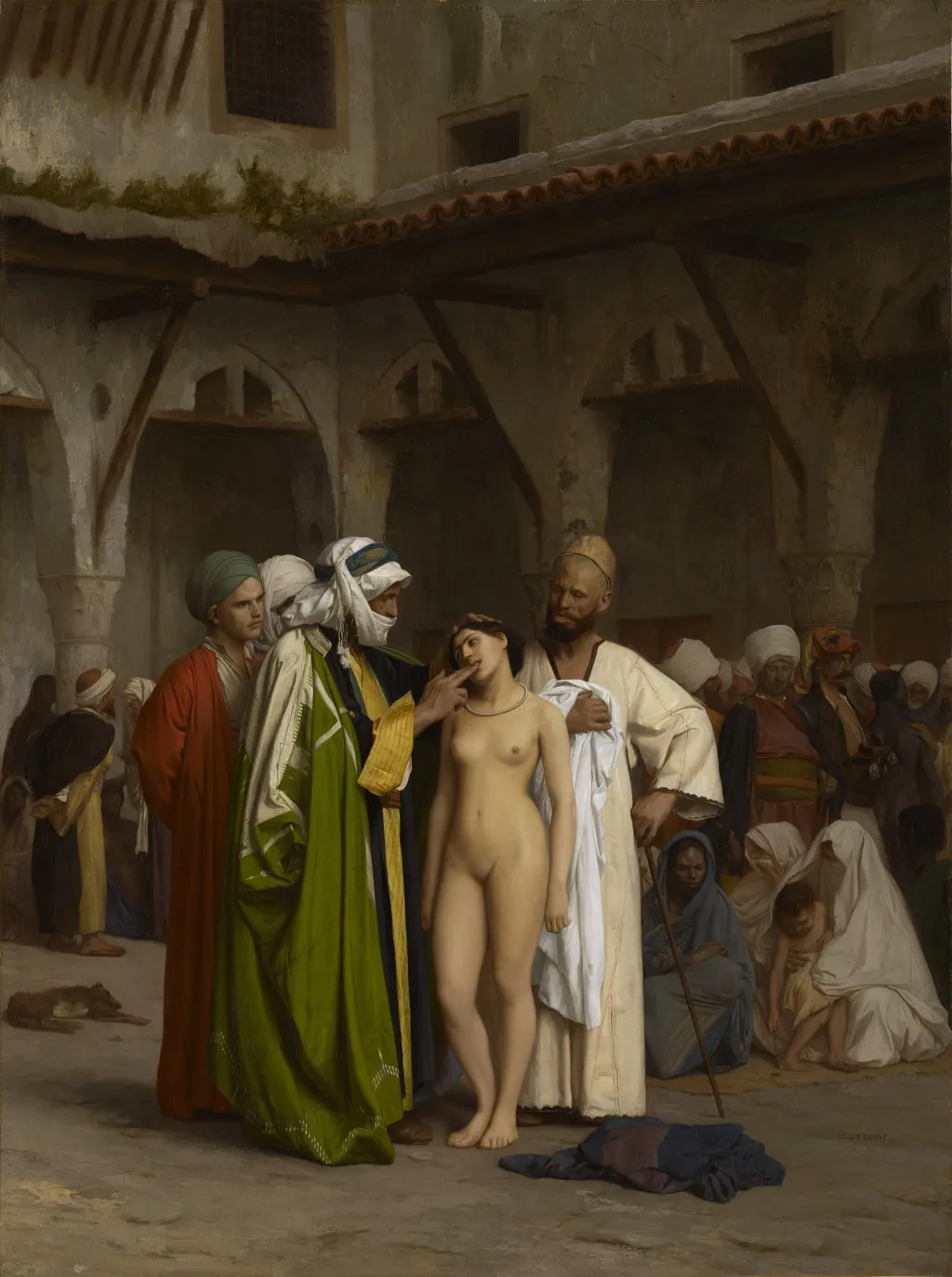
The Slave Market is an oil painting by the Academic Art artist Jean Léon Gérôme. It dates from 1866 and is held in the collection of the Clark Art Institute.
About this work
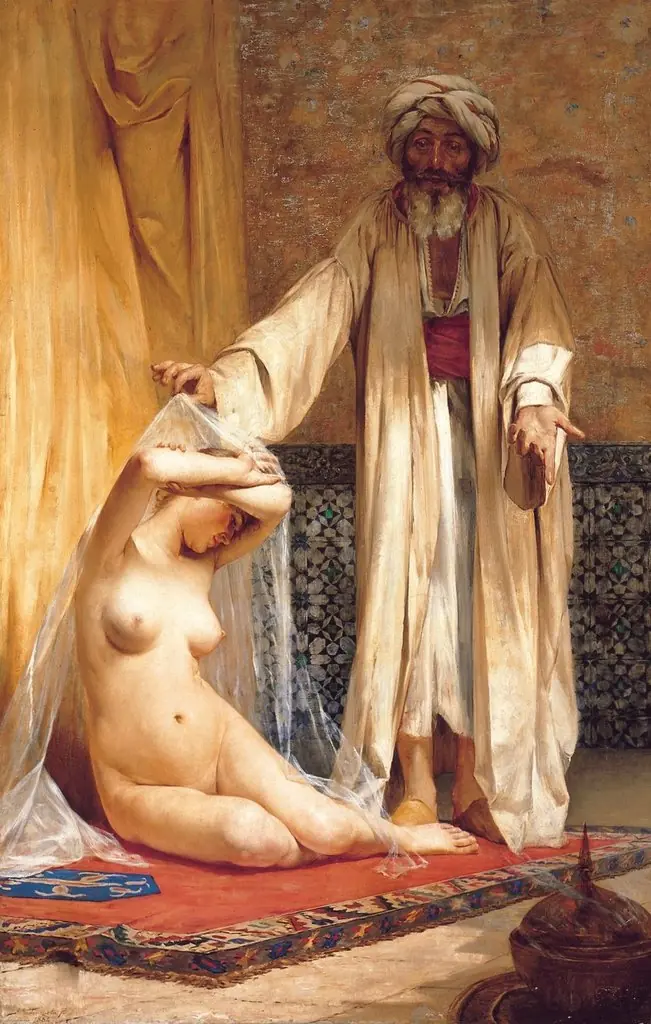
This painting shows a sale scene from long ago. A man checks a woman’s teeth before buying her. It’s an oil painting by Jean Léon Gérôme from 1866.
The artist set it in West Asia or North Africa during the Barbary slave trade. The woman’s nudity and the merchant’s gaze make the moment tense.
If this grabs you, look up the Clark Art Institute.
Subject & Meaning
Critics have noted the woman's ivory-like skin and lack of body hair, presenting her nudity as a posed state normal for a harem concubine.
Painted in 1866, this work depicts a scene of the Barbary slave trade set in an unspecific West Asian or North African courtyard. The central figure is a nude Abyssinian woman standing in a pose of fatalistic passivity while a potential buyer inspects her teeth, a gesture likened to livestock evaluation. She is flanked by a dark-skinned merchant holding a staff and cloth, emphasizing her status as commodified human property. In the background, other figures inspect a nude dark-skinned male slave, creating a racial and gendered contrast.
The painting functions as an iconic example of Orientalism, reflecting sexualized European fantasies rather than historical reality. Critics have noted the woman's ivory-like skin and lack of body hair, presenting her nudity as a posed state normal for a harem concubine. The composition juxtaposes clothed, dominant men against vulnerable, naked bodies to explore themes of power, ownership, and the objectification of women within the imagined Muslim world.
Technique & Style
The Slave Market is an oil on canvas painting measuring 84.8 × 63.5 cm. Gérôme executed the work with the fine, detailed brushwork characteristic of academic painting, rendering individual stones in the foreground, the textures of fabrics, and facial features with meticulous precision. The lighting is theatrical and frontal, as if the scene were stage-lit from the front rather than by natural overhead sunlight, casting shadows that fall diagonally to the left.
The composition centers on a nude female slave presented in frontal view, flanked by clothed male figures. The woman is depicted with no body hair and pale, ivory-like skin, a quality noted by contemporary critic Paul Mantz. The male figures wear Orientalist costume, turbans, kaftans, and draped fabrics in ocher, green, and gold tones.
The background architecture of columns, arches, and light-colored masonry suggests an indeterminate Middle Eastern or North African setting, populated by additional figures including veiled women and another enslaved male figure in the distance.
History & Provenance
The Slave Market, an 1866 oil on canvas by Jean-Léon Gérôme, was painted in Paris and first shown at the Salon of 1867. Goupil purchased the work on 23 August 1866 and it changed hands several times before Robert Sterling Clark acquired it in 1930. The painting entered the Clark Art Institute's collection in Williamstown, Massachusetts, in 1955 and measures 84.8 × 63.5 cm.
In 2019, the artwork garnered renewed attention when the German political party Alternative for Germany used it in an election advertisement. The Clark Art Institute publicly denounced this usage, citing the exploitative and racist framing of the image in the campaign material.
Context
The Slave Market (1866) occupies a central place in Jean-Léon Gérôme's sequence of slave-market scenes and in nineteenth-century Orientalist genre painting more broadly. The work's Salon debut in 1867 drew critical notice from Maxime Du Camp, who claimed the scene was painted "on the spot" in Cairo's slave market and praised Gérôme's rendering of the Abyssinian slave's "fatalistic passivity."
Scholars situate the picture within Gérôme's wider production of Near Eastern subjects, noting its continuity with his related slave-market and harem scenes, which progressively foreground racialized bodies and markets. The painting's staged lighting, meticulous costume detail, and the vendor's stick, read as a tool of coercion, reflect Gérôme's Academic method and the genre's characteristic conflation of fantasy with pseudo-documentary effect.
Legacy
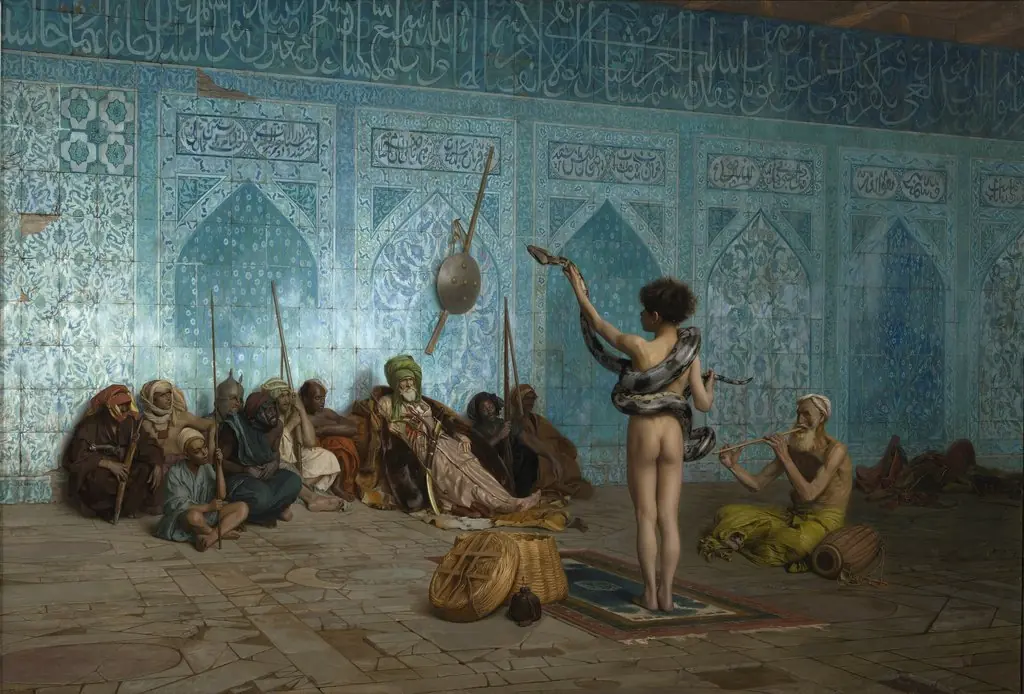
The Slave Market has become an iconic example of nineteenth-century Orientalist art, frequently cited alongside Gérôme's The Snake Charmer. Contemporary reception included Maxime Du Camp's 1867 review, which praised the work's perceived authenticity, while the cartoonist Cham parodied the tooth-inspection motif in Le Charivari that same year. The painting's reputation has evolved to encompass significant controversy regarding its racial and sexual implications.
In 2019, the German right-wing party Alternative for Germany utilized the image in a political campaign with racist slogans, prompting a strong denunciation from the Clark Art Institute. This modern appropriation highlights the work's enduring, albeit contentious, presence in public discourse beyond its original academic context.
Overview
Jean-Léon Gérôme's 1866 oil painting, The Slave Market, portrays a scene from the Barbary slave trade. Set in a North African or West Asian locale, the work depicts a potential buyer examining the teeth of a nude Abyssinian woman, who is presented as a slave for sale. This painting exemplifies Gérôme's detailed approach to historical and ethnographic subjects, characteristic of his oeuvre.
Own this work as a print
Artist & collection

Artist
Jean-Léon Gérôme was a French painter and sculptor in the style now known as academicism.