Artwork
Three Scenes on the Road to Calvary
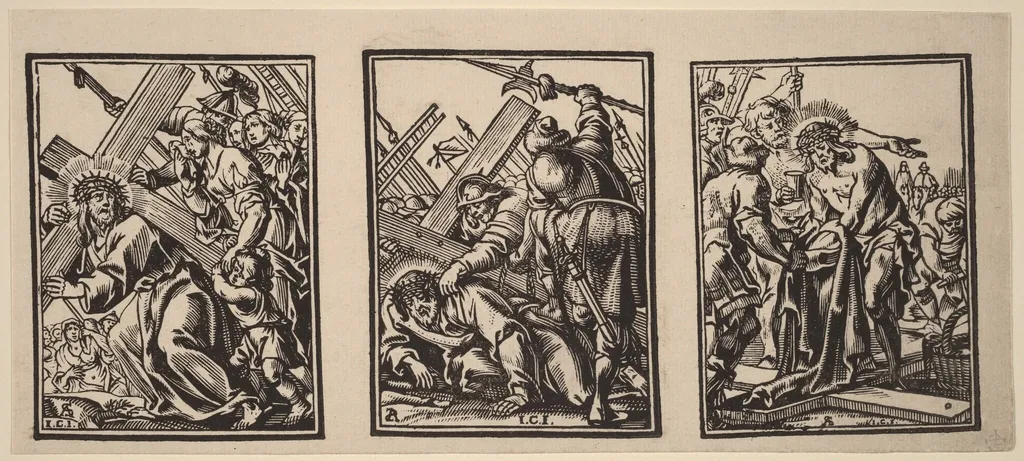
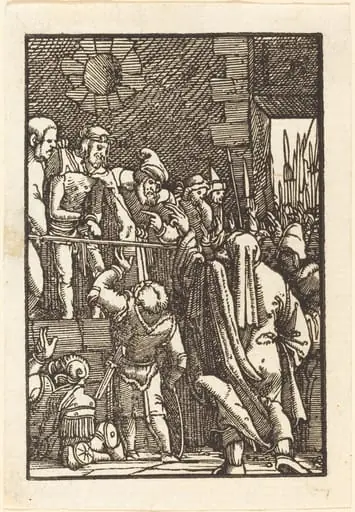
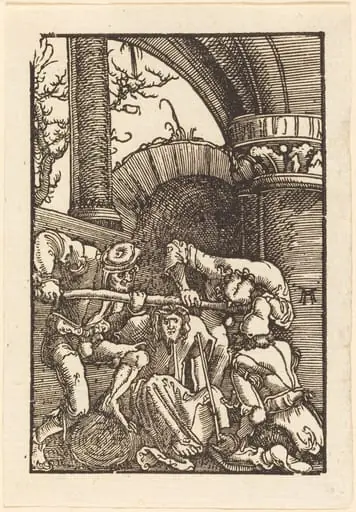
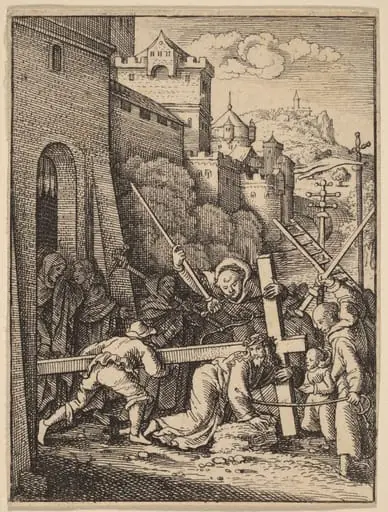
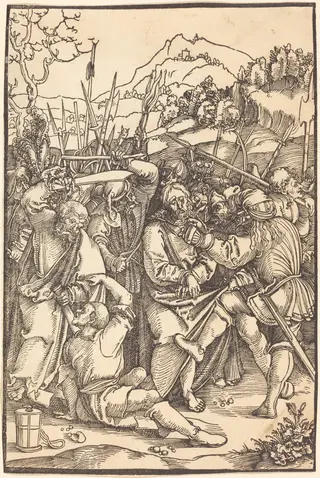
Three Scenes on the Road to Calvary is an ink print by the Renaissance artist Christoffel Jegher. It dates from 1649 and is held in the collection of the National Gallery of Art.
- Inscription
- Inscribed:lower left of first two scenes: AS (in monogram); lower center of third scene: AS (in monogram); lower left of first scene: I.C.; lower center of second and third scenes: I.C.; by later hand, center verso in graphite: Chr. Jegher / N. M. I 1239 / Th-Becker XVIII / Hzb Sallaert 5 / Wzb. p. 754 …
About this work
Overview
This series exemplifies the Flemish Baroque interest in emotional intensity and detailed narrative storytelling translated into the graphic arts.
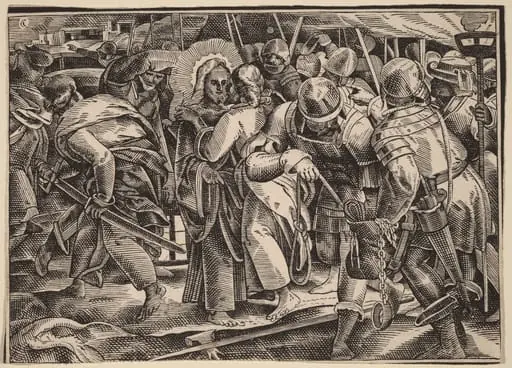
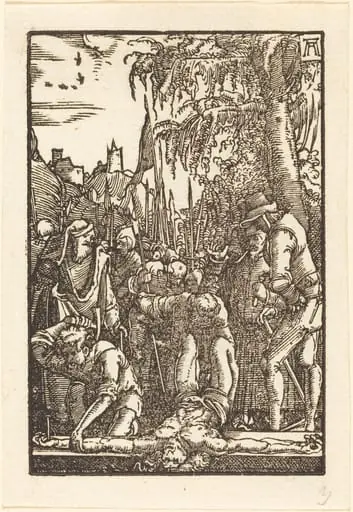
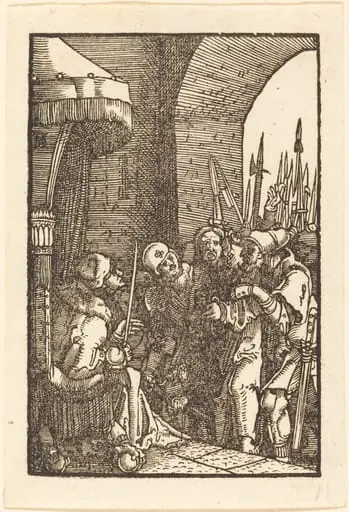
Created in 1649, Three Scenes on the Road to Calvary is a set of three woodcuts by the Flemish artist Christoffel Jegher. Executed on laid paper as uncut proofs, these prints belong to a larger series of forty illustrations depicting the Passion of Christ. The work captures three sequential, dramatic episodes along the path to Golgotha.
The left panel portrays a group of figures straining under the weight of heavy wooden beams, with some kneeling and others pushing from behind. The central scene depicts two men carrying a limp body on a stretcher, observed by a crowd of onlookers. The rightmost section continues the narrative progression of the journey.
Jegher, primarily known as a printmaker who collaborated extensively with Peter Paul Rubens, utilized the woodcut medium to render complex figures and dynamic movement with high contrast. This series exemplifies the Flemish Baroque interest in emotional intensity and detailed narrative storytelling translated into the graphic arts. The 1649 date places the work in the later period of Jegher's career, reflecting his mature style in interpreting religious themes through the lens of contemporary Baroque aesthetics.
Subject & Meaning
The leftmost print portrays a crowd laboring with massive wooden beams, some kneeling while others push, suggesting the weight of the crucifixion’s burden. The central image shows two men bearing a limp figure on a stretcher, surrounded by onlookers, evoking the transport of Christ’s body. The rightmost scene features a robed woman holding a child as a soldier watches, hinting at the human cost and witness of the events.
Technique & Style
Executed in black ink on laid paper, the woodcuts rely on stark contrasts and sharply cut lines to define figures. Jegher’s approach emphasizes angular, rigid forms that convey tension despite the flat medium. Subtle variations in hatching create a sense of depth and movement, while the minimal background focuses attention on the gestures and interactions of the characters.
History & Provenance
These three prints belong to a set of forty uncut proofs produced by Jegher, a noted collaborator of the Antwerp publisher Plantin. The series was likely intended for devotional use or as illustrative material for printed books. Surviving examples are held in several European collections, reflecting the work’s circulation among 17th‑century religious print markets.
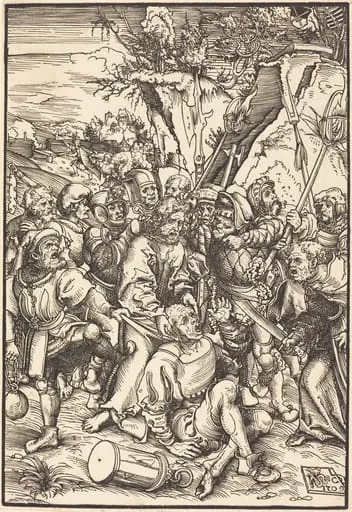
Artist & collection


 The Infant Christ and Saint John Playing with the Lamb
 Silenus Accompanied by a Satyr and a Faun
 Printer's Device for the Plantin Press
 The Garden of Love
 Vignette for the Title Page of C. Peregrino, Principes Hollandiae et Zelandiae
 Coronation of the Virgin
 The Temptation of Christ by the Devil
 Hercules Fighting the Fury and the Discord