Artwork
Psyke, der nærmer sig den sovende Amor
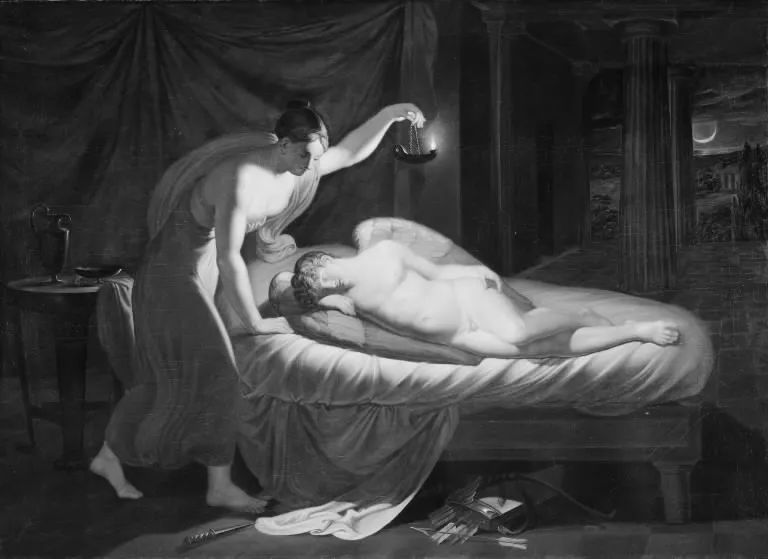
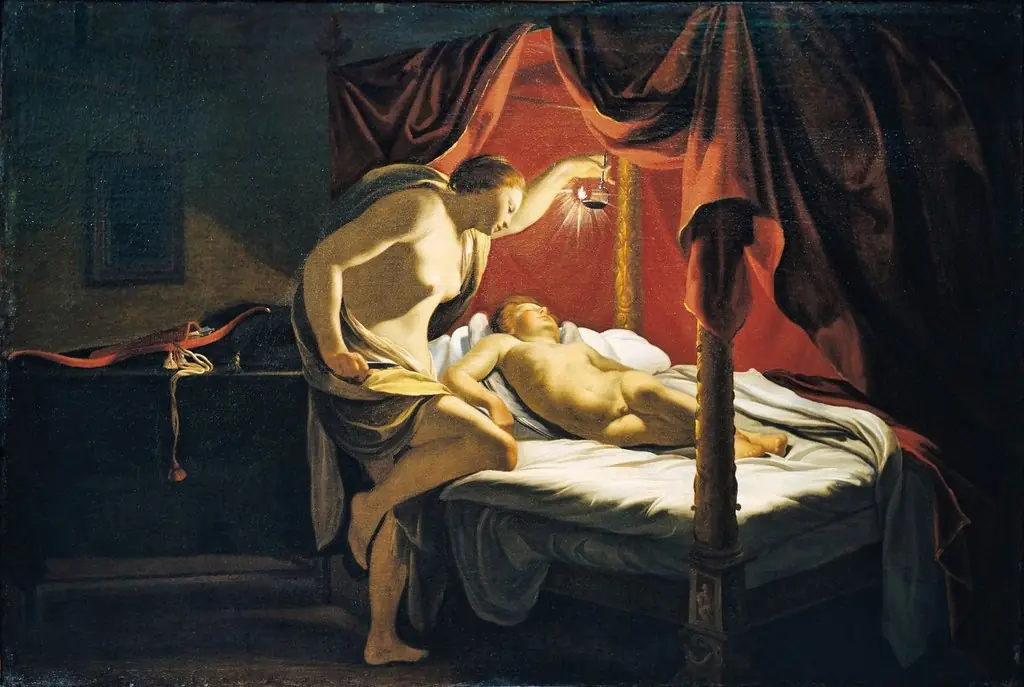
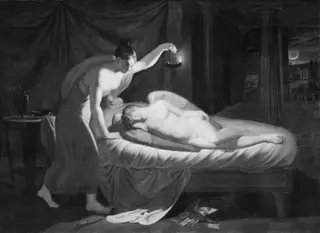
Psyke, der nærmer sig den sovende Amor is an oil painting by the German Romanticist artist Johann Georg Wahl. It dates from 1808 and is held in the collection of the Statens Museum for Kunst.
About this work
Subject & Meaning
Psyche, depicted with delicate features, embodies the soul's yearning, while Cupid's slumber signifies vulnerability and the latent power of desire.
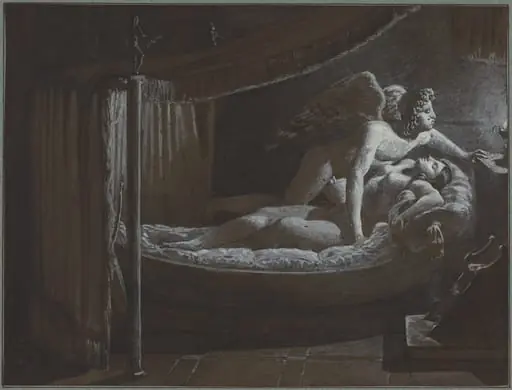
The painting portrays the mythological moment of Psyche approaching the sleeping Cupid, drawing on classical mythology to symbolize love's transformative journey. Psyche, depicted with delicate features, embodies the soul's yearning, while Cupid's slumber signifies vulnerability and the latent power of desire. The composition emphasizes the intimate encounter between mortal and divine, reflecting themes of longing, spiritual ascent, and the allegorical triumph of love over adversity.
Measured at 1450.0 cm in width and 1045.0 cm in height, the large-scale canvas underscores the grandeur of neoclassical mythological painting.
The work is housed in the Statens Museum for Kunst, where it remains part of its permanent collection of European art.
Technique & Style
The painting Psyke, der nærmer sig den sovende Amor is executed in oil on canvas, measuring 1045 cm in height by 1450 cm in width. It depicts the mythological scene of Psyche approaching the sleeping Cupid, rendered with the formal precision characteristic of neoclassical mythological painting. The work is part of the collection at the Statens Museum for Kunst, where it remains on display.
History & Provenance
Painted in 1808 by Johann Georg Wahl, the work was executed in oil on canvas and depicts the classical subject of Cupid and Psyche.
The painting entered the national collection when it was acquired by Statens Museum for Kunst, Copenhagen, where it has remained in continuous public ownership since receipt.
Johann Georg Wahl's 1808 oil painting Psyke, der nærmer sig den sovende Amor is held in the collection of the Statens Museum for Kunst in Copenhagen. The work depicts the mythological figures Cupid and Psyche and is executed on canvas with dimensions of 104.5 cm in height and 145 cm in width. While the artwork is confirmed as part of the museum's holdings, the provided sources do not specify a unique inventory or accession number, nor do they list any past or future exhibition history for this specific piece.
Legacy
Psyke, der nærmer sig den sovende Amor has been recognized for its role in shaping mythological painting in early 19th-century European art. The work, created by Johann Georg Wahl in 1808, depicts the moment when Psyche approaches the sleeping Cupid, drawing on classical mythological themes with a focus on emotional nuance and delicate chiaroscuro. Its composition influenced later interpretations of Psyche and Cupid in Romantic-era art, particularly in Northern European academic circles where mythological subjects were reimagined through heightened psychological realism.
The painting’s technical precision and symbolic depth contributed to renewed scholarly interest in Wahl’s body of work during the late 20th century, leading to increased exhibitions and academic discussion of his contribution to neoclassical mythological painting.
The piece remains part of the permanent collection at Statens Museum for Kunst, where it continues to be cited in studies of 1800s mythological painting and 19th-century European art movements.
Overview
Johann Georg Wahl's 1808 oil painting, 'Psyche Approaching the Sleeping Amor,' depicts a pivotal moment from Apuleius's 'The Golden Ass.' The composition centers on Psyche, dressed in a long, flowing robe, leaning over the sleeping form of Cupid (Amor). She holds a lit oil lamp aloft, casting a focused, dramatic illumination on the god's face while the surrounding chamber remains in deep shadow.
Heavy curtains frame the background, and a crescent moon is visible through a window, reinforcing the nocturnal setting. This work exemplifies the Danish Golden Age's engagement with Neoclassical mythology, blending precise anatomical study with a romantic, atmospheric mood. Created during the final years of Wahl's brief career, the painting reflects the period's interest in psychological tension and the sublime.
The artist captures the narrative climax where Psyche's curiosity leads to the accidental wounding of Amor, a theme that allowed Wahl to explore contrasts between light and dark, as well as the vulnerability of the divine figure. The work stands as a significant example of early 19th-century Danish mythological painting, demonstrating the artist's skill in rendering emotional narrative through chiaroscuro and careful composition.
Context
The work aligns with a broader European fascination with mythological subjects during the period, when artists frequently revisited ancient narratives to explore contemporary ideas of emotion and morality. Wahl’s rendering of Psyche’s secretive act mirrors the era’s interest in personal introspection within the framework of classical storytelling.
Artist & collection