Artwork
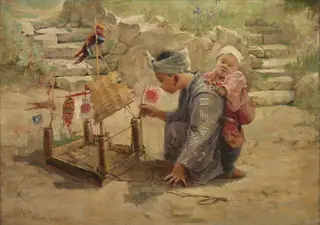
Japanese Boy Building a Man-of-War
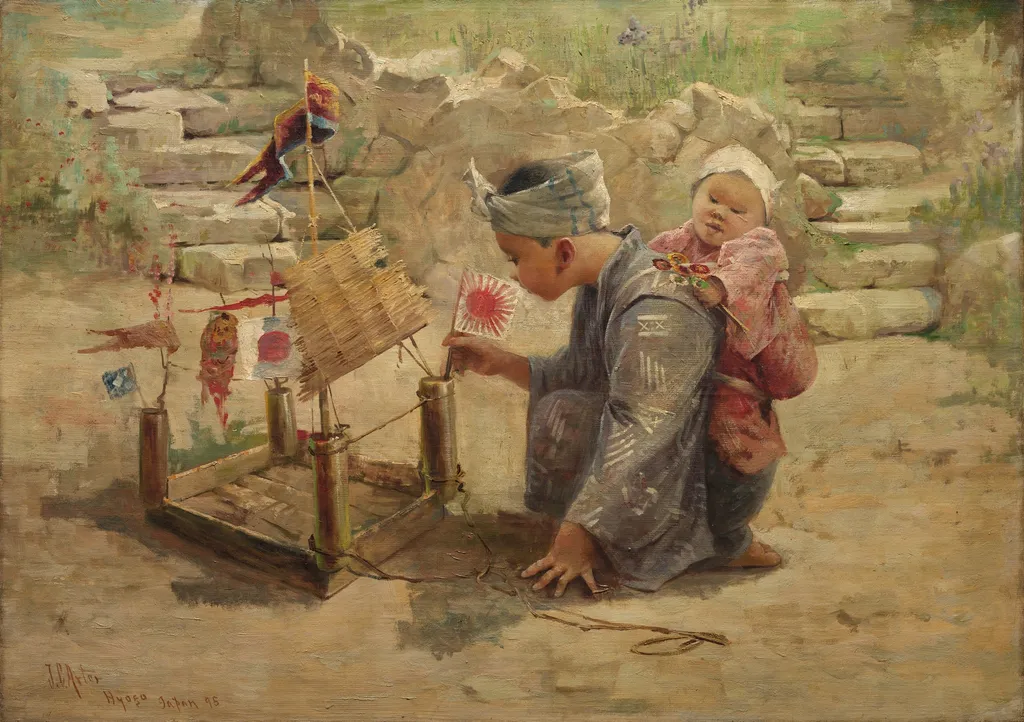
Japanese Boy Building a Man-of-War is an oil painting by the British Romanticist artist John Charles Arter. It dates from 1898 and is held in the collection of the Cleveland Museum of Art.
About this work
Technique & Style
The work is executed in oil on canvas, a support typical of late‑19th‑century American academic practice.
The work is executed in oil on canvas, a support typical of late‑19th‑century American academic practice. Created in 1895 in the United States, it measures roughly 56 × 79 cm and belongs to the history‑painting genre, reflecting Arter’s interest in narrative subjects. The composition portrays a Japanese boy engaged in constructing a miniature man‑of‑war, rendered with careful attention to anatomical detail and realistic lighting that aligns with the conventions of historical genre painting of the period. The painting was acquired by the Cleveland Museum of Art, where it remains on view.
History & Provenance
John Charles Arter's 1895 oil painting, Japanese Boy Building a Man-of-War, is held in the permanent collection of the Cleveland Museum of Art in Cleveland, United States. The work is cataloged under the accession number 1920.752. While the source material confirms the painting's current location and inventory details, it does not provide a record of specific exhibitions where the piece has been displayed. The artwork, classified as genre art, depicts a boy and was created in the United States.
Context
John Charles Arter painted Japanese Boy Building a Man-of-War in 1895, an oil on canvas work measuring roughly 56 × 79 cm. The painting is categorized as a history painting and was produced in the United States, reflecting the late‑19th‑century American academic interest in historical and genre subjects. Arter (1859–1923) built his reputation on such narrative scenes, often depicting idealized episodes from Japanese and American history. The work’s inclusion in the Cleveland Museum of Art collection underscores its significance as an example of period‑specific genre art that blends exotic subject matter with realist technique, positioning it within the broader discourse of transnational historical painting in the era.
Overview
John Charles Arter's oil painting, Japanese Boy Building a Man-of-War, was completed in 1898. This work depicts a young boy engaged in construction, likely of a toy vessel or kite, set against a natural backdrop. The painting is part of the collection at The Cleveland Museum of Art, representing a moment of focused childhood activity.
Subject & Meaning
The painting centers on a boy, clad in a striped shirt and hat, kneeling on the ground. He intently manipulates a wooden frame adorned with striking red paper shapes, which resemble flags or kites, suggesting the construction of a miniature ship or flying object. A smaller child observes his efforts, while a sparse hillside with scattered rocks and a bird perched on a pole forms the background, grounding the scene in a simple, outdoor setting.
Own this work as a print
Artist & collection