Artwork
Newport Rocks

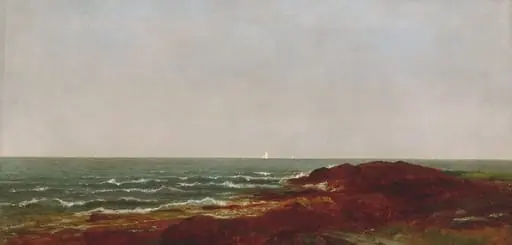
Newport Rocks is an oil painting by the Hudson River School artist John Frederick Kensett. It dates from 1872 and is held in the collection of the Metropolitan Museum of Art.
About this work
Subject & Meaning
Kensett’s rendering captures the luminous atmosphere and geological detail of the site, inviting viewers to contemplate the grandeur of nature.
The painting Newport Rocks portrays a coastal vista, presenting a sweeping view of the shoreline and rock formations. As a landscape, it foregrounds natural topography rather than narrative or allegorical content, emphasizing the aesthetic appreciation of the American environment in the late 19th century. Kensett’s rendering captures the luminous atmosphere and geological detail of the site, inviting viewers to contemplate the grandeur of nature.
The work’s iconography is limited to the physical features of the coast, serving as a visual record of a specific locale within the broader tradition of American landscape painting. This interpretation draws directly from source descriptions identifying the piece as a landscape painting.
History & Provenance
John Frederick Kensett's 1872 oil painting Newport Rocks is held in the collection of the Metropolitan Museum of Art, where it is classified within the American Wing. The work, measuring 78.7 cm in height and 121.9 cm in width, is cataloged as a landscape painting executed in oil on canvas. While the specific inventory or accession number is not detailed in the provided records, the museum maintains the piece as part of its permanent holdings.
The sources do not contain information regarding a specific exhibition history or past display dates for this particular artwork, limiting the record to its current institutional location and physical attributes.
Overview
Newport Rocks, painted by John Frederick Kensett in 1872, depicts a serene coastal scene on a small island in Rhode Island during the final year of the artist's life. The composition features a quiet stretch of ocean where pale blue water meets pinkish granite formations under a soft, hazy sky that suggests early morning light. Executed in oil on canvas, the work exemplifies Kensett's mature Luminist style, characterized by a refined palette and an emphasis on atmospheric clarity.
Unlike his earlier, more detailed Hudson River School landscapes, this late work displays a looser handling of paint; the artist left the edges of the canvas rough, revealing the underlying pencil sketch lines. This unfinished quality reflects a shift toward a more immediate, impressionistic approach to capturing the fleeting effects of light and atmosphere. As one of Kensett's final creations, Newport Rocks stands as a significant testament to his enduring focus on the New England coast and his evolution toward a simplified, meditative aesthetic that prioritizes the emotional resonance of the landscape over topographical precision.
Technique & Style
Kensett's working method is apparent in Newport Rocks, where the painting retains a sense of unpolished immediacy. The artist left the composition's edges somewhat rough, and faint pencil lines from his initial sketch remain visible beneath the oil layers. This deliberate rawness contributes to the artwork's authenticity, presenting the viewer with a direct and honest impression of the coastal setting rather than a highly finished, picturesque view.
Artist & collection

Artist
John Frederick Kensett was an American landscape painter and engraver born in Cheshire, Connecticut.