Artwork
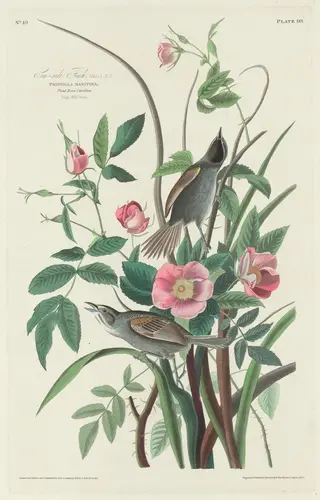
Sharp-Tailed Finch
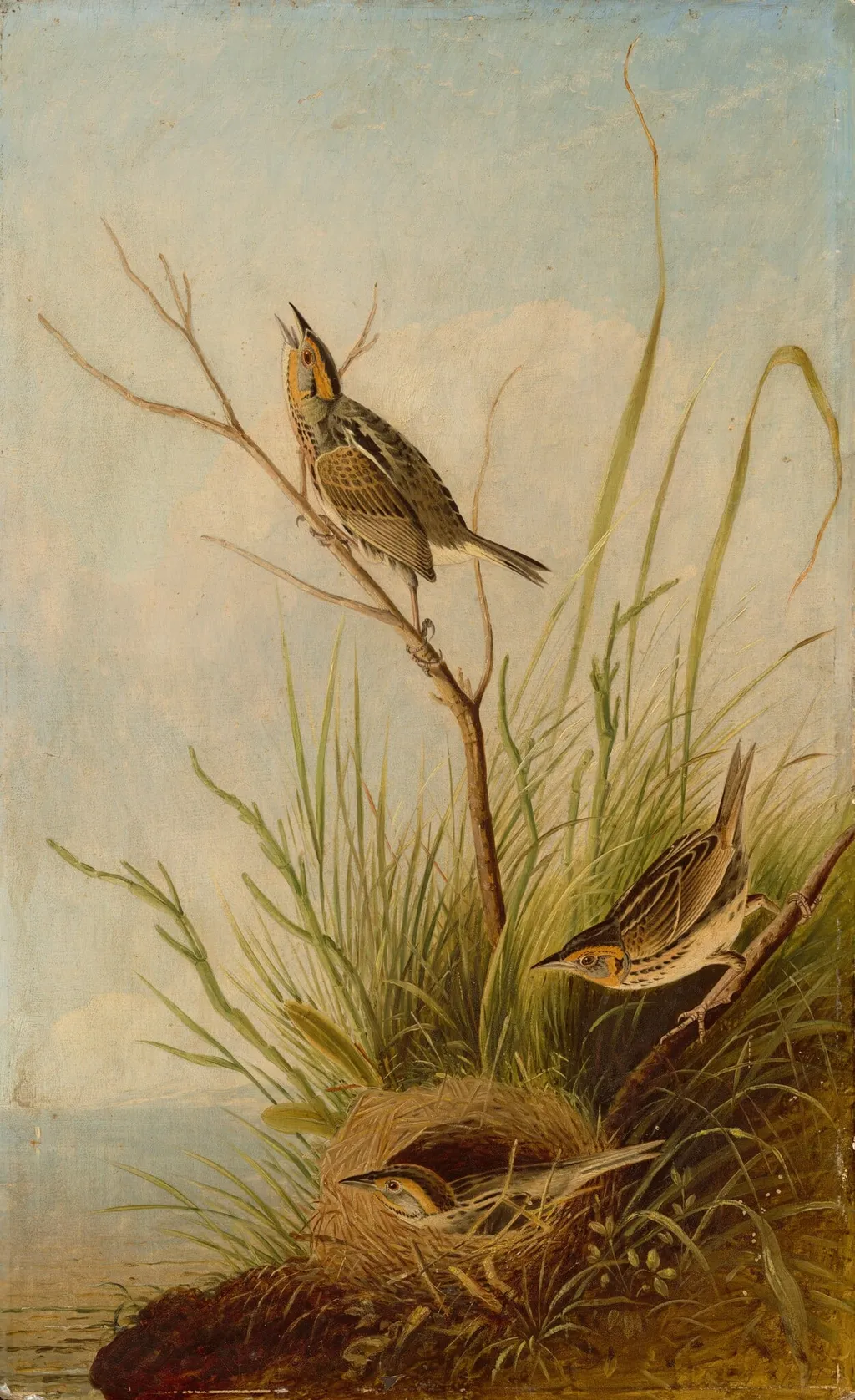
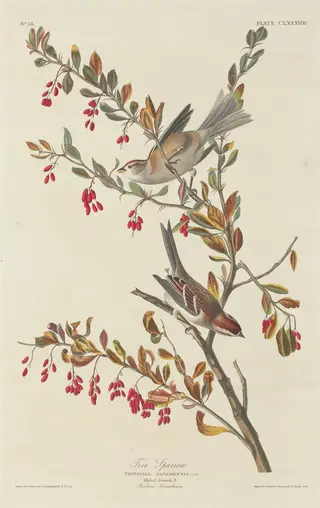
Sharp-Tailed Finch is an oil painting by the Romanticist artist Joseph Bartholomew Kidd. It dates from 1832 and is held in the collection of the National Gallery of Art.
About this work
Overview
9 centimeters, the work is held by the National Gallery of Art in Washington, D.
Sharp-Tailed Finch is a pencil and oil on millboard painting by the Scottish artist Joseph Bartholomew Kidd, executed in 1831 after designs by the American naturalist and painter John James Audubon. Measuring 48.3 by 29.9 centimeters, the work is held by the National Gallery of Art in Washington, D.C., where it entered the collection in 1951 as a gift from E.J.L. Hallstrom. The painting occupies a significant place in the history of American natural history art as one of the oil copies Kidd produced during his contracted work for Audubon, a project that bridged British landscape painting traditions and American ornithological illustration.
Technique & Style
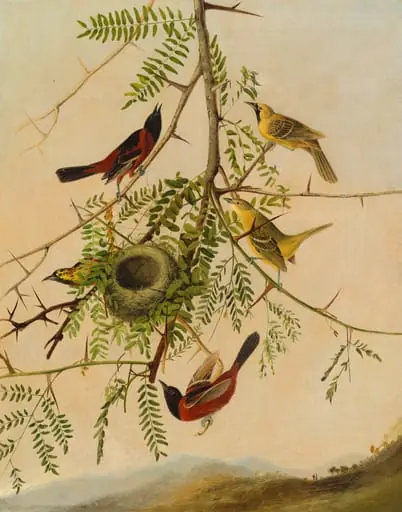
Kidd executed the work in pencil and oil on millboard, a support that provided a rigid, smooth surface suited to the detailed rendering required for natural history subjects. The overall dimensions are 48.3 by 29.9 centimeters, with the framed piece measuring 58.3 by 39.9 by 1.9 centimeters. The brushwork is smooth and detailed on the birds and nest, contrasting with looser handling in the grass and sky. Light enters from above and slightly left, casting subtle shadows beneath the birds and branches and lending the scene a sense of natural illumination. The palette is restrained, consisting of muted blues, greens, browns, and warm yellow tones. This combination of meticulous finish on the avian subjects with freer background treatment reflects Kidd's training in British landscape traditions and his adaptation to Audubon's demands for scientifically accurate yet aesthetically composed images.
History & Provenance
The painting was created in 1831 for John James Audubon as part of Kidd's commission to produce oil copies of Audubon's bird drawings. The provenance traces a remarkable transcontinental journey. After Audubon's death in 1851, the work descended through his family to his great-great-grandson Leonard Benjamin Audubon in Sydney, Australia. The transfer to Australia occurred when William Bakewell Audubon, John James Audubon's grandson, emigrated in either 1880 or 1882, bringing family paintings with him; family correspondence indicates the works were sent to Australia around 1899 or 1900, following the death of Caroline Hall Audubon in February 1899. Leonard Benjamin Audubon sold the painting in 1950 to E.J.L. Hallstrom, a Sydney collector and industrialist, who gifted it to the National Gallery of Art in 1951. The accession number is 1951.9.5. The painting was exhibited at the Audubon Centennial Exhibition in New York in January-February 1951 as The Sharp-Tailed Sparrow, and later that year in Washington, D.C. It was shown at Kennedy Galleries in New York in 1954 for a benefit exhibition, and was on extended loan to the White House from 1969 to 1978, and subsequently to CIA Director William J. Casey from 1981 to 1987.
Context
Joseph Bartholomew Kidd was born in 1808, probably in Edinburgh, and trained under the Reverend John Thomson of Duddingston. He was a founder Associate of the Royal Scottish Academy in 1826 and became a full Academician in 1829. In 1830, Audubon commissioned Kidd to paint copies of one hundred of his bird drawings, but Kidd's dilatoriness caused Audubon to terminate the arrangement in December 1833. The Sharp-Tailed Finch thus belongs to the brief but significant period of their collaboration. Kidd's practice as a landscape painter in Edinburgh continued until about 1835, when he sailed to Jamaica, where he remained with interruptions until 1843. He resigned from the Royal Scottish Academy in 1838, and after returning to Britain in 1843, he settled in Greenwich as a drawing master until his death in May 1889. Scholarly literature on the work includes Waldemar H. Fries's 1963 study of Kidd and Audubon's oil paintings, and John Hayes's 1992 catalogue entry in the National Gallery's systematic catalogue of British paintings. The painting has been catalogued under variant titles, including Sharp-Tailed Sparrow, reflecting taxonomic uncertainties or shifts in nomenclature.
Legacy
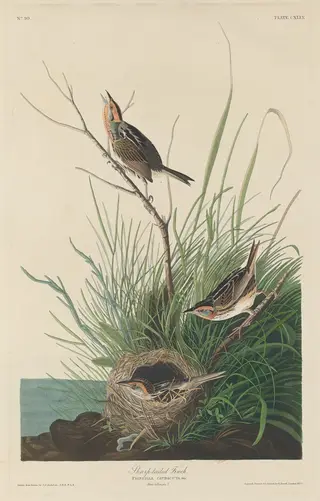
The painting's later history reflects the international dispersal of Audubon-related material and the enduring collector interest in works connected to the Birds of America project. Its residence in Australia for roughly half a century, followed by its return to the United States through the patronage of E.J.L. Hallstrom, illustrates the global afterlife of natural history art. The work's inclusion in the National Gallery of Art's collection, its display at the White House for nearly a decade, and its subsequent loan to a senior government official underscore its status as a culturally significant object beyond its ornithological documentary value. In the broader art-historical narrative, Kidd's copies remain important as the primary oil paintings derived from Audubon's designs, preserving in a different medium the compositions that became famous through hand-colored engravings. The Sharp-Tailed Finch thus stands as material evidence of the collaborative and reproductive practices that underpinned major natural history projects in the nineteenth century.
Own this work as a print
Artist & collection