Artwork
Untitled
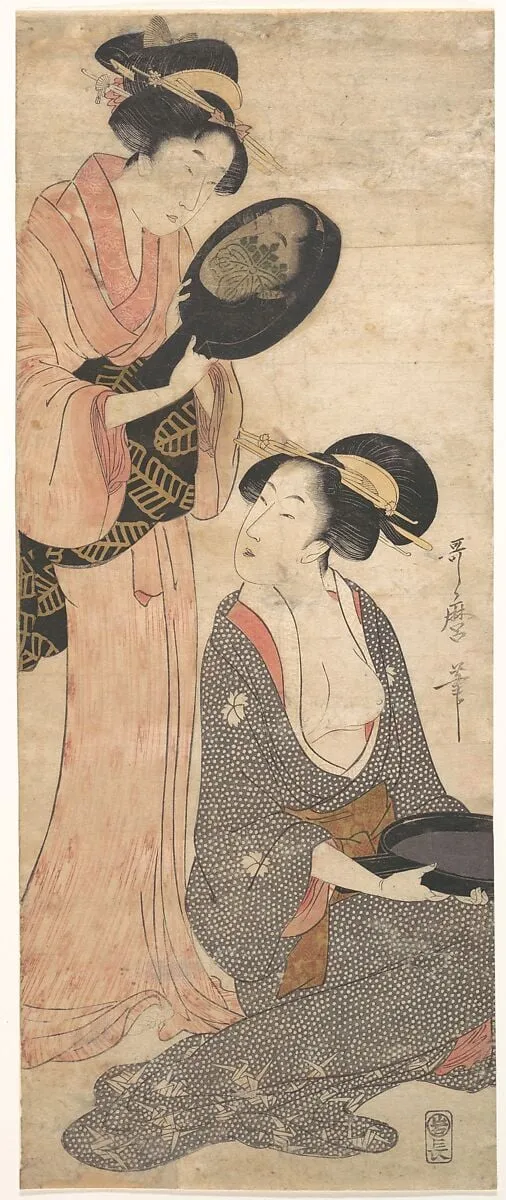
Untitled is an ink print by the Romanticist artist Kitagawa Utamaro. It dates from 1794 and is held in the collection of the Metropolitan Museum of Art.
About this work
Overview
Untitled is a woodblock print by Kitagawa Utamaro, one of the three preeminent masters of late eighteenth-century Japanese ukiyo-e, created in 1790.
Untitled is a woodblock print by Kitagawa Utamaro, one of the three preeminent masters of late eighteenth-century Japanese ukiyo-e, created in 1790. Measuring 47.3 by 19.4 centimeters, the work is rendered in ink and color on paper and is held in the collection of the Metropolitan Museum of Art. The print exemplifies Utamaro's revolutionary approach to bijin-ga, or pictures of beautiful women, which helped define the golden age of ukiyo-e and established his international reputation as the master of feminine portraiture.
Subject & Meaning
The composition depicts two women in traditional Japanese dress engaged in an intimate grooming scene. A standing figure at left, clad in a pale pink kimono with a black underlayer patterned with gold geometric designs, holds a round black mirror decorated with a floral motif, angled toward the seated woman below. The seated figure wears a dark blue-grey kimono covered in small white dots and scattered light-colored flowers, with a red undergarment visible at her chest; she holds a flat black object in her lap, likely another grooming implement. Both women wear elaborate black coiffures secured with gold hair ornaments and pins. The depicted objects, catalogued as hand mirror, kanzashi, and mirror, situate the scene within the_updated_ the daily rituals of feminine beauty that Utamaro made his signature subject. The intimate scale and private moment suggest the artist's characteristic interest in the inner lives and domestic spheres of women, rather than public or performative contexts.
Technique & Style
The print demonstrates the flat color areas and fine linear detail characteristic of woodblock printing, with delicate contour lines defining faces, hair, and fabric folds. The palette is restrained, relying on black, pale pink, muted blue-grey, and touches of red and gold. Shadows are minimal, with form indicated primarily by line rather than tonal modeling. The tall, narrow format of the composition reflects Utamaro's innovative approach to pictorial design, which often broke from the full-length group scenes that had dominated bijin-ga for over a century. Vertical calligraphy appears at right center, with a small square seal below it, indicating the collaborative nature of ukiyo-e production involving artist, carver, printer, and publisher. The visible aging and discoloration of the plain, uncolored paper background attest to the work's historical authenticity and material fragility.
History & Provenance
Dated to 1790, the print belongs to a pivotal period in Utamaro's career, following his early work in actor prints and his collaboration with publisher Tsutaya Jūzaburō, who had assigned him to series covering Yoshiwara events and festivals by 1783. The Metropolitan Museum of Art acquired the work for its collection, where it is now held; the specific accession details are not provided in the available sources. The print's provenance chain prior to museum acquisition remains undocumented in the given materials. Exhibition history is similarly not specified in the available sources.
Context
Utamaro emerged from the competitive Edo print market, where publishers dictated themes and artists, carvers, and printers collaborated on multicolored nishiki-e prints sold in quantity. His career took definitive shape through Tsutaya Jūzaburō's patronage, which channeled his talent toward bijin-ga. By 1790, Utamaro had not yet fully developed the ōkubie large-head portraits that would revolutionize the genre around 1792 or 1793, making this print representative of his transitional style. The Kansei reforms of 1791 would soon crack down on the publishing industry, eventually forbidding the depiction of ordinary women with their names in prints by 1793, a restriction that pushed Utamaro and Tsutaya toward depictions of Yoshiwara pleasure quarter life. Western critical reception, later articulated by Mary Cassatt, Edmond de Goncourt, and others, celebrated Utamaro's color and composition as central to Japonisme, the French fascination with Japanese art that influenced Impressionist and Post-Impressionist practice.
Legacy
Utamaro's broader legacy as the defining master of bijin-ga casts retrospective significance on works such as this 1790 print. His influence operated across multiple channels: shin hanga artists including Hashiguchi Goyō and Itō Shinsui later turned to his works in reassessing ukiyo-e methods, while Western collectors and artists from Vincent van Gogh to Henri de Toulouse-Lautrec transformed European painting through engagement with his prints. The specific afterlife of this particular Untitled print within these networks remains unrecorded in the available sources. Utamaro's career ended abruptly in 1804 with his arrest and fifty days' imprisonment for depicting the military ruler Toyotomi Hideyoshi and his concubines, an event from which he never fully recovered before his death in 1806.
Artist & collection


 Untitled
 Untitled
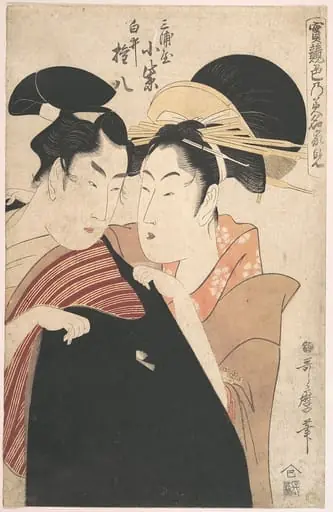 実競色乃美名家見 三浦屋小紫 白井権八|The Lovers Miura-ya Komurasaki and Shirai Gonpachi.
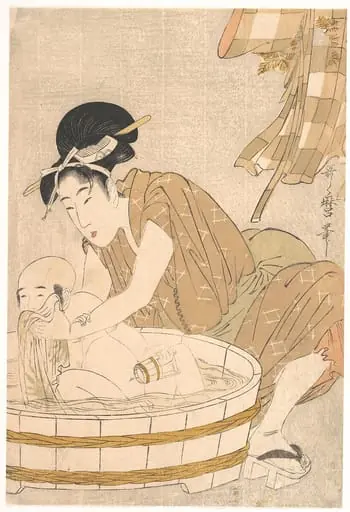 行水|Bathtime (Gyōzui)
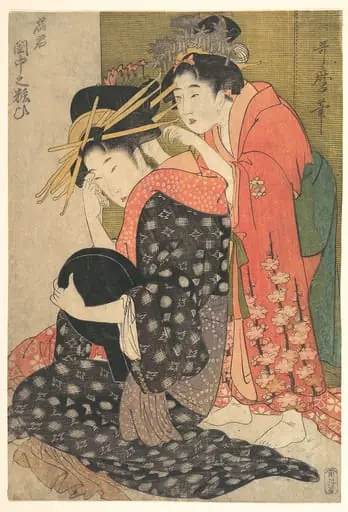 名君 閨中の粧ひ|The Oiran Yoso-oi Seated at Her Toilet
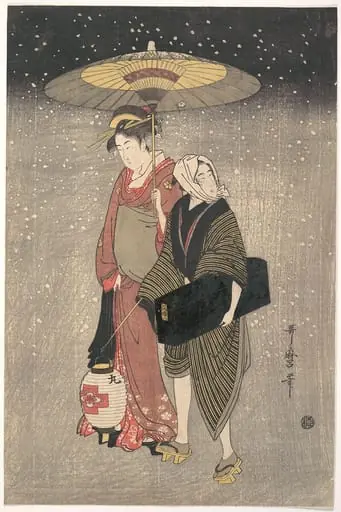 Untitled
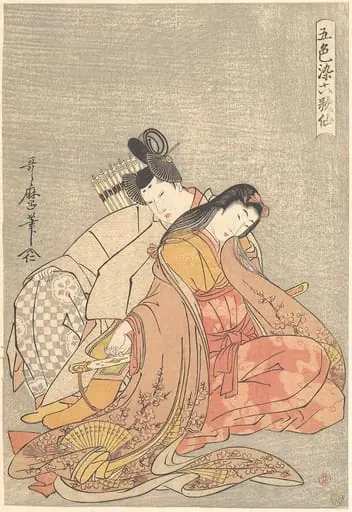 『五色染六歌仙』 在原業平と小野小町|“The Poet Ariwara no Narihira (825–880) and Ono no Komachi,” from the series Five Colors of Love for the Six Poetic Immortals (Goshiki-zome rokkasen)
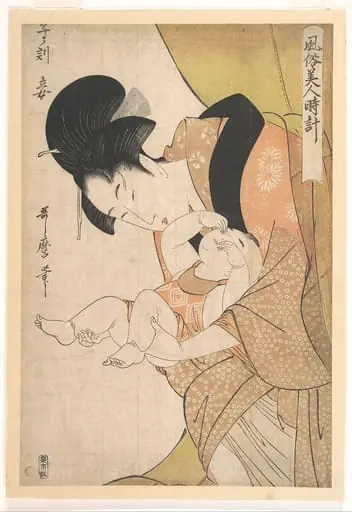 風俗美人時計 子ノ刻 妾|Midnight: Mother and Sleepy Child
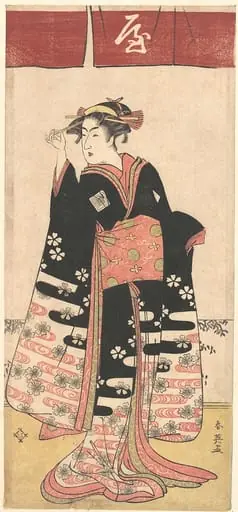 Untitled
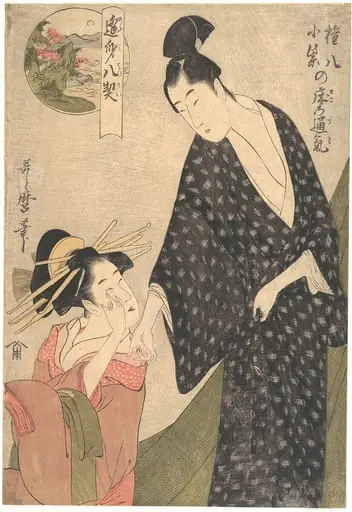 Gompachi Komurasaki no Toko no Tsuki|逢身八契 権八小紫の床の通気|Shared Feelings in the Bedchamber of Komurasaki and Gompachi
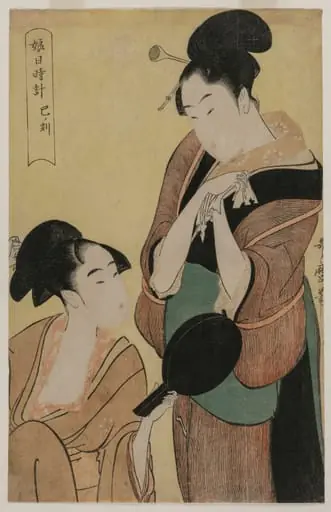 The Hour of the Snake (from the series A Clock for Young Women)
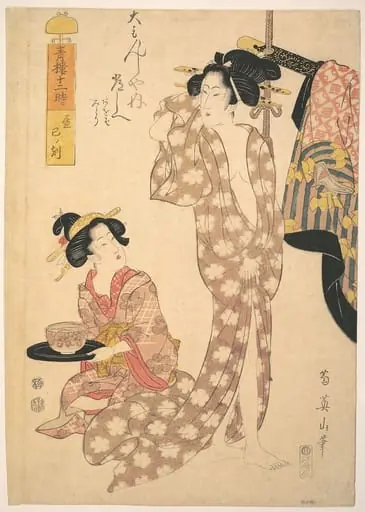 Untitled
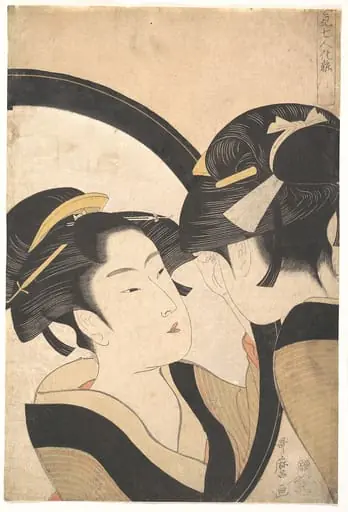 姿見七人化粧|Naniwa Okita Admiring Herself in a Mirror
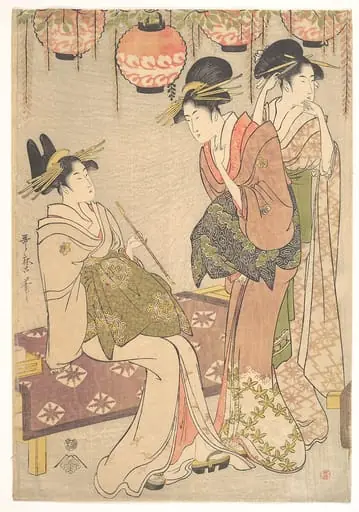 Untitled
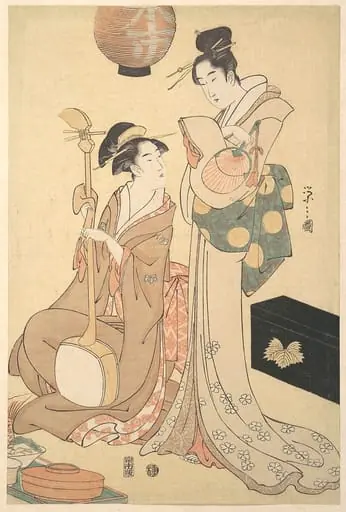 Untitled
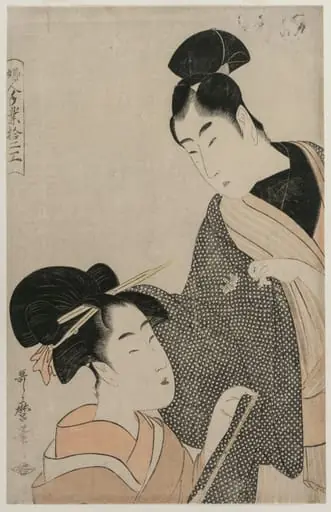 Woman Measuring a Man's Gown (from the series Twelve Occupations of Women)
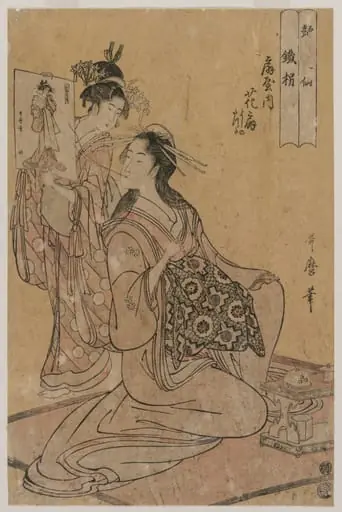 The Courtesan Hana-ogi of Ogiya as the Sennin Tekkai (from the series Eight Immortals of Sensuality)
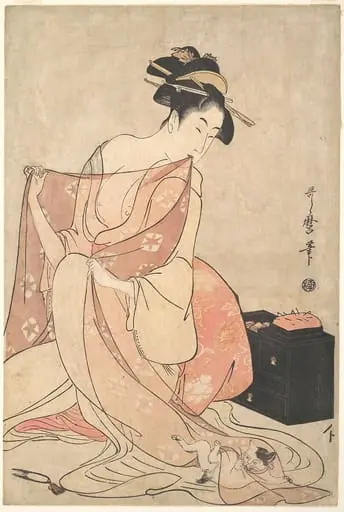 Untitled
- Untitled