Artwork
The Watering Can (Emblems: The Garden)
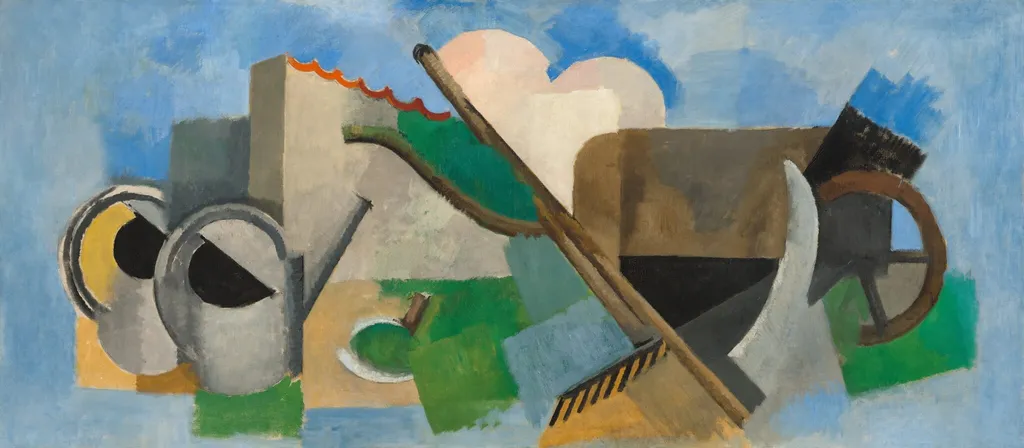
The Watering Can (Emblems: The Garden) is an oil painting by the Cubism Synthetic artist Roger de La Fresnaye. It dates from 1913 and is held in the collection of the National Gallery of Art.
About this work
Technique & Style
Classified as a painting within the still life genre, the piece exhibits the formal qualities of a canvas-based oil work from the early 20th century.
Roger de La Fresnaye created The Watering Can (Emblems: The Garden) in 1913 using oil paint on a canvas support. The work measures 88.9 cm in height and 200.66 cm in width, presenting a substantial horizontal format typical of the era's large-scale still life compositions. Classified as a painting within the still life genre, the piece exhibits the formal qualities of a canvas-based oil work from the early 20th century.
The physical dimensions and material composition align with the artist's practice during this period, resulting in a durable surface that has been preserved in the collection of the National Gallery of Art.
History & Provenance
The Watering Can (Emblems: The Garden) was painted by Roger de La Fresnaye in 1913 using oil on canvas, measuring 88.9 cm by 200.66 cm. The work entered the collection of Paul Mellon, who later bequeathed it to the National Gallery of Art in 1999, with a life interest reserved for his wife Rachel Lambert Mellon. Since the bequest, the painting has remained in the National Gallery of Art’s permanent holdings, where it is displayed as part of the institution’s still‑life collection.
The Watering Can (Emblems: The Garden) is held in the collection of the National Gallery of Art in Washington, D.C. The work entered the museum's holdings in 1999 following the death of Paul Mellon, who bequeathed it to the institution after retaining a life interest for his wife, Rachel Lambert Mellon. Prior to this transfer, the painting was part of the Mellon family collection in Upperville, Virginia. The artwork has not been documented in the provided sources as having a specific inventory or accession number, nor is an exhibition history recorded in the available data.
Context
Roger de La Fresnaye completed The Watering Can (Emblems: The Garden) in 1913, rendering it in oil on canvas with dimensions of 88.9 cm by 200.66 cm. The work belongs to the still‑life genre and exemplifies the artist’s exploration of domestic subjects within a Cubist‑inspired vocabulary. It entered the National Gallery of Art in Washington, D.C., as part of Paul Mellon’s bequest in 1999, a donation that included a life interest for his wife Rachel Lambert Mellon. The painting’s presence in a major public collection underscores its significance within early‑twentieth‑century French painting and continues to be cited in scholarship examining de La Fresnaye’s contribution to modernist still life.
Overview
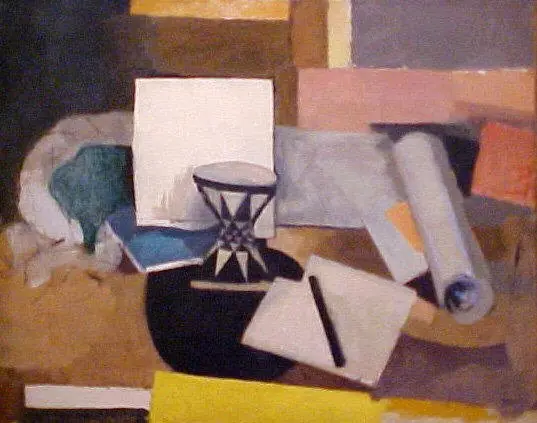
Roger de La Fresnaye completed The Watering Can (Emblems: The Garden) in 1913. Executed in oil on canvas, this painting offers a distinctive take on the still life genre. It features a common garden implement, rendered with a particular formal approach that characterizes the artist's work from this period, exploring the interplay of everyday objects and abstract forms.
Subject & Meaning
The composition centers on a watering can, depicted in the act of pouring water onto a patch of green. Positioned at an angle, its spout directs a stream towards the ground. In the background, a structure with a distinctive red roof stands beneath a sky filled with clouds, providing an architectural and atmospheric backdrop to the domestic scene.
Artist & collection