Artwork
Mischief and Repose
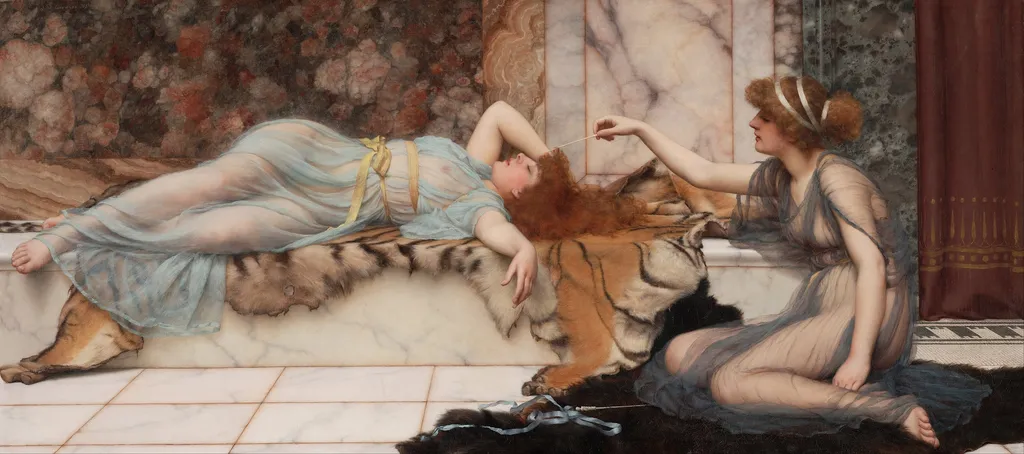
Mischief and Repose is an oil painting by the Aestheticist artist John William Godward. It dates from 1898 and is held in the collection of the J. Paul Getty Museum.
About this work
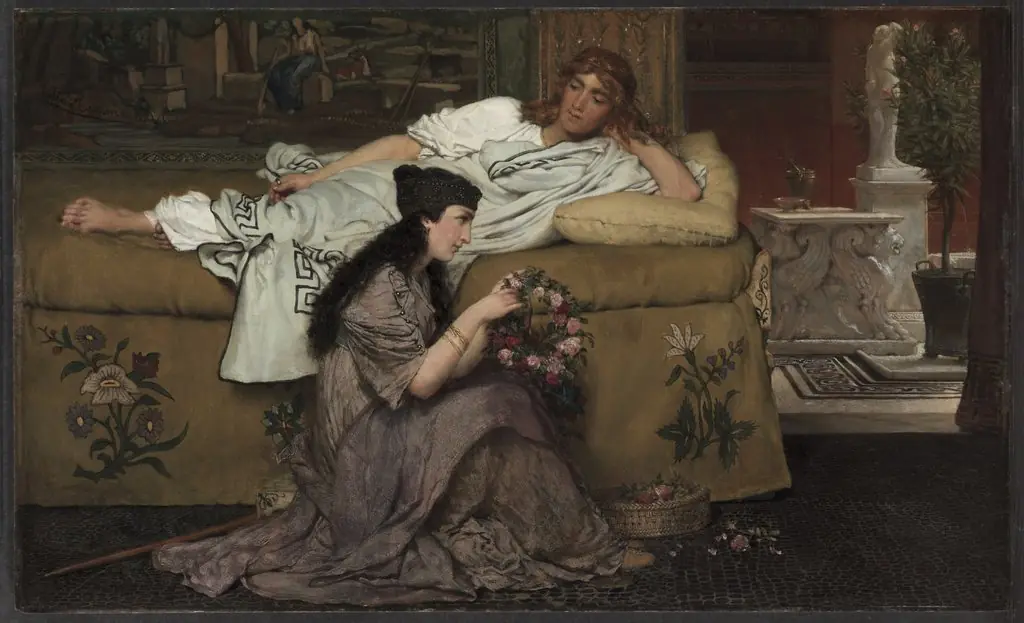
This work shows a quiet moment with two women in ancient dress. Oil paint lets Godward play with light and shadow. The Getty bought it in 1979.
The same title pops up again in 1909 with a new scene. That smaller version lives elsewhere. Two paintings, one name, kind of fun.
Grab a closer look at the J. Paul Getty Museum.
Subject & Meaning
John William Godward's 1898 oil painting functions as an allegory personifying the contrasting concepts of Repose and Mischief within a Neo-Pompeian interior.
John William Godward's 1898 oil painting functions as an allegory personifying the contrasting concepts of Repose and Mischief within a Neo-Pompeian interior. The composition features two sisters, Hetty and Lily Pettigrew, dressed in sheer ancient chitons against a backdrop of richly patterned marble. On the left, the figure of Repose lies asleep on a tiger skin draped over a marble bench, embodying calmness and slumber.
Conversely, the figure of Mischief kneels on the floor, holding a long white dress pin poised above the sleeper's forehead in an attempt to disturb her rest.
The narrative is reinforced by discarded accessories, including a second pin and a hair ribbon on the mosaic floor. Godward renders the women with pale, statue-like skin and a cold academic style that integrates them into the petrified marble environment, emphasizing a serene yet imperturbable atmosphere detached from the viewer.
Technique & Style
Created in 1898, Mischief and Repose is an oil-on-canvas painting measuring 60.6 cm by 133 cm. The work exemplifies the neo-Pompeian movement through its meticulous depiction of an ancient interior featuring white marble tiles, a veined marble bench, and walls clad in richly patterned colored marbles. Godward employs a cold, academic style that renders the pale-skinned figures as petrified statues, enhancing the scene's static, marble-like atmosphere. The composition relies on sheer, flowing chitons in blue and grey that drape over the models, contrasting with the textures of tiger and black animal skins used as bedding.
A purple curtain with a gold border and a mosaic floor with a black patterned border further define the spatial setting. The painting is signed and dated by the artist on a multicolored marble panel in the upper left corner.
History & Provenance
John William Godward painted Mischief and Repose in 1898, signing and dating the work on the multicoloured marble wall in the upper left corner. The oil-on-canvas measures 60.6 cm by 133 cm. Godward used his regular models, Hetty and Lily Pettigrew, to depict two auburn-haired women in a neoclassical interior. A second, smaller version (38.4 cm by 76.9 cm) was completed in 1909.
The painting was purchased from the artist by the dealer Léon Henri Lefèvre, resold at Christie's in 1924, and passed through collectors Nathan Mitchell and H. Aron before being sold by J. Woolf in 1938 to J. Paul Getty. Following Getty's death, his estate transferred it to the J. Paul Getty Museum in Los Angeles in 1979, where it remains. The later 1909 version, depicting a single figure, was sold at Christie's in December 2008.
Context
Mischief and Repose belongs to John William Godward's late-19th-century corpus of neo-Pompeian scenes, aligning with the academic classicism practiced by contemporaries such as Lawrence Alma-Tadema. Art-historical treatments situate the painting within a broader late-Victorian taste for allegorical subjects rendered in polished marble interiors, where attenuated figures enact small narratives of repose and interruption. After its debut and early sale to the dealer Léon Henri Lefèvre, it passed through British and American collections before entering the J. Paul Getty Museum in 1979.
Scholarly discussions emphasize the painting's technical finish and its calculated evocation of arrested time, qualities that typify Godward's practice. The 1909 reprise of the same title, though compositionally distinct, signals the motif's resonance for the artist, and the later work's appearance at auction indicates sustained market interest. Within histories of Victorian classicism, Mischief and Repose exemplifies the genre's synthesis of archaeological detail and pictorial idealization, securing Godward's place among the last exponents of a fading academic tradition.
Overview
John William Godward's 1895 oil painting, "Mischief and Repose," depicts an intimate scene from classical antiquity. This large canvas, now part of the J. Paul Getty Museum collection since 1979, presents two young women in a moment of playful interaction. Godward later revisited the title for a different, smaller composition in 1909, making this 1895 version the primary representation of the theme.
Artist & collection
Artist
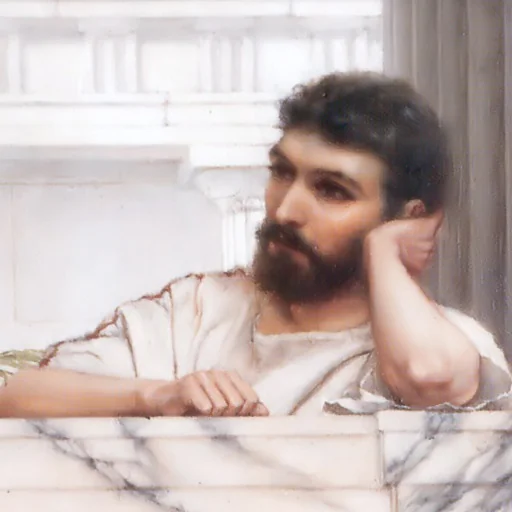
John William Godward (9 August 1861 – 13 December 1922) was an English painter from the end of the Neo-Classicist era. He was a protégé of Sir Lawrence Alma-Tadema, but his style of painting fell out of favour with the rise of modern art.