Artwork
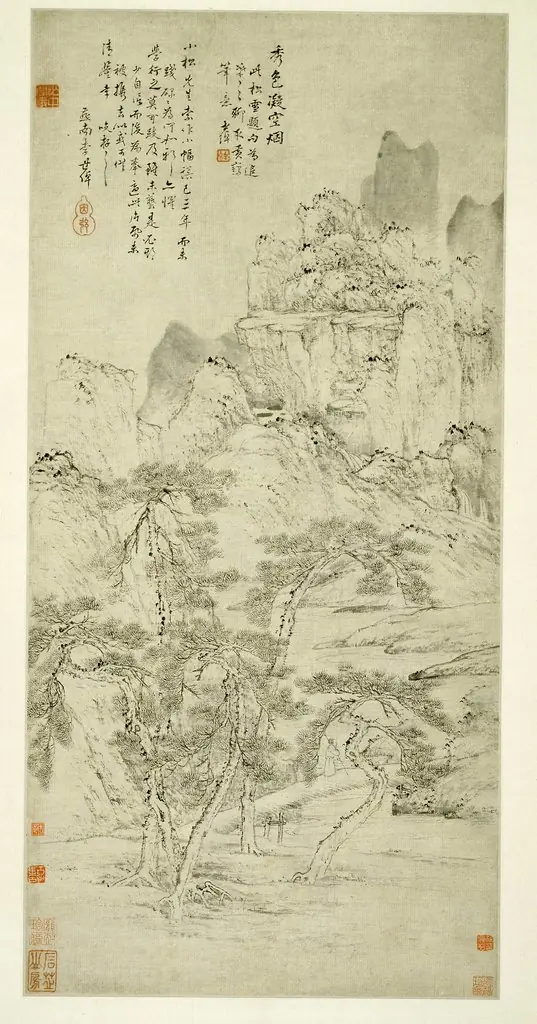
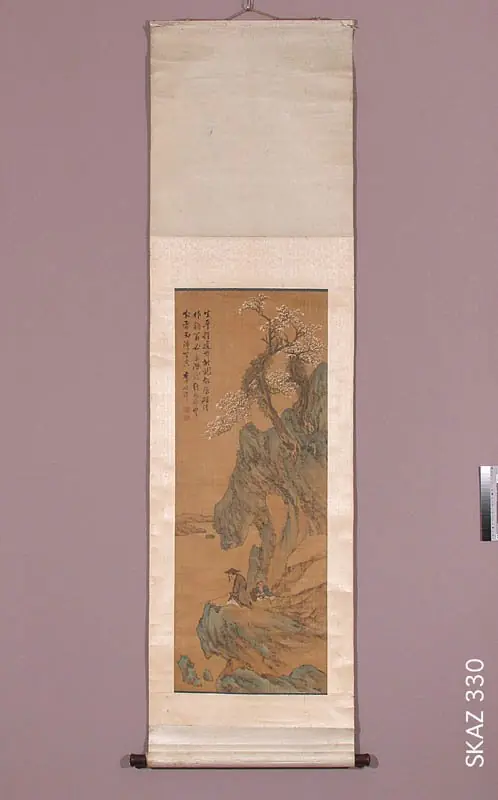
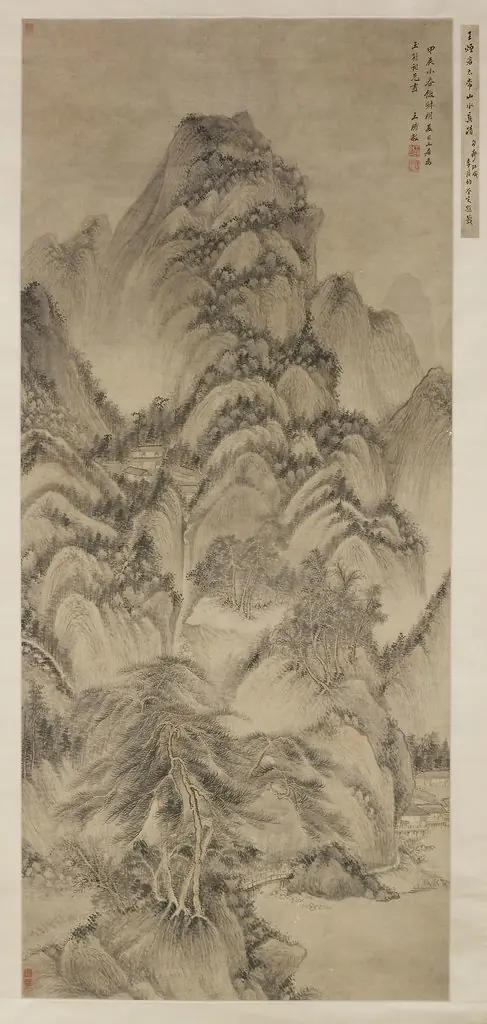
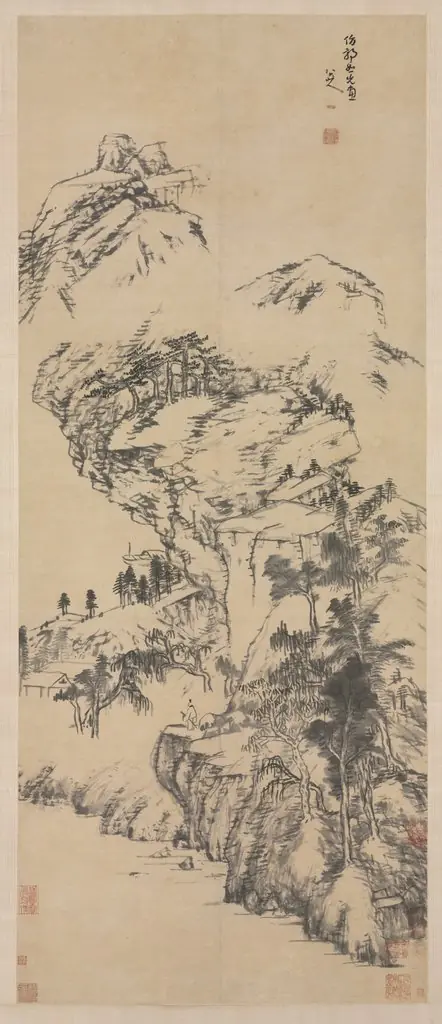
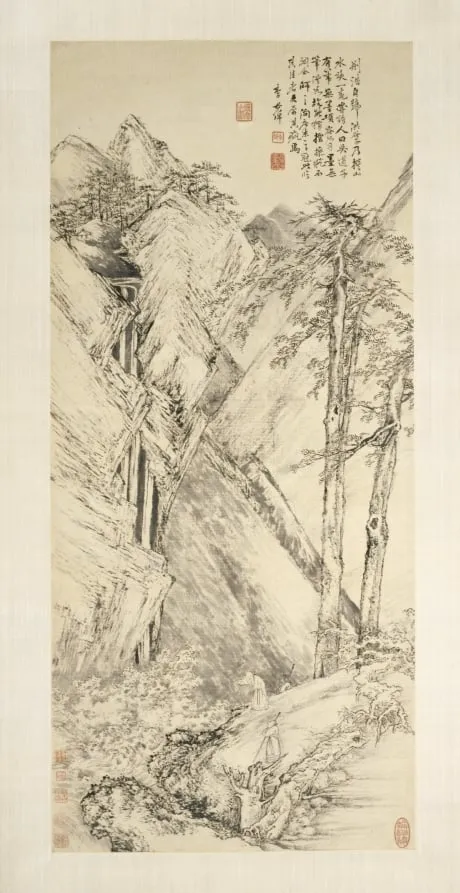
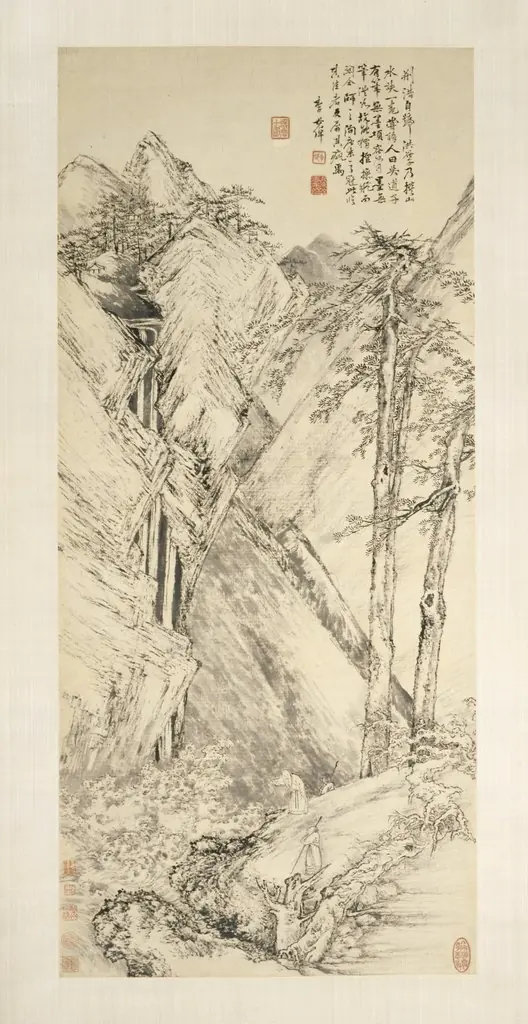
Landscape after Jing Hao and Guan Tong
- Accession no.
- 1952.588
- Credit line
- John L. Severance Fund
About this work
Overview
Subject & Meaning
The composition depicts a precipitous mountain crag, its cliffs rendered in stark, angular forms. A narrow trail winds along the base of the slope, leading to a modest hut tucked into the lower left corner. Sparse trees cling to the rocky surface, suggesting a remote, contemplative setting that invites the viewer to consider humanity’s smallness before nature.
Technique & Style
Li Shizhuo employs a limited palette of gray and white ink, punctuated by occasional darker strokes that heighten the sense of depth. The brushwork is deliberately rough and sketchy, echoing the vigorous line quality associated with the Song painters Jing Hao and Guan Tong. Red seals and black calligraphic inscriptions occupy the upper corners, adding a scholarly signature to the piece.
History & Provenance
Created in the early eighteenth century, the painting reflects the Qing court’s interest in reviving and reinterpreting Song‑era landscape conventions. It entered the Cleveland Museum of Art’s collection through acquisition in the twentieth century, though the precise chain of ownership prior to that remains undocumented.
Context
During the Qing dynasty, artists often looked back to Song masters such as Jing Hao and Guan Tong for compositional models and brush techniques. Li Shizhuo’s homage illustrates this tradition of scholarly borrowing, positioning his work within a lineage that prized the expressive potential of ink and the moral resonance of rugged scenery.
Artist & collection
Artist
Li Shizhuo, with the style name Hanzhang, was a Chinese painter of the Qing dynasty active during the late seventeenth and early eighteenth centuries.