Artwork
Tobias and the Angel
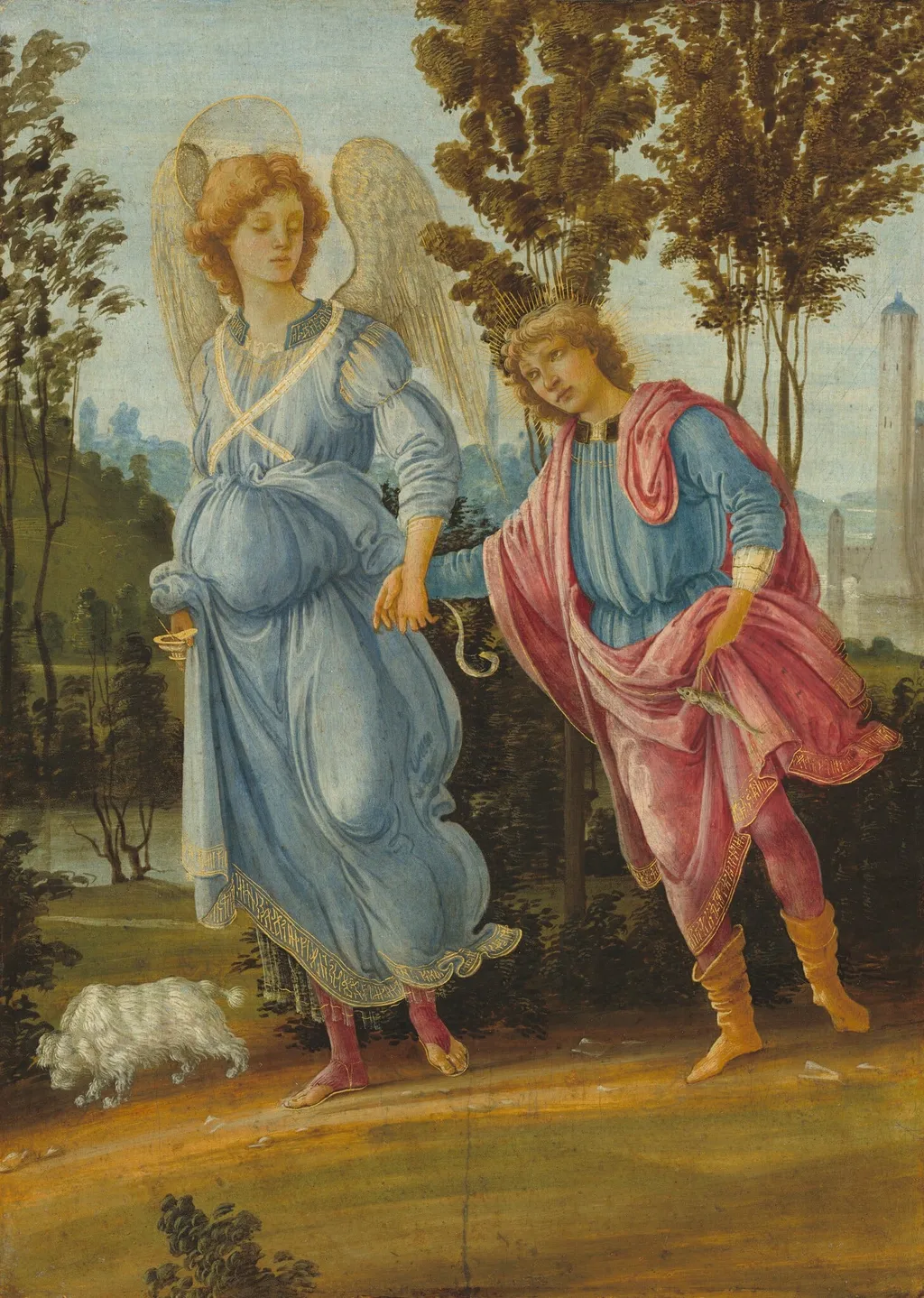
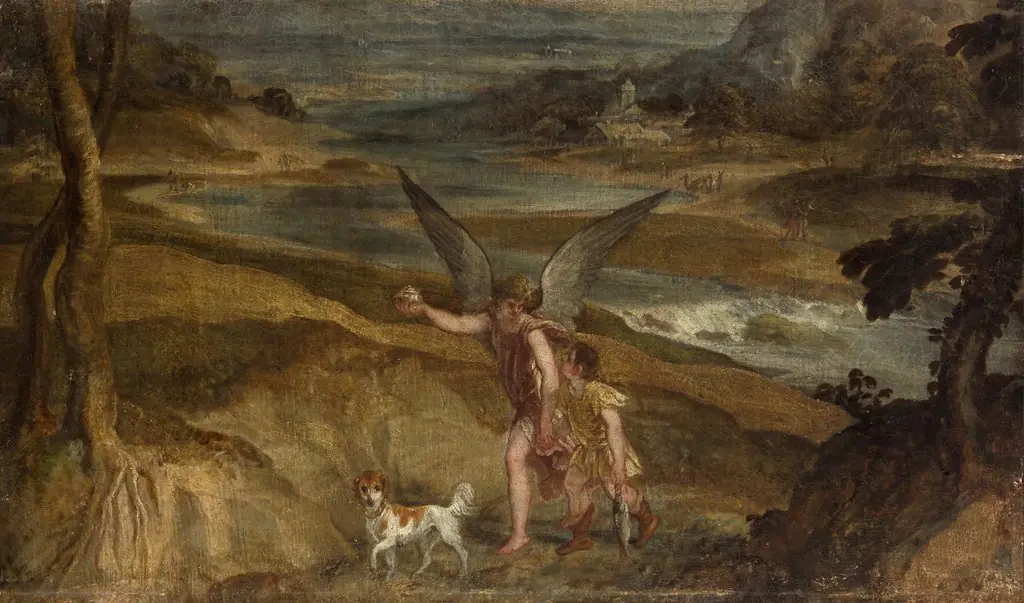
Tobias and the Angel is an oil painting by the Early Renaissance artist Filippino Lippi. It dates from 1478 and is held in the collection of the National Gallery of Art.
About this work
Subject & Meaning
The fish held by Tobias alludes to the remedy for his father's blindness and to baptismal symbolism.
The painting shows Tobias, a youthful figure in a blue tunic, walking arm-in-arm with the archangel Raphael, who is identified by his winged form, blue garment and a golden mortar. A white dog follows them, referencing the Book of Tobit. The fish held by Tobias alludes to the remedy for his father's blindness and to baptismal symbolism.
The landscape with a river and tower evokes the Tigris and the city of Media, while the composition reflects Renaissance motifs of merchant patronage, emphasizing themes of debt recovery, guidance, and the transition to adulthood.
Technique & Style
Filippino Lippi executed this work circa 1475–1480 using a mixed technique of oil and tempera applied to a poplar panel support. The painting measures approximately 32.7 cm by 23.5 cm. Stylistically, the composition features two elegant figures with fine features and blond hair, depicted walking arm-in-arm with slightly unstable postures to suggest movement. The angel wears a blue gown while Tobias is dressed in a blue tunic with a red cloak.
Lippi renders the drapery with a light touch, capturing the effect of wind, set against a soft, dreamlike riverine landscape that includes a tall tower and trees. A small white dog accompanies the pair. The handling reflects early Florentine Renaissance influences, showing compositional similarities to works by Antonio del Pollaiuolo and Andrea del Verrocchio.
History & Provenance
The painting Tobias and the Angel by Filippino Lippi is dated to c. 1475–1480, aligning with the artist's early career following his training under Botticelli. Its early provenance is undocumented; it first appears in the collection of Alexander Barker in London by 1868, likely acquired after 1857. Following Barker's death, it was sold at Christie's, London, in 1879, misattributed to Antonio Pollaiuolo, and resurfaced in 1887 in the collection of Colonel William Cornwallis-West.
By 1927, it belonged to Robert Henry and Evelyn Benson, whose collection was acquired by Duveen Brothers. The Samuel H. Kress Foundation purchased the work in 1936, donating it to the National Gallery of Art, Washington, D.C., in 1939.
Tobias and the Angel is housed in the National Gallery of Art, Washington, D.C., where it is part of the Samuel H. Kress Collection, a 1939 gift. The work entered the Kress collection after its 1936 purchase from Duveen Brothers, having previously belonged to Alexander Barker, William Cornwallis-West, and Robert Henry Benson. Its early public visibility occurred at the 1868 National Exhibition in Leeds, where it was listed as Barker's property.
The painting has since been exhibited as part of the Kress Collection displays at the National Gallery of Art.
Context
Filippino Lippi's Tobias and the Angel (c. 1475–1480) occupies a pivotal position in the transition from early to High Renaissance Florentine painting, reflecting the artist's synthesis of his father Filippo Lippi's lyrical style and Sandro Botticelli's influence, under whom he trained from 1472. Scholars highlight its compositional debt to Antonio del Pollaiuolo and Andrea del Verrocchio, whose depictions of the same biblical narrative established conventions for dynamic yet intimate figural interaction. Gertrude M. Achenbach's iconographic study underscores the theme's resonance with Florentine merchant patrons, who commissioned such works to symbolize debt recovery, filial guidance, and spiritual protection, linking commercial pragmatism to Christian allegory.
While modest in scale, the painting exemplifies Lippi's early mastery of delicate drapery, luminous landscapes, and the androgynous elegance of figures, traits that would define his mature oeuvre. Its critical reception emphasizes its role in popularizing the Tobias narrative within Renaissance devotional art.
Legacy
The subject of Tobias and the Angel held significant cultural resonance for wealthy Florentine merchants, who commissioned such works to symbolize debt recovery, the transition to adulthood, and divine protection for traveling sons. This popularity inspired numerous Florentine painters, including Antonio del Pollaiuolo and Andrea del Verrocchio, who created similar compositions. Filippino Lippi revisited the theme later in his career with a c. 1485 painting in Turin featuring multiple archangels.
Art historically, the work is recognized as an early piece by Lippi that shares compositional traits with his contemporaries. Its enduring reputation is evidenced by its prominent inclusion in the Samuel H. Kress Collection at the National Gallery of Art in Washington, D.C., where it has been held since 1939 following a provenance that included major 19th-century private collections and the Duveen Brothers.
Overview
Filippino Lippi, a Florentine Renaissance painter, created Tobias and the Angel around 1475–1480. This painting, executed in oil and tempera on a poplar panel, illustrates a popular biblical narrative. It features a young man accompanied by a winged angel, who carries a fish. The artwork is presently held in the collection of the National Gallery of Art in Washington, DC.
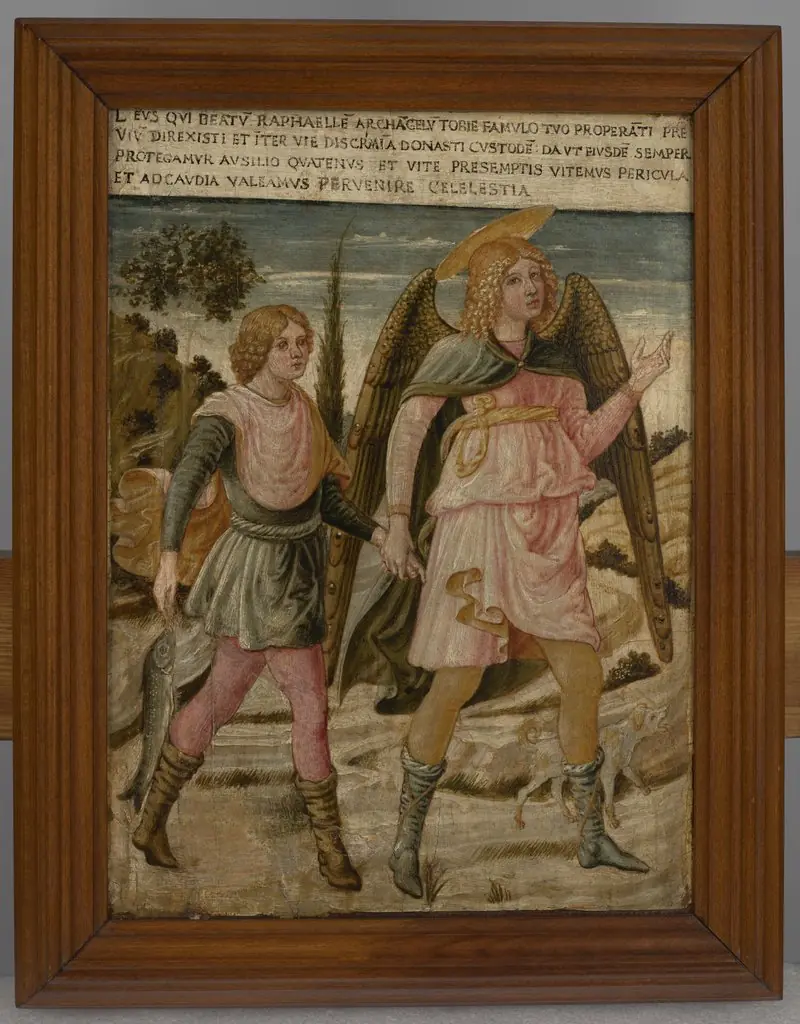
Own this work as a print
Artist & collection

Artist
Filippino Lippi (probably 1457 – 18 April 1504) was an Italian Renaissance painter mostly working in Florence, Italy during the later years of the Early Renaissance and first few years of the High Renaissance.

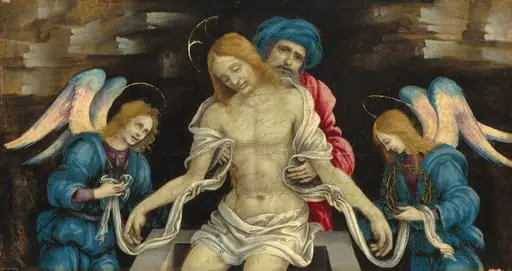 Pietà (The Dead Christ Mourned by Nicodemus and Two Angels)
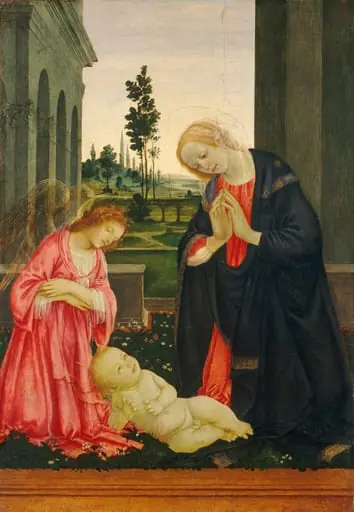 The Adoration of the Child
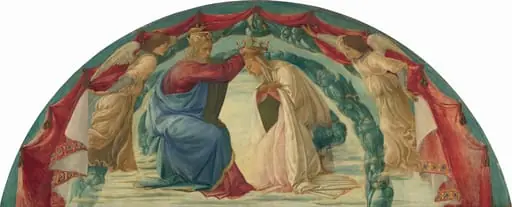 The Coronation of the Virgin
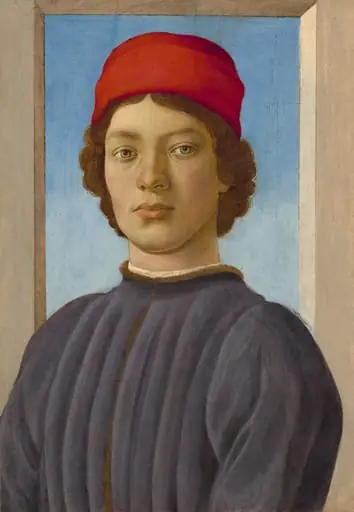 Portrait of a Youth
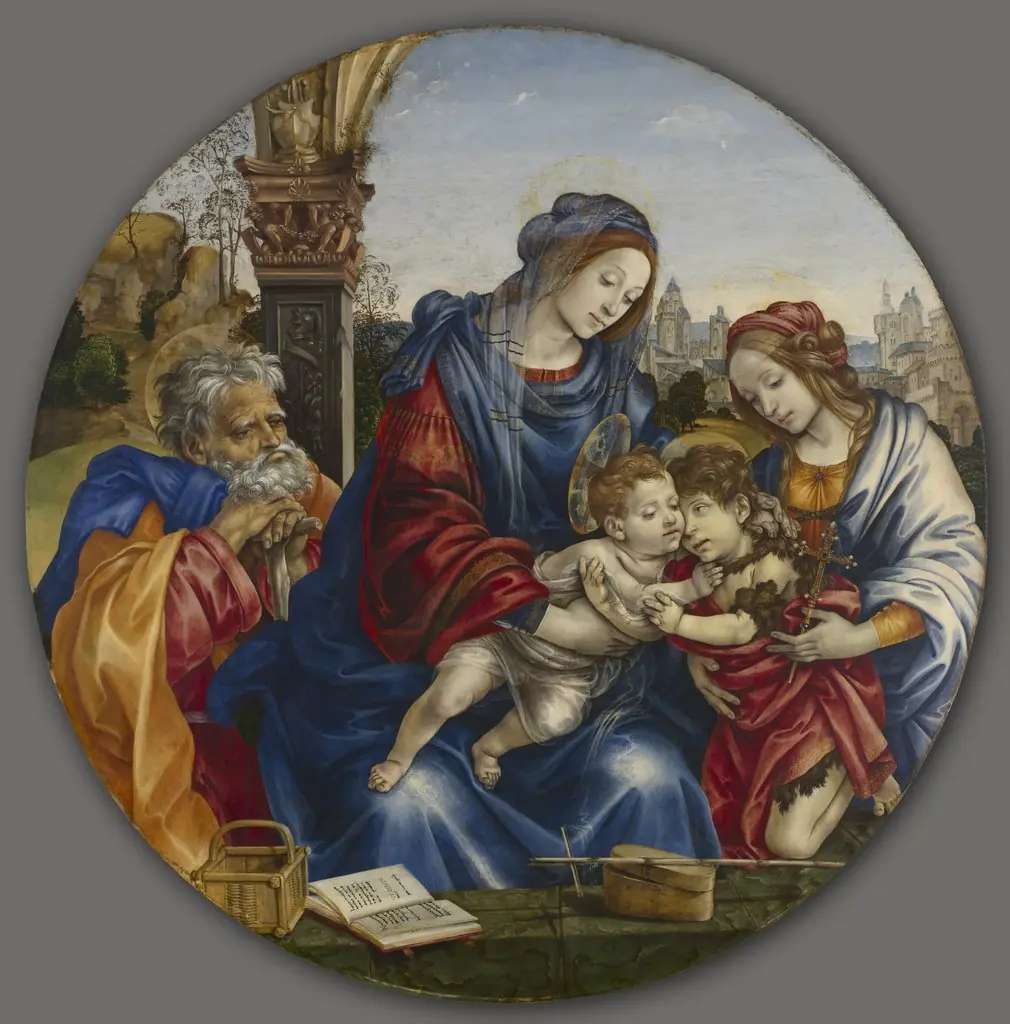 The Holy Family with Saint John the Baptist and Saint Margaret
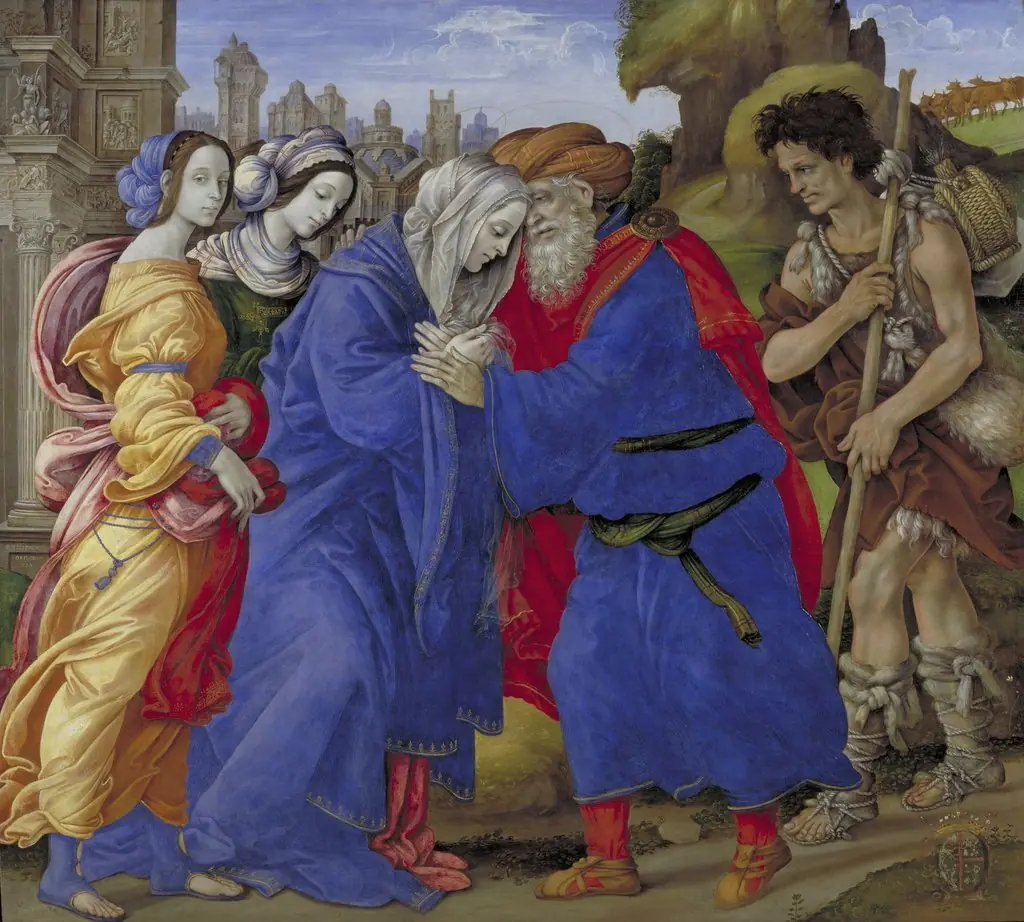 The Meeting of Joachim and Anne outside the Golden Gate of Jerusalem
 Portrait of a young man
 Crucifixion of Christ