Artwork
The Coronation of the Virgin
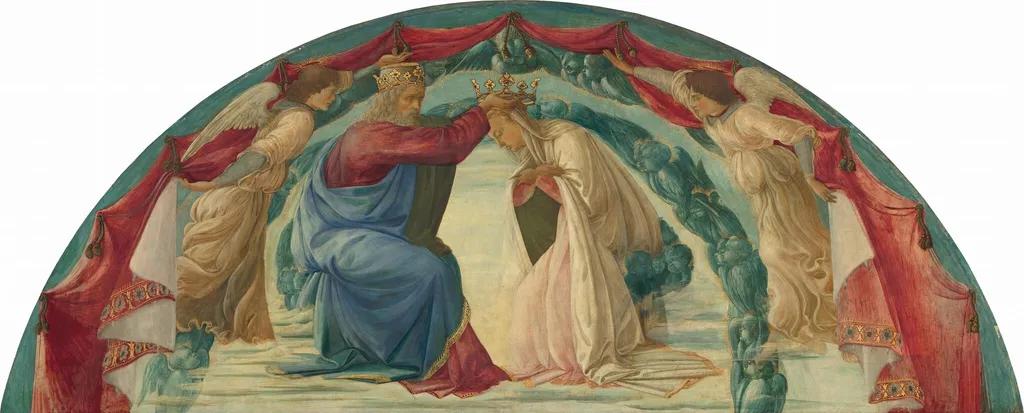
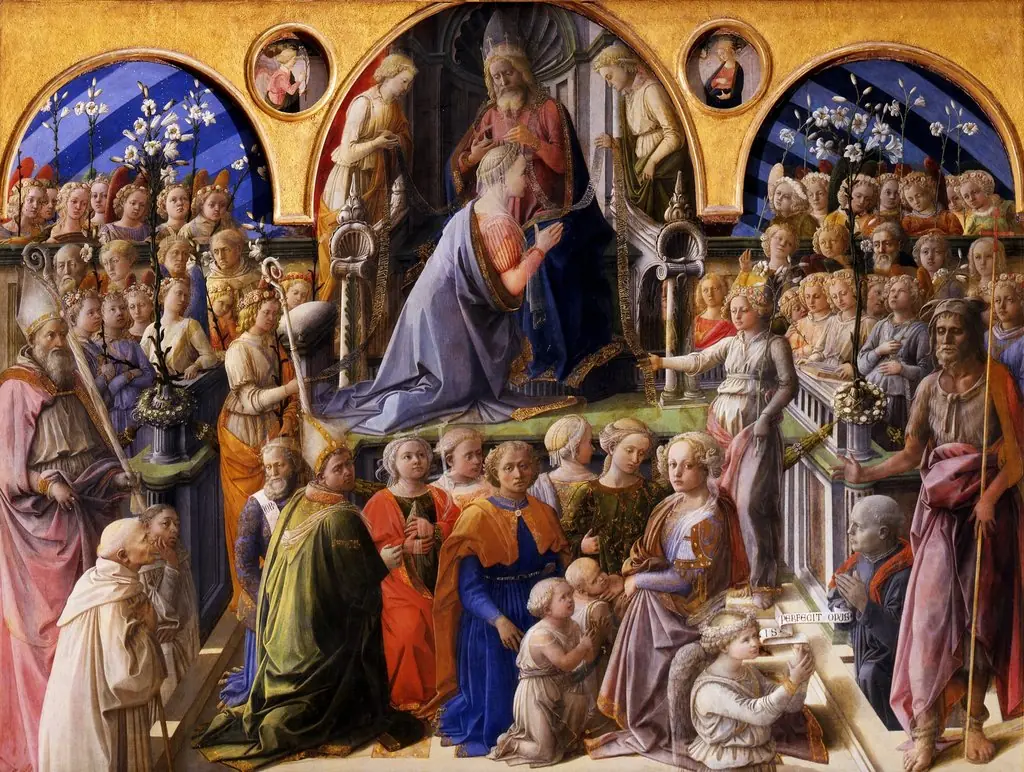
The Coronation of the Virgin is a tempera painting by the Early Renaissance artist Filippino Lippi. It dates from 1475 and is held in the collection of the National Gallery of Art.
About this work
Technique & Style
Filippino Lippi executed The Coronation of the Virgin around 1475 using a mixed technique of tempera and oil on a poplar panel.
Filippino Lippi executed The Coronation of the Virgin around 1475 using a mixed technique of tempera and oil on a poplar panel. The painting measures 90.5 cm in height by 222.9 cm in width, consistent with its horizontal, multi-figure devotional format. The combination of tempera and oil on a wooden support was characteristic of late fifteenth-century Florentine panel practice, allowing the artist to build up layered glazes while retaining the precision afforded by egg-based binders.
The poplar panel, a standard Tuscan support, provided a stable ground for the broad compositional span of the Coronation scene. The work is classified as a religious painting and is held in the Samuel H. Kress Collection at the National Gallery of Art, Washington, D.C.
History & Provenance
The painting is dated to circa 1475. Its provenance begins with William Blundell Spence in Florence around 1860, who sold it in February 1861 to William Schomberg Robert Kerr, 8th Marquess of Lothian, at Newbattle Abbey. The panel remained in the Lothian family, passing by inheritance to Schomberg Henry Kerr (9th Marquess), then to Robert Schomberg Kerr (10th Marquess), and subsequently to Philip Henry Kerr (11th Marquess).
After the 11th Marquess's death, the work passed through Duveen Brothers and was sold in 1940 to the Samuel H. Kress Foundation, which donated it to the National Gallery of Art in Washington, D.C., in 1943.
Context
The Coronation of the Virgin, executed by Filippino Lippi around 1475 in tempera and oil on poplar panel, is housed in the National Gallery of Art as part of the Samuel H. Kress Collection. The painting has appeared in provenance records tracing its passage from Florentine dealer William Blundell Spence to the Lothian family and subsequently to Duveen Brothers before entering the Kress holdings. Scholarly attention includes discussions in John Fleming's 1979 article on art dealing, Bernard Berenson's 1938 Drawings of Florentine Painters, and Fern Rusk Shapley's 1979 catalogue of Italian paintings, which situate the work within Lippi's later output and the broader Florentine Renaissance tradition.
Overview
Filippino Lippi's The Coronation of the Virgin, executed around 1475, is a religious panel painting. This work, rendered in tempera and oil on poplar, depicts a significant moment in Christian theology. It exemplifies the artistic trends prevalent during the Early Renaissance in Italy, a period when artists began to explore new techniques and a more naturalistic approach to sacred subjects.
Subject & Meaning
The painting portrays the Virgin Mary, dressed in a white robe, receiving a golden, pointed crown from a figure in blue and red attire, likely Christ. Two angels flank the central figures, holding aloft a rich red canopy, emphasizing the solemnity and divine nature of the event. This scene celebrates Mary's ascent to queenship in heaven, a common theme in Renaissance religious art.
Artist & collection

Artist
Filippino Lippi (probably 1457 – 18 April 1504) was an Italian Renaissance painter mostly working in Florence, Italy during the later years of the Early Renaissance and first few years of the High Renaissance.