Artwork
Madonna and Child with a Pomegranate
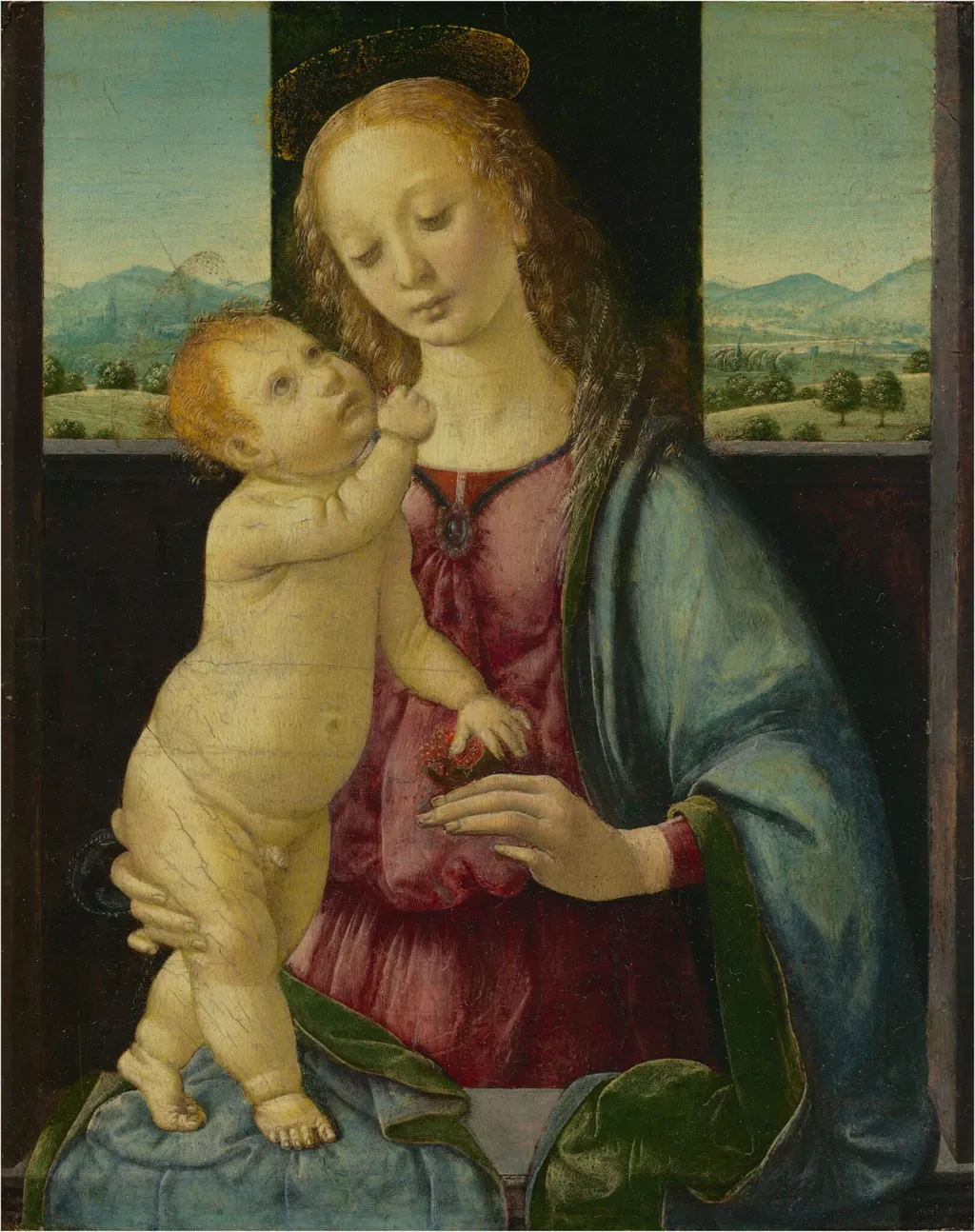
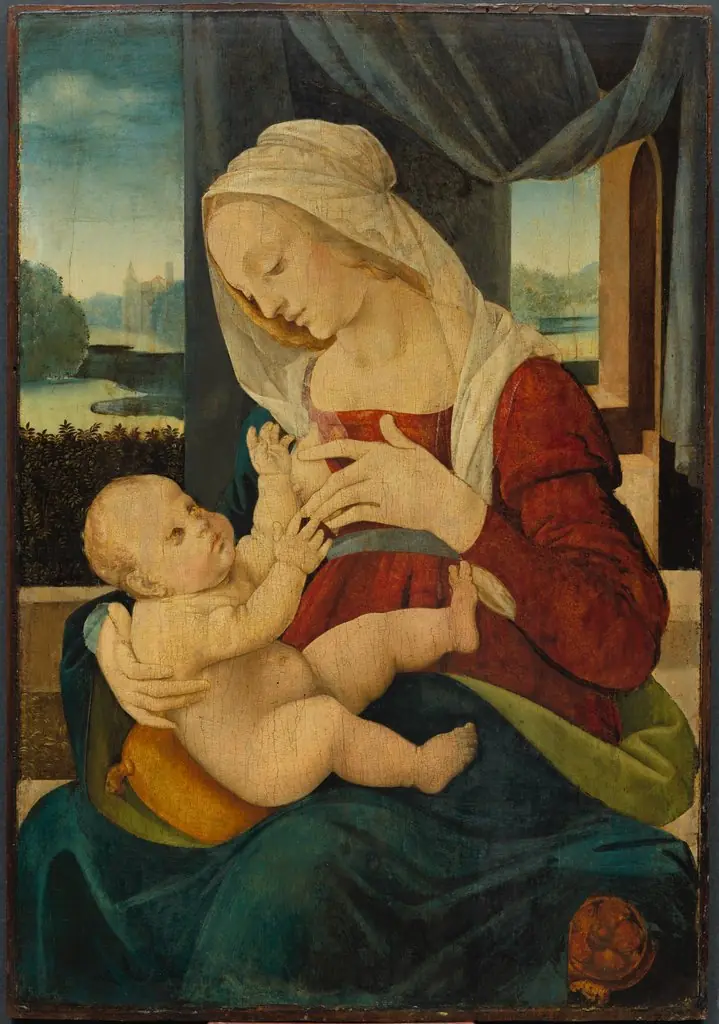
Madonna and Child with a Pomegranate is an oil painting by the High Renaissance artist Lorenzo di Credi. It dates from 1478 and is held in the collection of the National Gallery of Art.
About this work
Lorenzo di Credi painted it in Florence around 1475 to 1480, while working in Andrea del Verrocchio's busy workshop alongside the young Leonardo.
In a panel barely larger than a postcard, the Virgin holds a split pomegranate while the Christ child offers her a single seed, their figures pressed close against a dark ground. Lorenzo di Credi painted it in Florence around 1475 to 1480, while working in Andrea del Verrocchio's busy workshop alongside the young Leonardo. It later joined the Samuel H. Kress Collection at the National Gallery of Art.
Subject & Meaning
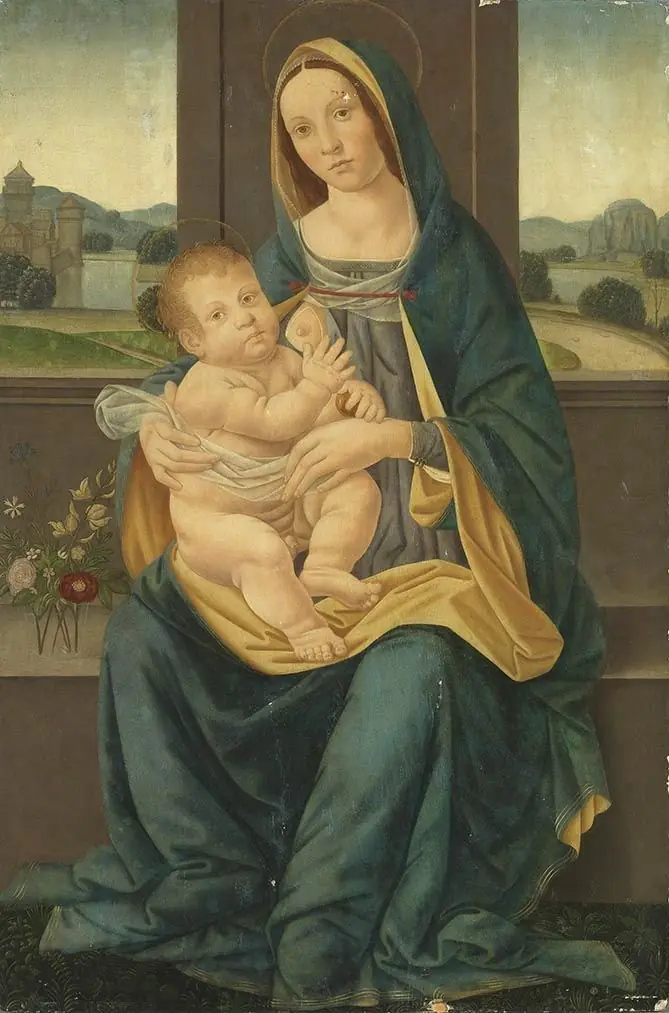
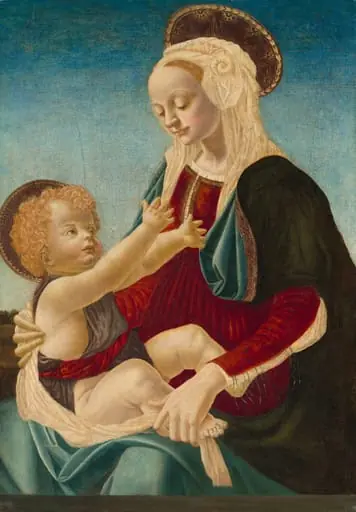
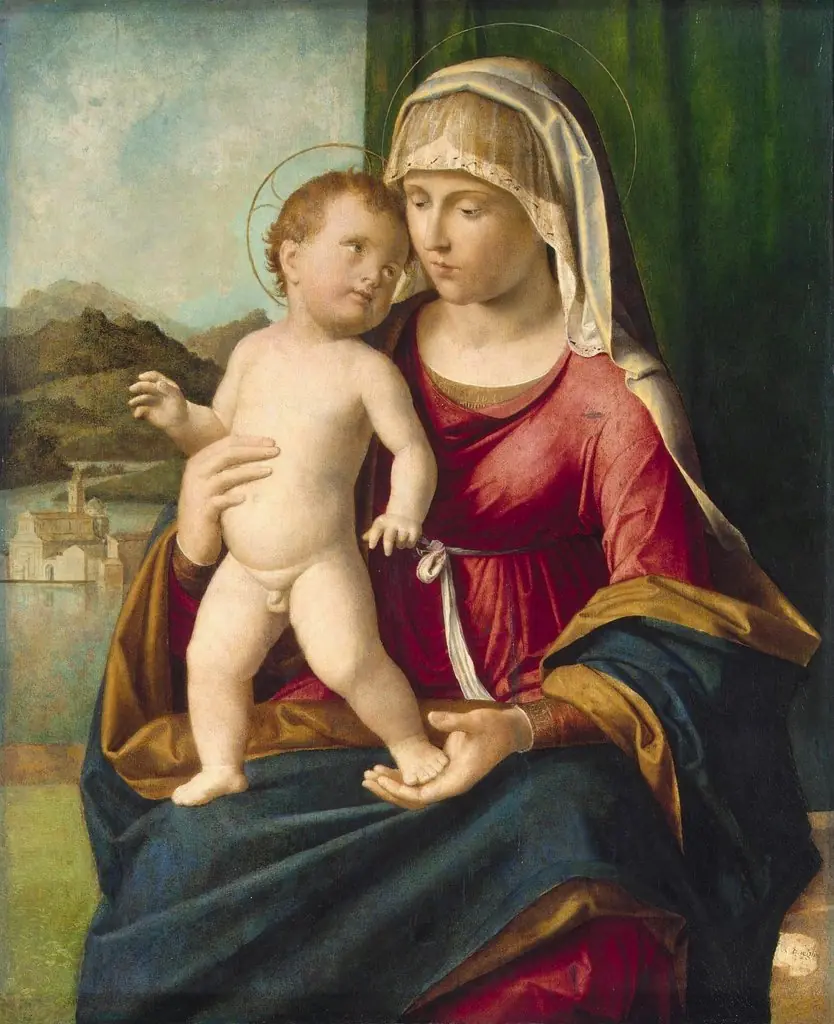
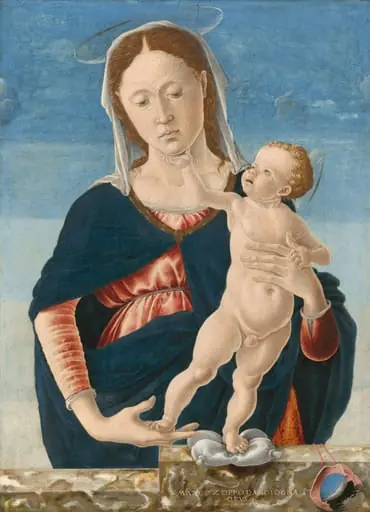
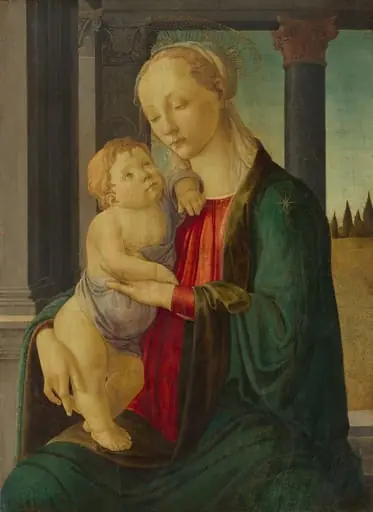
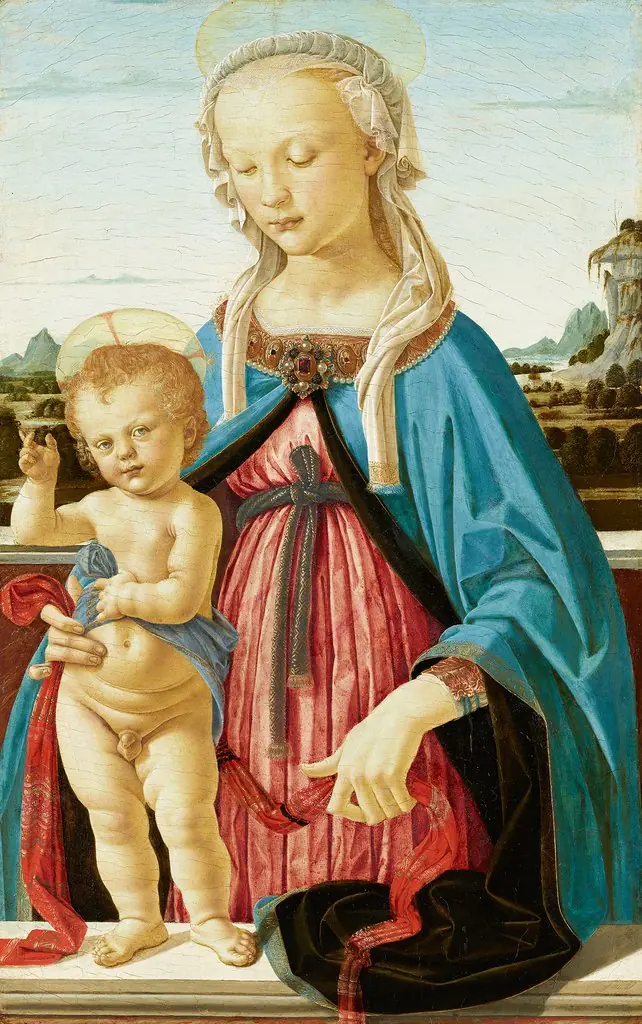
The painting depicts the Virgin Mary holding the Christ Child, who stands on a parapet before a landscape visible through twin windows. Mary holds a pomegranate in her left hand, a fruit rich in symbolic meaning: its red seeds prefigure the blood of Christ's Passion, while the fruit also signifies fertility and the promise of resurrection. The Child reaches for the seeds, offering them back to his mother, an intimate gesture that subtly alludes to the sacrificial offering of his life.
Mary's composed yet melancholic expression foreshadows her son's tragic fate. The refined aureoles and the contrast between the dark interior and the luminous landscape reinforce the work's devotional character, typical of small-format domestic altarpieces from the late fifteenth century.
Technique & Style
The painting is executed in oil on a poplar panel, measuring 16.5 × 13.4 cm. Its handling demonstrates soft transitions of color and contour, yielding delicate, almost transparent flesh tones, while maintaining clear, Verrocchiesque contours. The color palette combines red, dark green, yellow, blue, and violet, with strong chromatic contrasts in the Virgin’s robe that create marble-like highlights. The composition, featuring a parapet, multiple light sources, and a landscape viewed through windows, reflects Flemish influence.
Radiography has revealed that the landscape was painted at a later stage, suggesting collaborative workshop execution. The Christ Child’s figure is noted for elongated, somewhat disproportionate forms, differing from typical Leonardesque infant depictions. Overall, the stylistic technique bridges Florentine workshop traditions with emerging Leonardesque sfumato effects.
History & Provenance
The early provenance of the painting is uncertain, though it may have belonged to the Parisian collector Charles Timbal before entering the collection of Gustave Dreyfus, probably via a purchase in England. After Dreyfus's death in 1914, his heirs sold the work in 1930 to Duveen Brothers. In September 1951 it was acquired by the Samuel H. Kress Foundation, which donated it to the National Gallery of Art in Washington in 1952.
Created in the workshop of Andrea del Verrocchio, the work is often dated to about 1477, but varying attributions (to Leonardo da Vinci or to Lorenzo di Credi) have led to proposed dates ranging from circa 1469 to 1480.
The painting is held at the National Gallery of Art in Washington, D.C., as part of the Samuel H. Kress Collection. It was accessioned into the museum in 1952 as a gift from the Samuel H. Kress Foundation. No specific inventory or accession number is recorded in the available sources, and no exhibition history is documented.
Context
The painting has been the subject of extensive scholarly debate, with attributions oscillating among Andrea del Verrocchio, Lorenzo di Credi, and Leonardo da Vinci. Early 20th-century scholars such as Wilhelm Suida argued for Leonardo, while others like Bernard Berenson maintained it was di Credi imitating Leonardo. Later research noted disparities from Leonardo’s style, including the absence of his characteristic finger marks and the use of an oak panel instead of poplar.
The work is now generally cataloged as a product of Verrocchio’s workshop, with the National Gallery of Art attributing it to Lorenzo di Credi. Its composition, with the Christ Child standing on a parapet holding a pomegranate, shows Venetian influence via Bellini and echoes di Credi’s other Madonnas, placing it within the experimental environment of 1470s Florence.
Legacy
The work’s legacy is defined by a long-running attribution debate that has made it a touchstone for scholars of the Verrocchio workshop. Known as the Madonna Dreyfus after its former owner, the painting has been variously assigned to Verrocchio, Lorenzo di Credi, and Leonardo da Vinci. If accepted as Leonardo’s, it would be his earliest surviving panel painting, dating to about 1469, and thus of singular importance for his oeuvre.
The controversy, which began with Wilhelm Suida’s 1929 proposal of Leonardo’s authorship, continues today, with the National Gallery of Art cataloguing it as Lorenzo di Credi while many modern scholars lean toward Leonardo. This persistent debate ensures the painting remains a key object of study in Renaissance art history.
Overview
Lorenzo di Credi's "Madonna and Child with a Pomegranate" is a compact oil painting on poplar panel, created around 1475-1480 in Florence. Measuring just 16.5 by 13.4 centimeters, this intimate work served as a private devotional image. It reflects the precise draftsmanship and refined finish characteristic of the Florentine workshops of the late Quattrocento, where di Credi trained under Andrea del Verrocchio.
Own this work as a print
Artist & collection

Artist
Lorenzo di Credi (1456/59 – January 12, 1537) was an Italian Renaissance painter and sculptor best known for his paintings of religious subjects, and portraits.