Artwork
Hot Springs at Abano
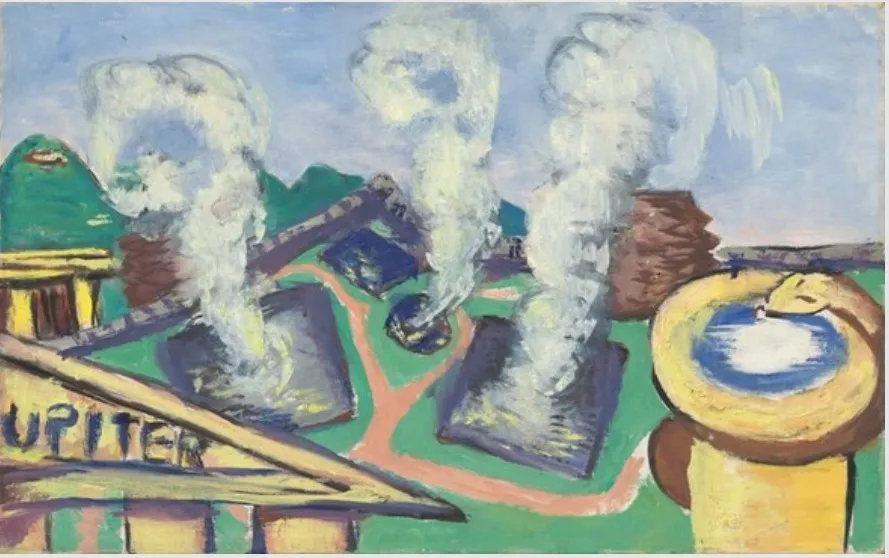
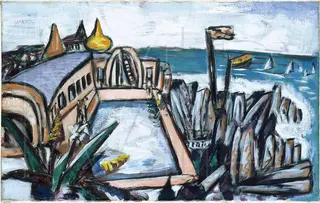
Hot Springs at Abano is an oil painting by the German Expressionist artist Max Beckmann. It dates from 1939 and is held in the collection of the National Gallery of Art.
About this work
History & Provenance
Max Beckmann painted Hot Springs at Abano in 1939 while working in Amsterdam, creating an oil on canvas measuring 50.2 cm by 80.7 cm. The painting is held in the collection of the National Gallery of Art in Washington, D.C. The available sources do not record a specific accession number or a documented exhibition history for the work beyond its place in the museum's collection.
Overview
Created in 1939, Hot Springs at Abano is an oil painting by German artist Max Beckmann. The work is held by the National Gallery of Art in Washington, D.C. It depicts a modest bathing complex, rendered with bright, flat planes of color and a pronounced impasto surface that gives the scene a tactile quality.
Subject & Meaning
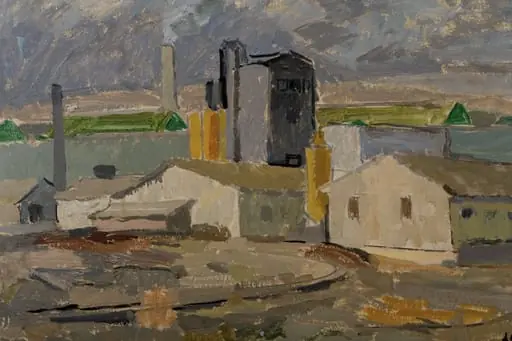
The composition presents a row of low‑rise structures from which steam rises, forming translucent, ghost‑like shapes above the roofs.
The composition presents a row of low‑rise structures from which steam rises, forming translucent, ghost‑like shapes above the roofs. Everyday objects, a few pots and a hat, appear on the right, while a sign bearing the word “SUPER” is visible on the left. Though the subject appears light‑hearted, the overall atmosphere conveys a subtle tension, reflecting Beckmann’s habit of infusing ordinary scenes with an undercurrent of unease.
Technique & Style
Beckmann employs a palette of vivid, unmodulated hues, green roofs, yellow walls, blue windows, applied in thick, impasto strokes that create a rough texture. The flatness of the color fields contrasts with the sculptural quality of the paint, a hallmark of his approach that balances precise draftsmanship with a tactile, almost sculptural surface.
Context
Although often associated with Expressionism, Beckmann rejected that label and aligned himself with the New Objectivity (Neue Sachlichkeit) movement of the 1920s, which emphasized a detached, observational stance toward reality. Hot Springs at Abano illustrates this shift, presenting a seemingly simple leisure scene with a sober, objective eye while retaining a hint of emotional ambiguity.
Legacy
The painting exemplifies Beckmann’s mature period, where his synthesis of precise composition and expressive surface treatment influenced post‑war European art. Its inclusion in a major national collection underscores its role in demonstrating the transition from early 20th‑century Expressionist fervor to the more measured, socially aware perspective of New Objectivity.
Artist & collection
Artist
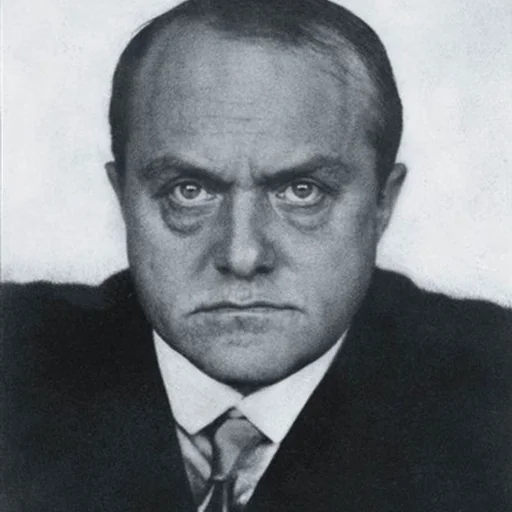
Max Carl Friedrich Beckmann (February 12, 1884 – December 27, 1950) was a German painter, draftsman, printmaker, sculptor, and writer.