Artwork
Christ in the Wine Press
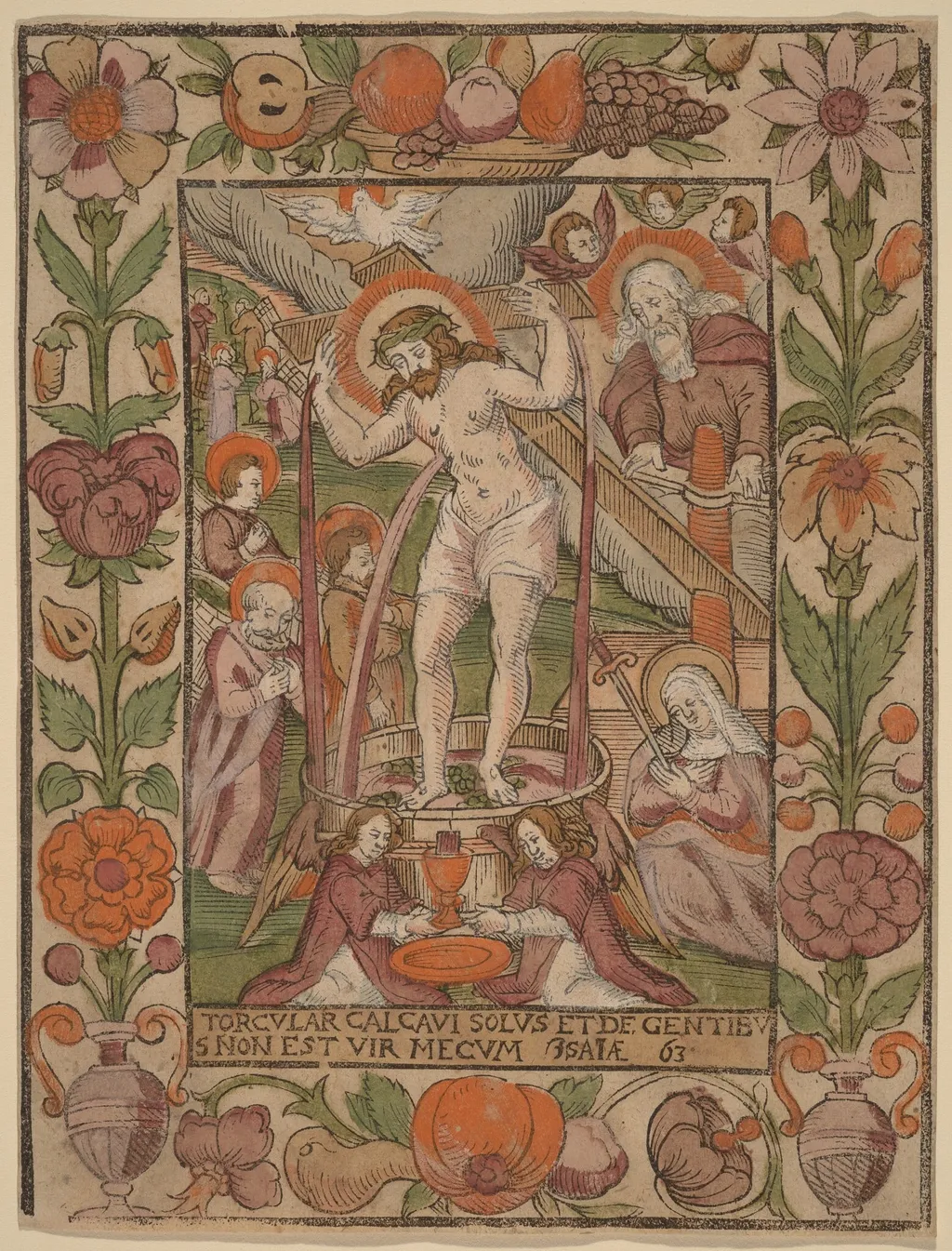
Christ in the Wine Press is an ink print by the Renaissance artist Netherlandish 16th Century. It dates from 1501 and is held in the collection of the National Gallery of Art.
- Inscription
- Inscribed:in block, below central image: TORCVLAR CALCAVI SOLVS ETDE GENTIEV / S NON EST VIR MECVM ISAIAE 63
About this work
Overview
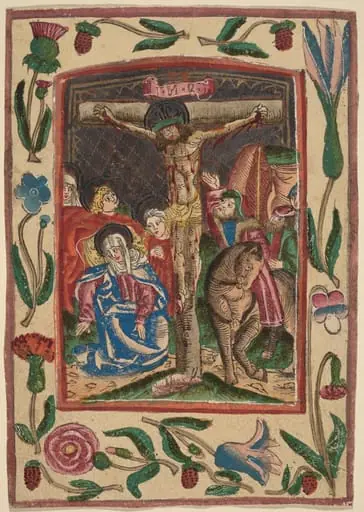
The work is a hand‑colored woodcut on laid paper, depicting a densely populated interior framed by a decorative border of fruit, flowers, and vines.
The work is a hand‑colored woodcut on laid paper, depicting a densely populated interior framed by a decorative border of fruit, flowers, and vines. At its centre a shirtless, haloed figure stands within a wine press, grasping a long pole, while surrounding figures observe or assist. Two angels hover above, and a bearded man on the right holds a scroll.
The palette is restrained, dominated by muted burgundy, green, and tan, with occasional bright reds and oranges in the botanical elements.
Subject & Meaning
The central figure is identified as Christ, positioned in a wine press to evoke the biblical metaphor of wine as his blood. The accompanying Latin inscription references Isaiah 63, linking the scene to prophetic imagery of divine wrath and redemption. The presence of angels and the scroll‑bearing figure reinforces the theological narrative, presenting the crucifixion as a sacrificial act tied to Old Testament prophecy.
Technique & Style
Executed as a woodcut, the image was carved in relief on a wooden block, inked, and printed onto laid paper. After printing, the artist applied hand‑coloring using burgundy red, pink, dull green, dull orange, brown, tan, and white, creating a limited yet nuanced chromatic scheme. The style reflects the intricate line work typical of late‑Renaissance printmaking, with dense figuration and ornamental borders characteristic of devotional prints.
History & Provenance
The print belongs to the tradition of religious woodcuts produced for private devotion and liturgical use in the early modern period. While the exact date and creator are not specified, its iconography and hand‑coloring technique align with 16th‑ to 17th‑century European practices. The work has circulated among collectors of devotional prints, appearing in catalogues of religious imagery.
Context
During the Reformation and Counter‑Reformation, visual representations of Christ’s sacrifice were employed to reinforce doctrinal messages. The wine‑press motif draws on medieval allegory, where the pressing of grapes symbolised the extraction of Christ’s blood. Such prints served both as meditative aids and as didactic tools, reinforcing scriptural connections for a largely illiterate audience.
Artist & collection

Artist
This artist carved scenes with fine lines, mostly religious and mythological ones.