Artwork
The Launch of a Ship
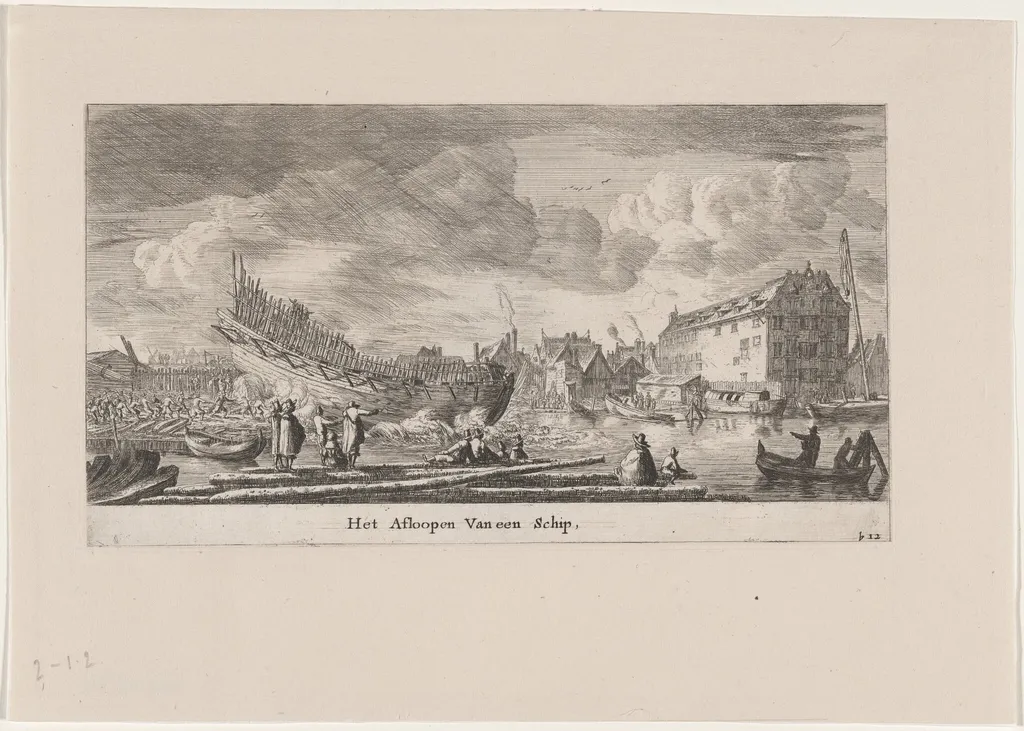
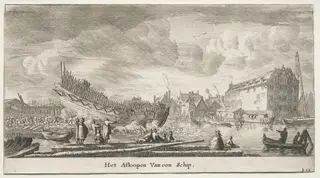
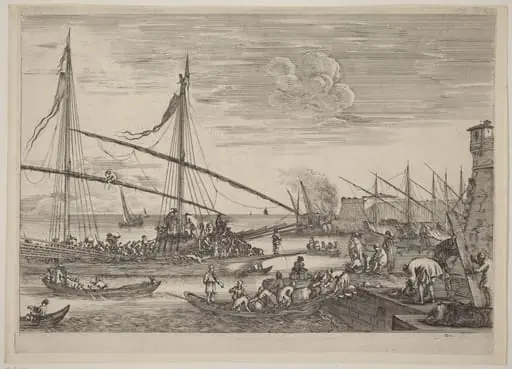
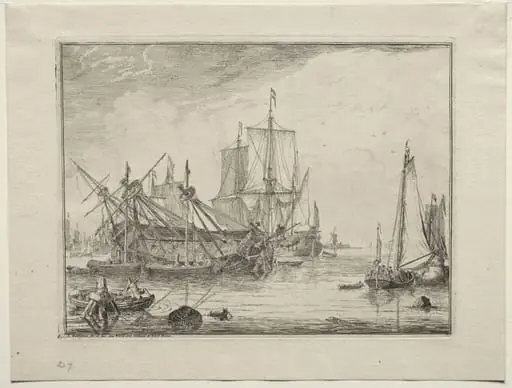
The Launch of a Ship is an ink print by the Baroque artist Nooms, called Zeeman, Reinier. It dates from 1653 and is held in the collection of the National Gallery of Art. Reinier Nooms, known as Zeeman, created this black-and-white print around 1653 using etching and drypoint on laid paper.
- Inscription
- Inscribed:lower center in plate: Het Afloopen Van een Schip, / b 12
About this work
Overview
Reinier Nooms, known as Zeeman, created this black-and-white print around 1653 using etching and drypoint on laid paper.
Reinier Nooms, known as Zeeman, created this black-and-white print around 1653 using etching and drypoint on laid paper. The work belongs to a series focused on Dutch maritime life, reflecting his deep engagement with nautical subjects. Mounted on a larger sheet, the print captures a ship’s launch with precise detail, demonstrating Nooms’s skill in rendering complex scenes through fine linear techniques.
Subject & Meaning
The scene depicts a large vessel being lowered into the water along a wooden slipway, surrounded by laborers and onlookers. Smaller boats and coastal buildings frame the activity, suggesting a commercial or naval port. The storm-lit sky adds tension, emphasizing the scale and risk of maritime enterprise.
Nooms presents the event not as spectacle but as routine labor, grounded in the daily rhythms of Dutch seafaring culture.
Technique & Style
Nooms combined etching with drypoint to achieve fine detail and tonal depth. The drypoint’s burr creates rich, velvety lines in the ship’s rigging and water’s surface, while etched lines define structural elements like the slipway and buildings. The dense, controlled linework renders texture with remarkable clarity, wood grain, fabric, and waves all emerge through subtle variations in line weight and density.
History & Provenance
Produced in the 1650s during the height of the Dutch Golden Age, this print was part of Nooms’s broader documentation of ships and harbors. His works were circulated among collectors and artists, valued for their accuracy. Though the original mounting and early ownership are undocumented, the print’s survival in institutional collections attests to its enduring reputation for technical fidelity.
Context
In mid-17th century Amsterdam, shipbuilding and trade were central to national identity. Nooms’s prints responded to public interest in maritime affairs, serving both as records and artistic interpretations of naval activity. His focus on specific vessels and locations aligned with a broader trend in Dutch art toward topographical precision and observational realism.
Legacy
Nooms’s detailed renderings influenced later maritime artists and cartographers seeking accurate depictions of ships and harbor scenes. His use of drypoint to enhance texture became a model for others working in printmaking. Though not widely celebrated in his lifetime, his works remain important references for historians studying Dutch naval architecture and seafaring practices.
Own this work as a print
Artist & collection

Artist
Reinier Nooms (c. 1623 – 1664), also known as Zeeman or Seeman (Dutch for "sailor"), was a Dutch maritime painter known for his highly detailed paintings and etchings of ships. From the 1650s, Nooms started producing…