Artwork
Village on the Island of Ischia
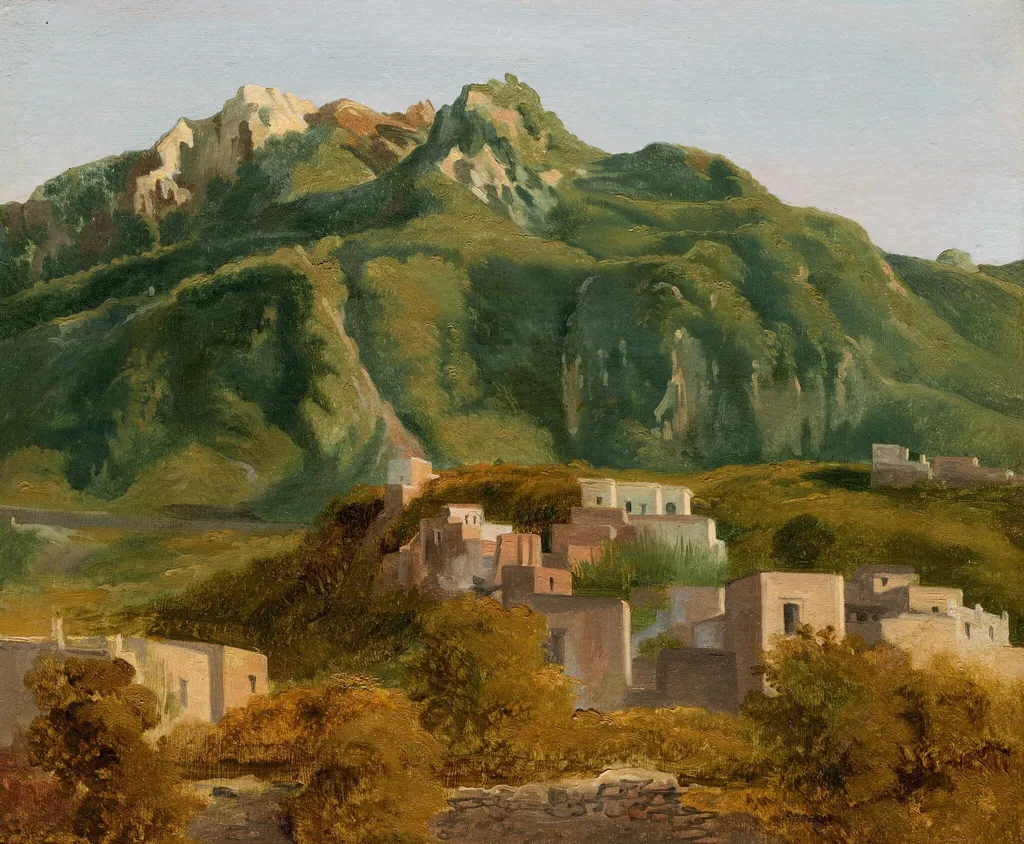
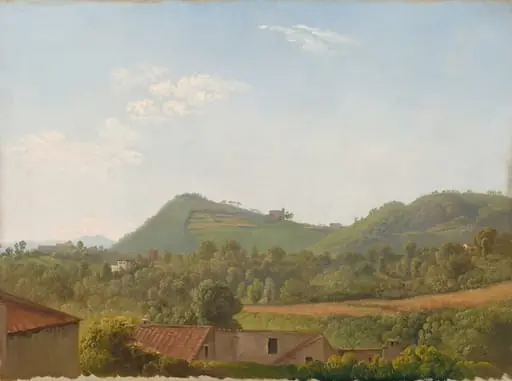
Village on the Island of Ischia is an oil painting by the Romanticist artist Sébastien-Louis-Guillaume Norblin de la Gourdaine. It dates from 1826 and is held in the collection of the National Gallery of Art.
- Inscription
- Inscribed:center of top stretcher bar: Etude Peinte a Ischia / par Norblin (fils, le graveur) / Prix de Rome; upper right on top stretcher bar, torn label on which was originally written text now on center of top stretcher bar; scratched in upper center of frame: NORBLIN
About this work
Overview
Village on the Island of Ischia is an oil painting created around 1826 by the French artist Sebastien-Louis-Guillaume Norblin de la Gourdaine.
Village on the Island of Ischia is an oil painting created around 1826 by the French artist Sebastien-Louis-Guillaume Norblin de la Gourdaine. Executed in oil on paper mounted on canvas, the work measures 27 by 32.8 centimeters and is unsigned. The painting depicts a rustic settlement on the Italian island of Ischia and is recognized for its incorporation of atmospheric perspective typical of early nineteenth-century European landscape traditions. Today, the painting is held in the collection of the National Gallery of Art in Washington, D.C., under accession number 2004.166.30.
Subject & Meaning
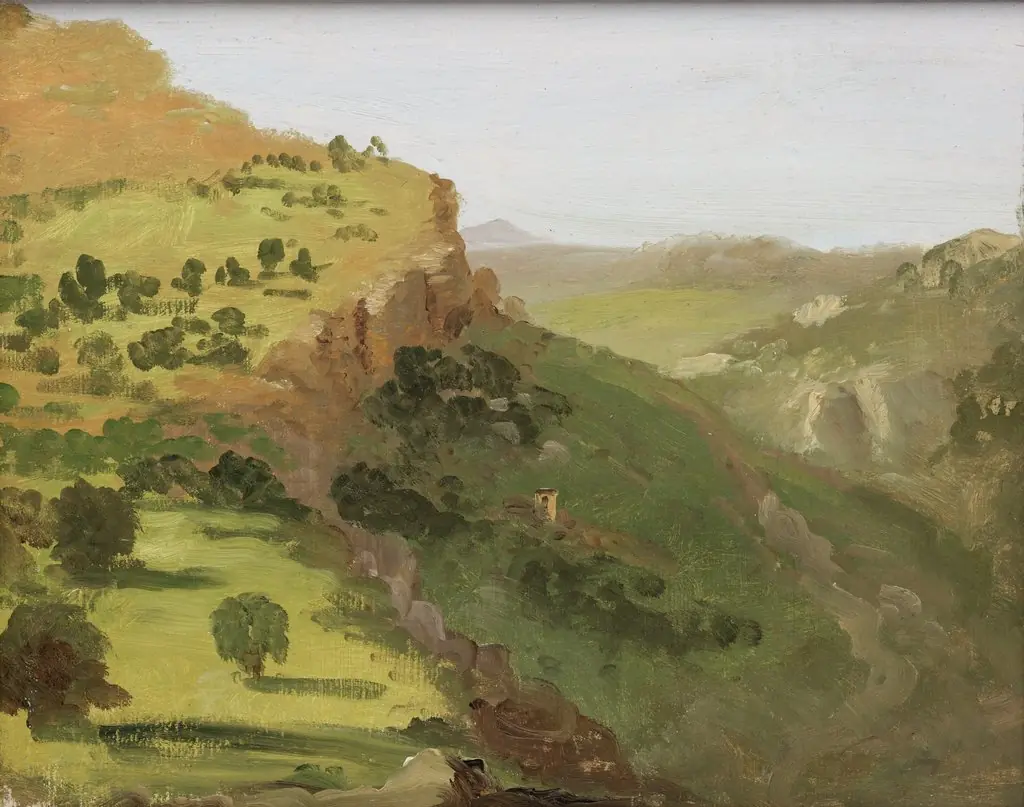
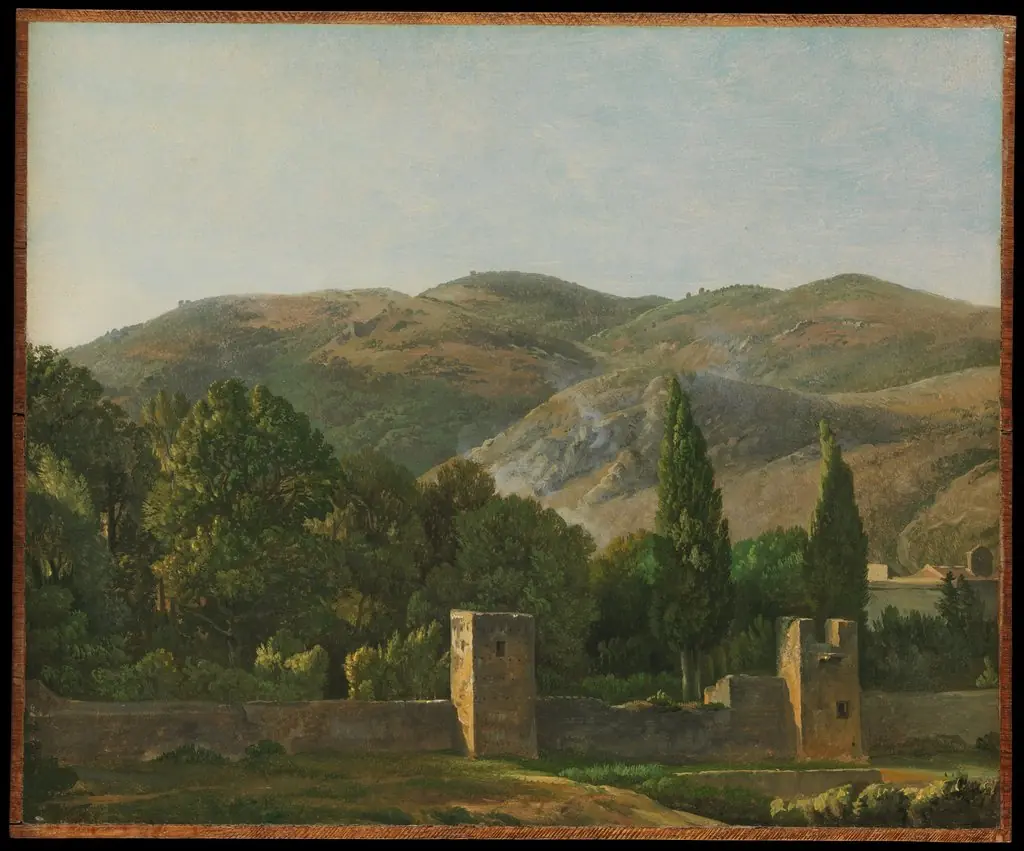
The composition is dominated by a massive green mountain that fills the background, its upper slopes broken by rocky outcrops in warm ochre and light tan. Below the peak, a cluster of simple rectangular buildings with flat roofs sits on a hillside, rendered in muted tones of white, cream, and dusty rose. Dense trees and shrubs in deep green and golden brown partially obscure these structures. The foreground features dry, golden vegetation and a low stone wall. Devoid of human or animal figures, the scene emphasizes the quiet, unpopulated rural character of the island hamlet. The even, diffused light and soft shadows convey a serene, clear day in the Italian countryside.
Technique & Style
Norblin employed oil paint applied over paper, which was subsequently mounted on canvas, a technique allowing for a specific surface texture and portability. The brushwork varies across the composition, appearing smooth in the pale, hazy blue sky, while becoming more textured and visible in the foliage and mountain surfaces to define the undulating terrain. The artist uses atmospheric perspective to achieve the hazy, diffused light characteristic of early nineteenth-century landscape painting. The painting is unsigned, though an inscription on the top stretcher bar identifies the work as an oil study painted in Ischia by Norblin, noting his status as a Prix de Rome recipient.
History & Provenance
Painted circa 1826, the artwork's early history remains undocumented in the provided records, though the stretcher bar inscription confirms it was an oil study executed on Ischia. By the late twentieth century, the painting belonged to the London collector John Gere, who died in 1995. It subsequently passed to the London art dealer James Mackinnon, who exhibited the work in 1996 at W.M. Brady and Co., Inc. in New York for the exhibition Aspects of Landscape 1760-1880. That same year, Frank Anderson Trapp of Pittsburgh purchased the painting. Trapp gifted the artwork to the National Gallery of Art in 2004.
Context
Sebastien-Louis-Guillaume Norblin de la Gourdaine, also known as Sobeck, was a French artist born in 1796 who lived until 1884. His career unfolded within the broader context of early nineteenth-century European landscape painting, a period marked by a growing interest in direct observation of nature and atmospheric effects. The inscription on the painting's stretcher bar indicates that Norblin had won the Prix de Rome, a prestigious French scholarship that allowed artists to study in Italy. This Italian sojourn provided the direct geographical context for the creation of this Ischia study, reflecting the period's artistic emphasis on capturing the Italian countryside en plein air or through on-site oil sketches.
Legacy
Village on the Island of Ischia survives as a focused example of a Prix de Rome winner's Italian landscape study, contributing to the understanding of nineteenth-century plein air practices that preceded the later innovations of the Barbizon School and Impressionism. Its public exhibition at the 1996 New York show, Aspects of Landscape 1760-1880, highlighted its role in the historical trajectory of European landscape art. The painting's inclusion in the National Gallery of Art's collection, facilitated by the Frank Anderson Trapp gift, ensures its continued preservation and study as a document of French artistic engagement with the Italian landscape and the specific topography of Ischia.
Own this work as a print
Artist & collection

Artist
Sébastien-Louis-Guillaume Norblin de la Gourdaine
Sébastien-Louis-Guillaume Norblin de la Gourdaine (1826–1826) was an artist.