Artwork
Flax Scutching Bee
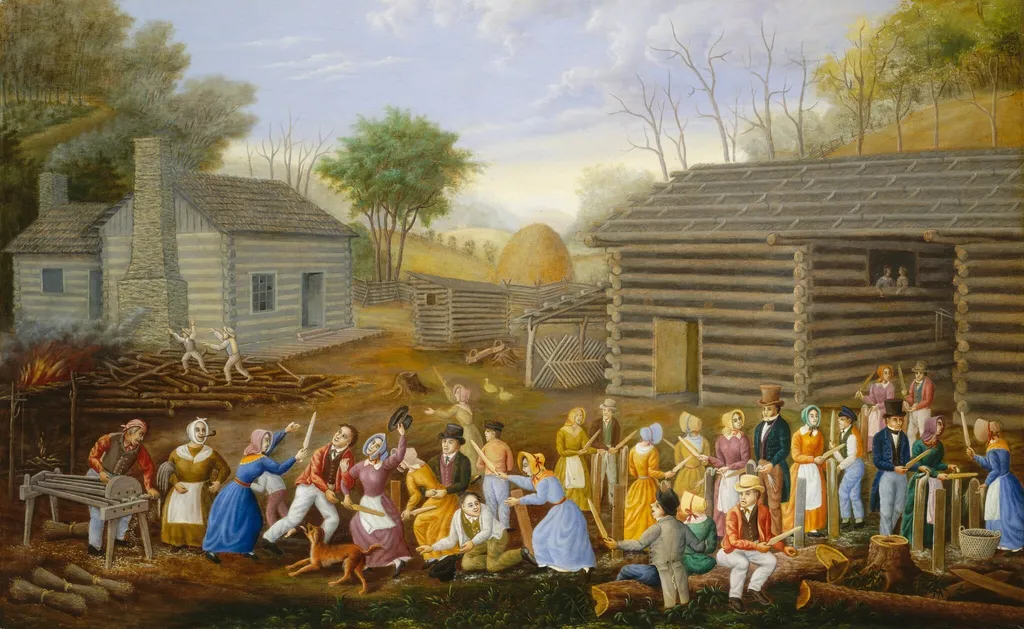
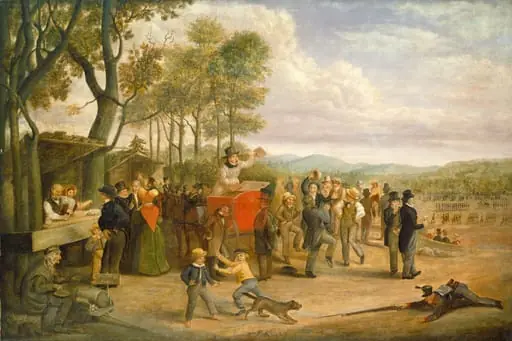
Flax Scutching Bee is an oil painting by the Impressionist artist Linton Park. It dates from 1885 and is held in the collection of the National Gallery of Art.
About this work
Technique & Style
Executed in oil on bed ticking, the work measures 80 by 128.3 centimetres. It exemplifies nineteenth-century American genre themes with a focus on rural labour, depicted through a realist handling of light on the textured support. The composition balances figural activity against a flattened spatial depth, reflecting Park's adaptation of European narrative strategies to a domestic American scene.
History & Provenance
It entered the possession of John Houk of Pennsylvania, who bought it directly from the artist for $10.
The painting was created in 1885 by Linton Park as an oil work on bed ticking. It entered the possession of John Houk of Pennsylvania, who bought it directly from the artist for $10. Houk later sold it to Mrs. Nanny Sedgwick of Indiana County, Pennsylvania.
After Sedgwick's death, Houk repurchased the work. It then passed through several owners, including Michael de Sherbinen in New York City by 1939 and Harry Stone in New York by 1942, before Edgar William and Bernice Chrysler Garbisch acquired it in 1948. The Garbischs subsequently gifted the work to the National Gallery of Art, Washington, D.C., in 1953, where it remains. The records do not list a specific accession number or public exhibition history.
Context
Flax Scutching Bee belongs to Linton Park's modest but documented body of work focused on Pennsylvania vernacular scenes, reflecting the artist's engagement with local agricultural traditions. Its depiction of communal flax processing offers insight into nineteenth-century rural labour and material culture, and the painting is studied within broader accounts of American folk and genre painting. Scholarly attention to the work remains limited, but its inclusion in the National Gallery of Art's collection has secured its standing as a representative example of late nineteenth-century American realist genre painting.
Overview
Flax Scutching Bee, painted in 1885 by Linton Park, is an oil work on bed ticking. The composition captures a bustling rural gathering centered on a hefty log, where figures in period attire engage in the labor of flax processing. The backdrop features modest log cabins, scattered trees and a muted, overcast sky, establishing a clear sense of place and time.
Subject & Meaning
The scene illustrates a communal flax‑scutching event, a traditional agricultural practice in which fibers are separated from the plant stalks. Participants are shown striking the log with tools, while others observe or rest, highlighting the collective effort required for this seasonal task. The painting reflects the social dimension of rural labor, emphasizing cooperation and shared routine in a pre‑industrial community.
Own this work as a print
Artist & collection