Artwork
Muster Day
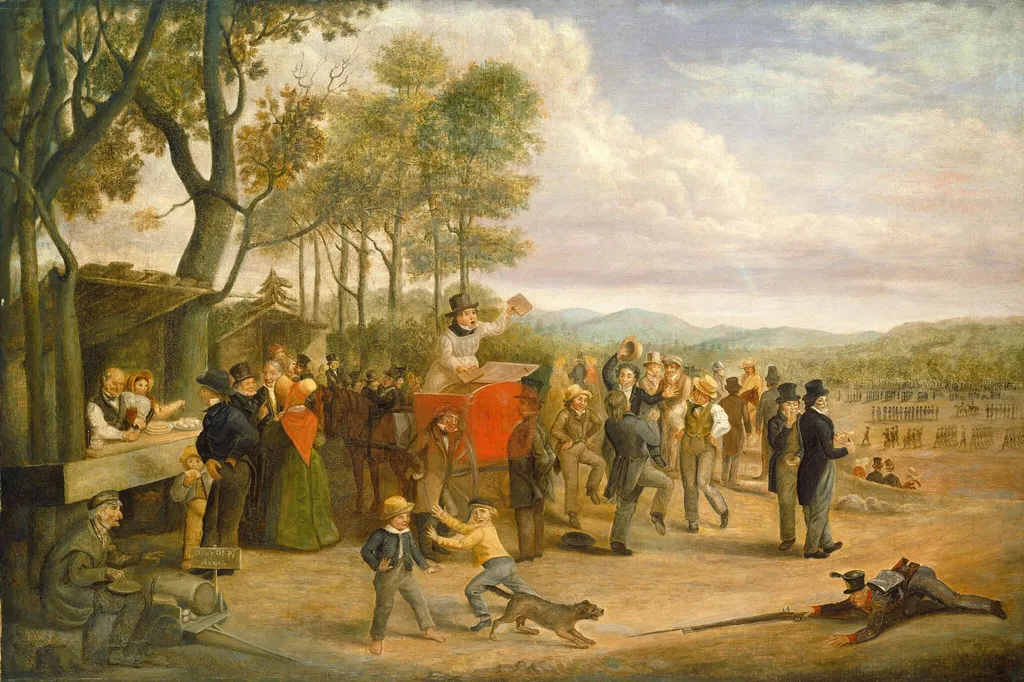
Muster Day is an oil painting by the Regionalist artist Charles Henry Granger. It dates from 1843 and is held in the collection of the National Gallery of Art.
- Inscription
- Inscribed:on sign at lower left: Bear O! Pi / Aiggs
About this work
Technique & Style
Muster Day is executed as an oil painting on canvas. The work measures 55.9 cm in height and 83.9 cm in width. Classified as a genre scene, the piece depicts a specific subject matter through the application of oil paint on a woven fabric support.
History & Provenance
The painting was commissioned and created by Charles Henry Granger, with the earliest documented date of execution given as 1843.
The painting was commissioned and created by Charles Henry Granger, with the earliest documented date of execution given as 1843. It remained in New Hampshire until it was owned by Robert Schuyler Tompkins of Montague, Massachusetts. In 1949, Tompkins sold the work to collectors Edgar William and Bernice Chrysler Garbisch.
Upon Bernice Chrysler Garbisch’s death, the painting passed by bequest to the National Gallery of Art, Washington, D.C., in 1980, where it entered the permanent collection.
The painting is held by the National Gallery of Art in Washington, D.C. It entered the collection through the bequest of Edgar William and Bernice Chrysler Garbisch in 1980, having been acquired by the Garbisches in 1949 from Robert Schuyler Tompkins of Montague, Massachusetts. The work was recorded as coming from New Hampshire.
Context
Charles Henry Granger (1809–1866) painted Muster Day in 1843, depicting a rural militia gathering in New Hampshire that reflects antebellum American civic life. The work was recorded in New Hampshire before being sold in 1949 by Robert Schuyler Tompkins of Montague, Massachusetts to Edgar William and Bernice Chrysler Garbisch; it entered the National Gallery of Art collection through their bequest in 1980. Granger's genre scenes, including this piece, contributed to 19th-century American realism, though his work remains less studied than contemporaries like Winslow Homer.
Muster Day is part of the National Gallery of Art's permanent collection in Washington, D.C., where it is displayed as an example of pre-Civil War social documentation in American art.
Legacy
Muster Day has shaped American genre painting through its vivid narrative of rural celebration. Granger's precise rendering of communal ritual influenced subsequent artists who documented regional customs, embedding the work in scholarly discussions of 19th-century American social realism. The painting's inclusion in the National Gallery of Art's permanent collection cemented its standing as a representative example of mid-century folk scene art, ensuring continued study of its technical and cultural resonance.
Overview
Muster Day, painted in 1843 by American artist Charles Henry Granger, is an oil on canvas that captures a bustling outdoor gathering. The work is held in the collection of the National Gallery of Art in Washington, D.C., and exemplifies mid‑nineteenth‑century genre painting with its detailed depiction of everyday communal activity.
Subject & Meaning
The composition presents a crowd dressed in period attire assembled around a horse‑drawn carriage. A man lies on the ground clutching a firearm, while a young boy perched on the carriage waves a sheet of paper, suggesting the announcement of a local muster or militia call‑to‑arms. The scene conveys a sense of collective readiness and civic participation typical of rural New England gatherings of the era.
Own this work as a print
Artist & collection

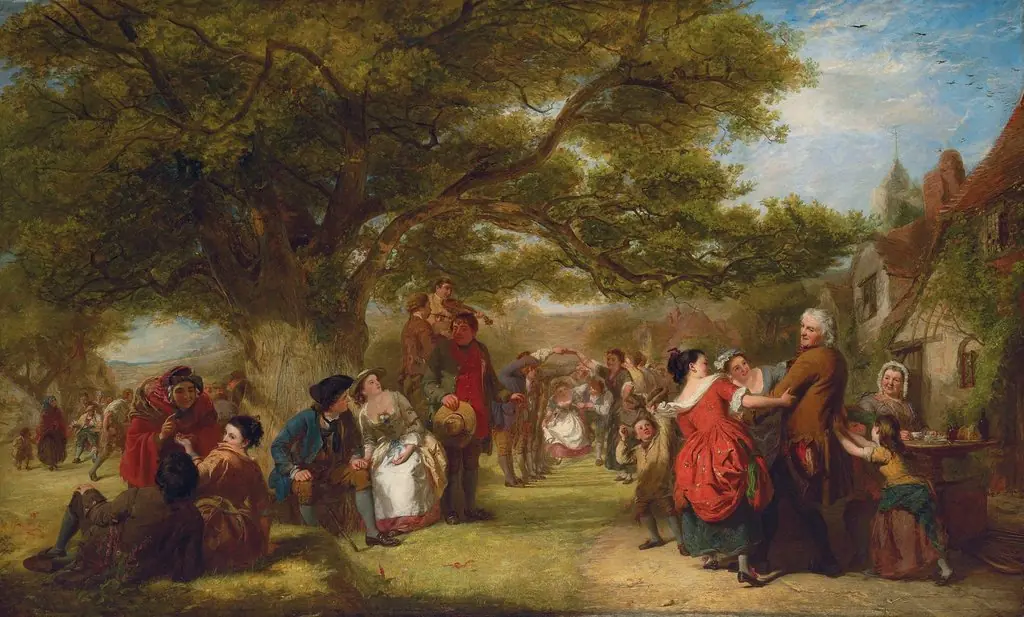
- An English Merrymaking a Hundred Years Ago
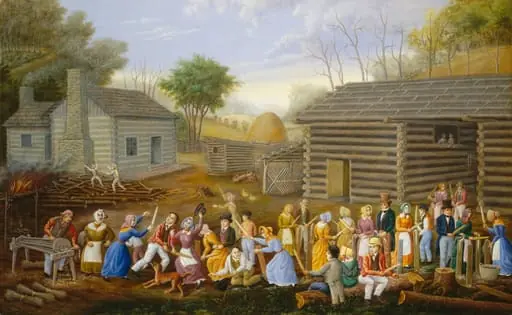 Flax Scutching Bee
 Fair in Tyniec
 Cider Making
 Heaton Park Races
 Der Auszug der Römer aus Vicenza
 Scene from the Ten Days' Campaign against the Belgian Revolt, August 1831
 Rising of the Kościuszko Mound
 Way to the ring
 The County Election
 Funeral of the Victims of the Year 1848
 The Finish