Artwork
The Circumcision
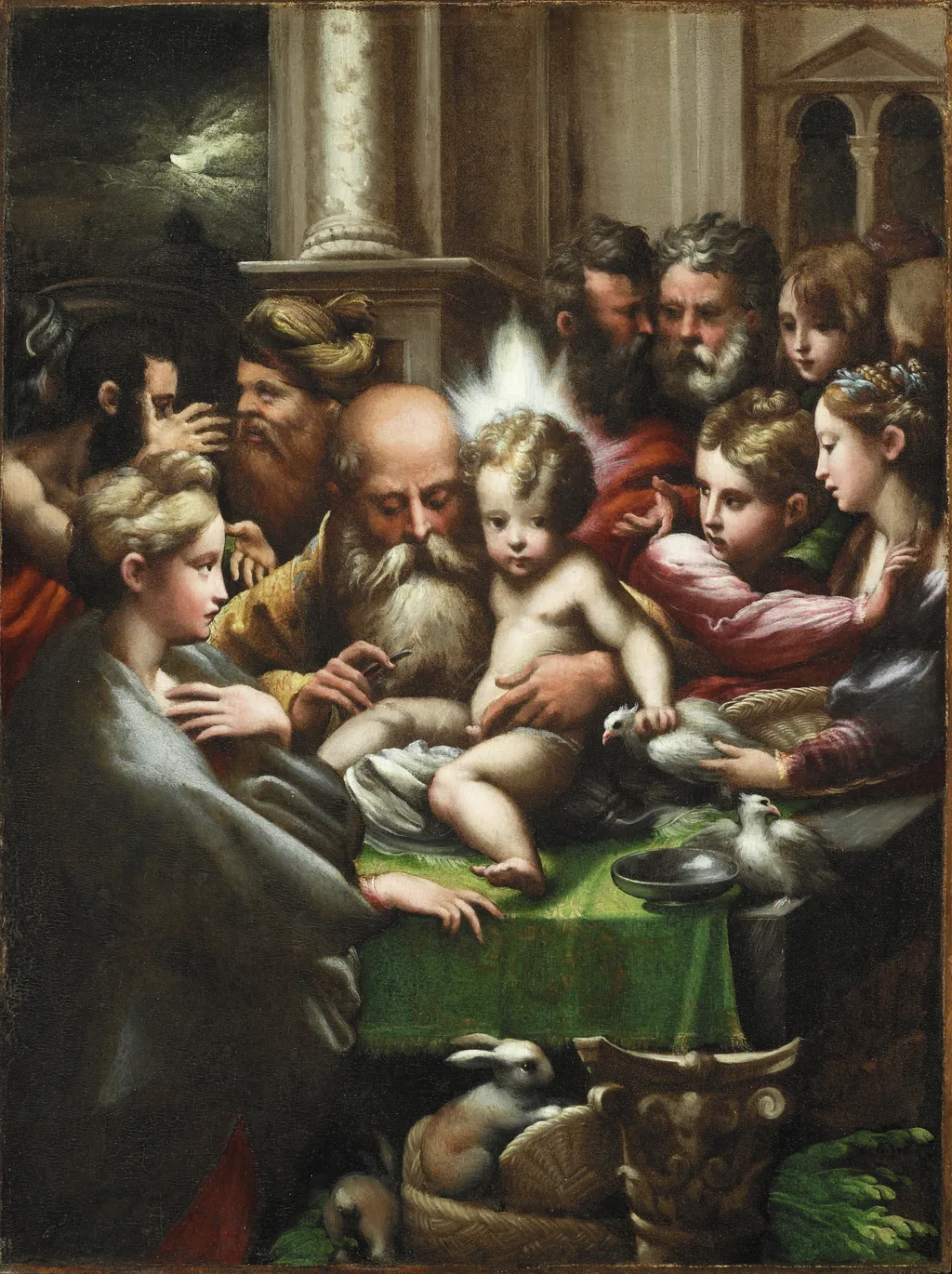
The Circumcision is an oil painting by the High Renaissance artist Parmigianino. It dates from 1523 and is held in the collection of the Detroit Institute of Arts.
About this work
The painting is called The Circumcision. It was made by an Italian artist around 1523. The Detroit Institute of Arts has this painting, which is about a common subject in art, the circumcision of Jesus.
This event is often depicted in art, and it's interesting to see how different artists show it. You can learn more about this type of art at the Detroit Institute of Arts.
Subject & Meaning
The well-illuminated Christ Child sits at the center, acting as a focal point for the surrounding figures' gestures and gazes, and emitting rays of light.
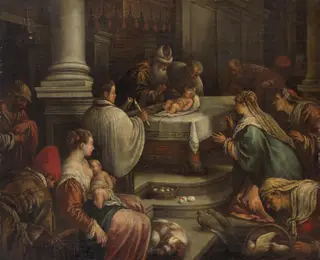
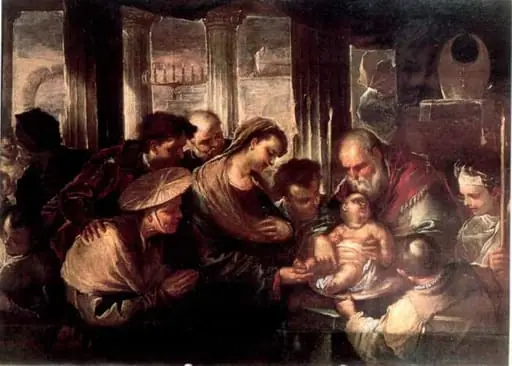
The painting depicts the circumcision of Jesus as described in the Gospel of Luke. The well-illuminated Christ Child sits at the center, acting as a focal point for the surrounding figures' gestures and gazes, and emitting rays of light. Two sacrificial doves allude to the concurrent purification of the Virgin Mary.
A very young, blonde Madonna stands at the left, while two figures converse behind her against a background featuring a rising sun emerging from a cloud. To the right, a priest holds the Christ Child on an altar and grips a ritual knife, surrounded by two rows of onlookers. Two small rabbits sit below among the offering baskets, serving as a symbolic detail.
Technique & Style
The Circumcision is executed in oil paint on panel, measuring 42 by 31.4 cm. The composition is built around the brightly illuminated Christ Child at the center, who serves as the luminous and geometric focal point, emitting rays of light that organize the surrounding figures' gazes and gestures. To the left stands a very young, blonde Madonna whose pure profile recalls Parmigianino's Saint Barbara in the Prado, while two figures converse against a background featuring a rising sun emerging from a cloud in a still-dark sky. To the right, six figures crowd into two rows alongside the priest, who holds the Child on the altar and grips the ritual knife.
Two small rabbits nestle among the offering baskets at the bottom, echoing a motif from the first chapel frescoed by the artist at San Giovanni Evangelista in Parma. The background is sketched swiftly with a column and an architectural backdrop. The handling combines cursive, enamel-like passages with velvety strokes, lending the small panel a strikingly modern quality that anticipates Mannerist taste.
History & Provenance
Parmigianino painted The Circumcision around 1523, a dating supported by stylistic comparison with his early works and a preparatory drawing held in the Cabinet des Dessins at the Louvre (inv. 6390). Giorgio Vasari described a Circumcision by the artist, though his account does not match the Detroit painting.
The work's secure provenance begins in the 1830s, when it belonged to the Russian imperial collection. It was documented in an 1851 etching by J. W. Muxel. In 1917 it was acquired in Stockholm by A.B. Nordiska Kompaniet, which later sold it to the American collector Axel Beskow.
Beskow donated the painting to the Detroit Institute of Arts in 1936. The attribution to Parmigianino, accepted by some scholars as early as 1930, was not unanimously established until 1991.
The Circumcision is currently held by the Detroit Institute of Arts in Michigan, United States. The work entered the museum's collection in 1936 as a donation from the American collector Axel Beskow, who had acquired it a few years earlier from the Swedish firm A.B. Nordiska Kompaniet. Prior to this transfer, the painting was documented within the Russian imperial collection starting in the 1830s, where it was recorded in an 1851 etching by J. W. Muxel.
The sources provide no specific inventory or accession number for the Detroit holding, nor do they list any specific exhibitions in the painting's history. While the work's attribution was debated until 1991, its physical residence has been established at the Detroit Institute of Arts since the mid-20th century.
Context
Scholarly debate regarding this work initially centered on its relationship to Giorgio Vasari's description of a Circumcision by Parmigianino featuring torch-bearing figures, a detail absent in the Detroit panel. While some researchers argue the painting matches Vasari's account of a small work gifted to Pope Clement VII, the attribution remained contested throughout the twentieth century. Although identified as Parmigianino's by early scholars, Sidney Freedberg removed it from the artist's catalogue in 1950, only reversing his stance following a 1977 restoration. Consensus was ultimately achieved in 1991 through the analyses of Konrad Oberhuber and Mario Di Giampaolo.
Art historically, the painting is situated within the artist's early Mannerist phase, dated circa 1523 based on stylistic comparisons with other youthful works and a preparatory drawing held at the Louvre. Critics note the sophisticated handling of multiple light sources and the modern, enamel-like brushwork as anticipatory of mature Mannerist aesthetics. Specific iconographic details, such as the rabbits included among the offerings, link the composition to Parmigianino's earlier fresco cycles in Parma.
Overview
Parmigianino’s oil painting titled The Circumcence portrays the biblical moment of Jesus’ circumcision. Executed circa 1523, the work belongs to the early sixteenth‑century Italian Mannerist tradition. It is presently displayed in the collection of the Detroit Institute of Arts in Michigan, where it forms part of the museum’s holdings of Renaissance art.
Own this work as a print
Artist & collection

Artist
Girolamo Francesco Maria Mazzola (11 January 1503 – 24 August 1540), also known as Francesco Mazzola or, more commonly, as Parmigianino (UK: US: Italian:; "the little one from Parma"), was an Italian Mannerist painter…