Artwork
Madonna and Child with Saints
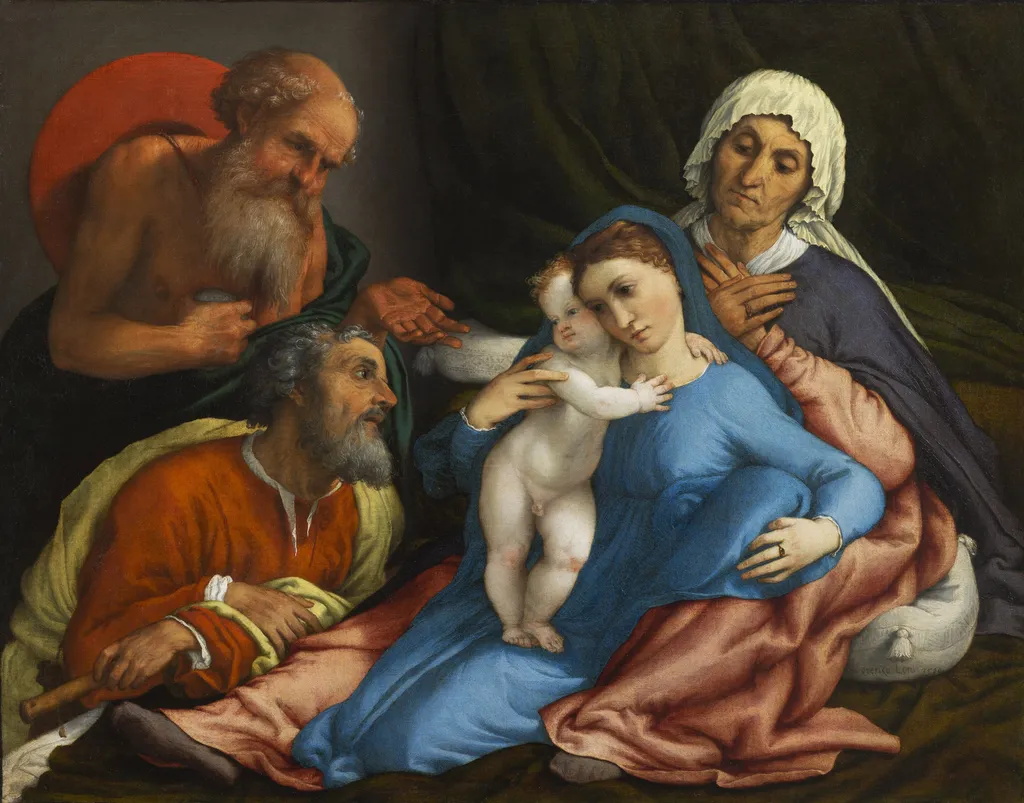
Madonna and Child with Saints is an oil painting by the Mannerist artist Lorenzo Lotto. It dates from 1534 and is held in the collection of the Uffizi Gallery.
About this work
Subject & Meaning
The painting is a sacra conversazione, a devotional format in which the Virgin and Child are flanked by saints gathered in a unified, contemplative space rather than separated into discrete panels. The composition centers on the Madonna with the Christ Child, watched over by Saint Anne on the right and venerated by Saint Joseph on the left, with Saint Jerome placed above them in shadow. Saint Joachim also appears alongside the Holy Family.
The arrangement plays along the diagonals of the canvas, balancing the tender intimacy of the maternal group on the right with the rapt, ecstatic figure of Joseph on the left, while Jerome recedes into a darker register. Vivid color contrasts and restless drapery heighten the pathos of the figures, and a free handling of light picks out the right-hand group, leaving the figures at left in relative shadow. The work is also thought to derive from a related prototype in the Seilern Collection in London, where an open window with a landscape replaces Jerome, underscoring the saint's symbolic weight in this version.
Technique & Style
A comparable version exists in the Seilern Collection in London, which differs by featuring a landscape through an open window instead of Saint Jerome.
Lorenzo Lotto's *Madonna and Child with Saints* is an oil painting on canvas, created in 1534. The work measures approximately 69 by 87.5 centimeters and is signed and dated by the artist. Stylistically, the composition relies on strong diagonal lines, arranging the Holy Family under the gaze of Saint Anne on the right and Saint Joseph in adoration on the left, with Saint Jerome positioned in shadow above. The painting exhibits the artist's characteristic vivid color contrasts and restless drapery. Light is applied with notable freedom, illuminating the right-hand group while relegating figures on the left to the background. A distinct feature is the expressive, almost ecstatic face of Saint Joseph, reflecting the period's emphasis on pathetic expressivity. A comparable version exists in the Seilern Collection in London, which differs by featuring a landscape through an open window instead of Saint Jerome.
History & Provenance
Lorenzo Lotto executed this oil-on-canvas painting in 1534, a date confirmed by the artist's signature on the work. Scholars suggest the composition may derive from an earlier prototype held in the Seilern Collection in London, which features a landscape visible through an open window rather than the figure of Saint Jerome found in this version.
The painting's documented history begins in the early eighteenth century, when it was recorded in the collections of the Palazzo Pitti in Florence. It currently resides in the Uffizi Gallery, having been transferred from the Pitti Palace.
The painting is currently held at the Uffizi Gallery in Florence. It was first documented at the Palazzo Pitti at the beginning of the 18th century before entering the Uffizi's collection. No specific inventory or accession number is recorded in the available sources, nor is any exhibition history noted.
Context
Lorenzo Lotto's 1534 *Madonna and Child with Saints*, held in the Uffizi Gallery, represents a mature example of the *sacra conversazione* genre within the artist's later career. Scholarship identifies the work as a signed and dated oil-on-canvas painting that likely derives from a prototype in the Seilern Collection, distinguished by the substitution of Saint Jerome for an open landscape window. Art historical analysis highlights the composition's dynamic diagonals and the expressive intensity of the figures, particularly the ecstatic face of Saint Joseph. The painting is noted for its vivid color contrasts, restless drapery, and dramatic lighting that isolates the right-hand group while casting Saint Jerome in shadow. Documented at the Palazzo Pitti since the early 18th century, the work exemplifies Lotto's stylistic traits of emotional pathos and complex spatial arrangement characteristic of his mid-1530s output.
Own this work as a print
Artist & collection
Artist
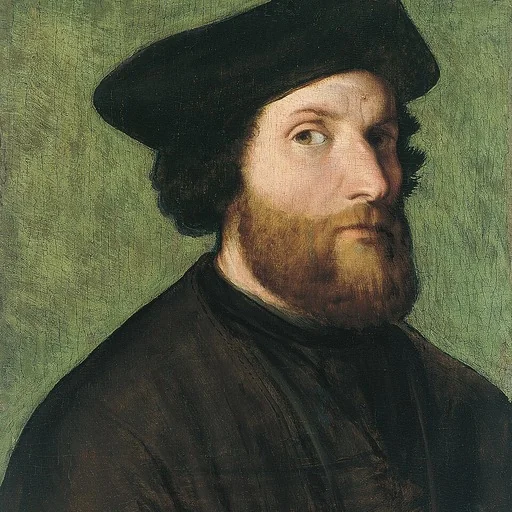
Lorenzo Lotto (c. 1480 – 1556/57) was an Italian Renaissance painter, draughtsman, and illustrator, traditionally placed in the Venetian school, though much of his career was spent in other north Italian cities. He…



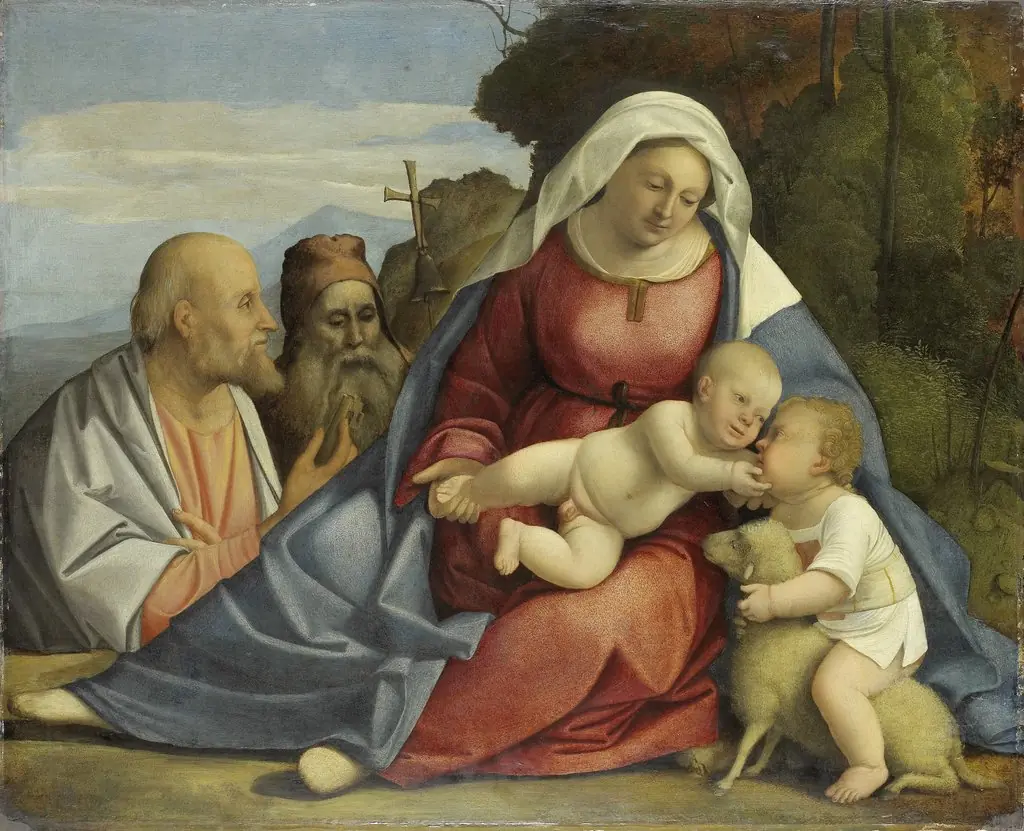 Virgin and Child with young John the Baptist, Saints Peter and Antony Abbot
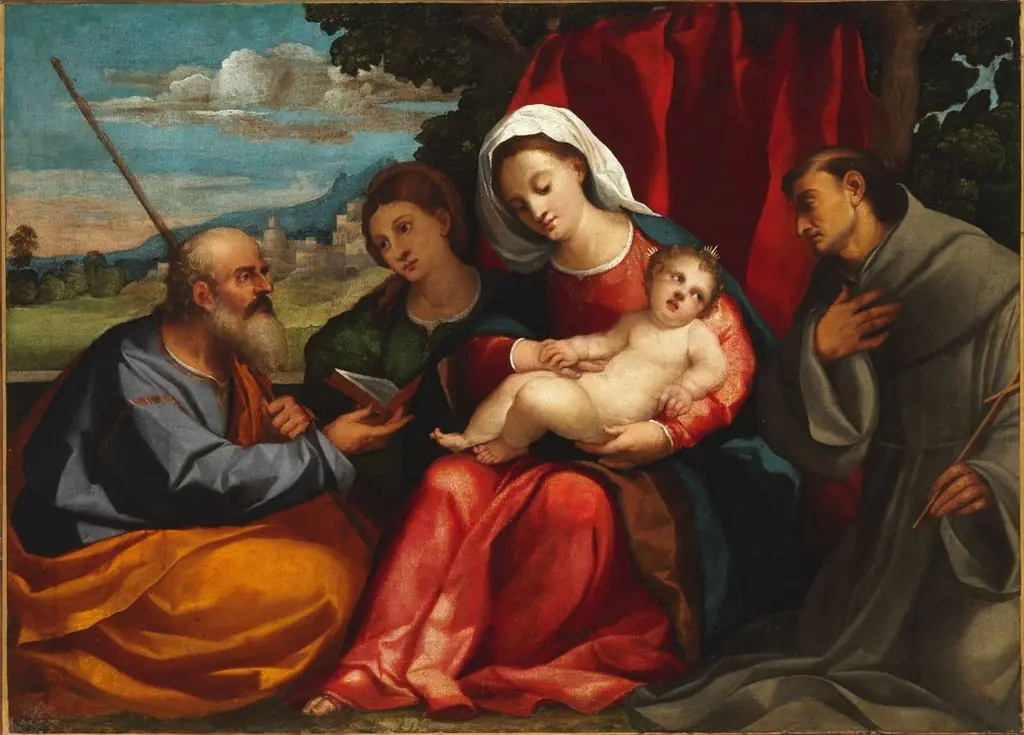 The Holy Family with a Female Saint and Saint Francis of Assisi
 Holy Family with the Mystic Marriage of Saint Catherine
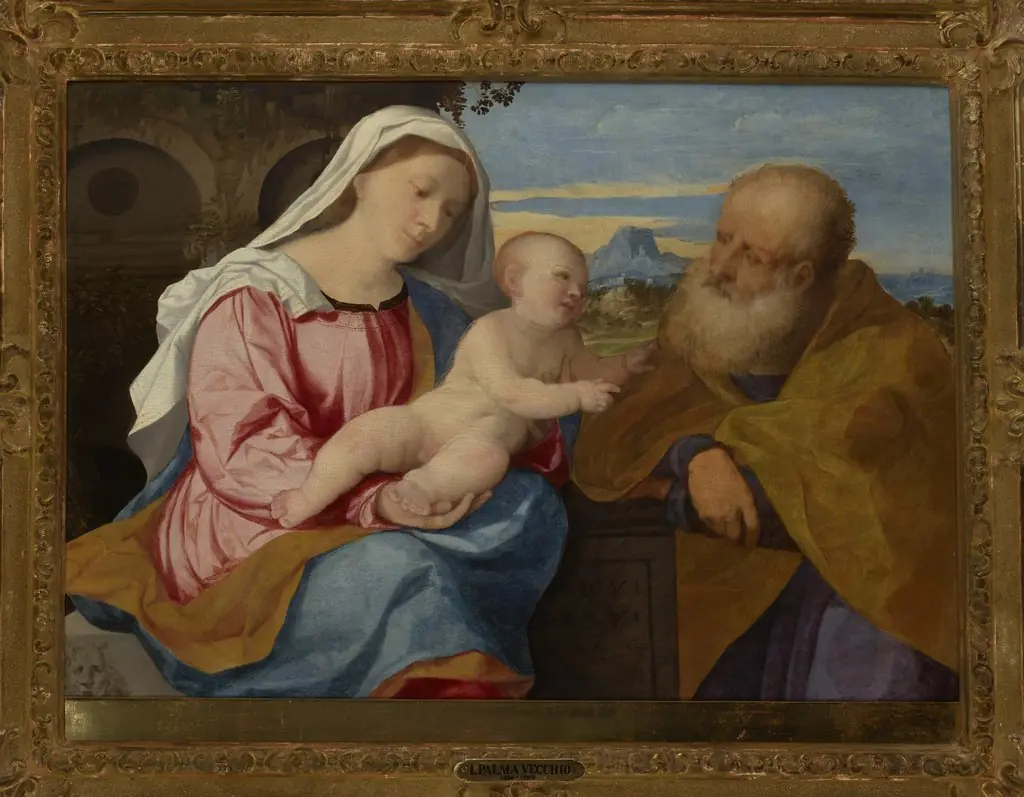 The Holy Family
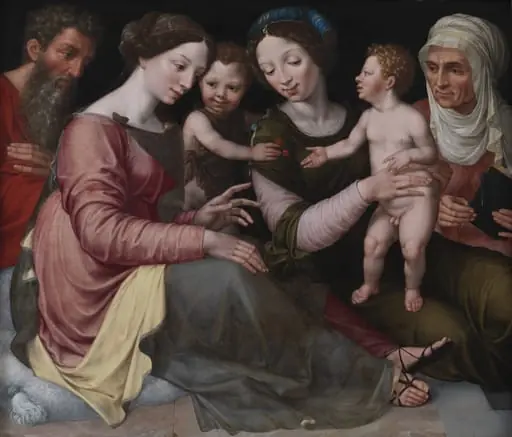 The Holy Family with the Infant St John, St Elizabeth and St Anna
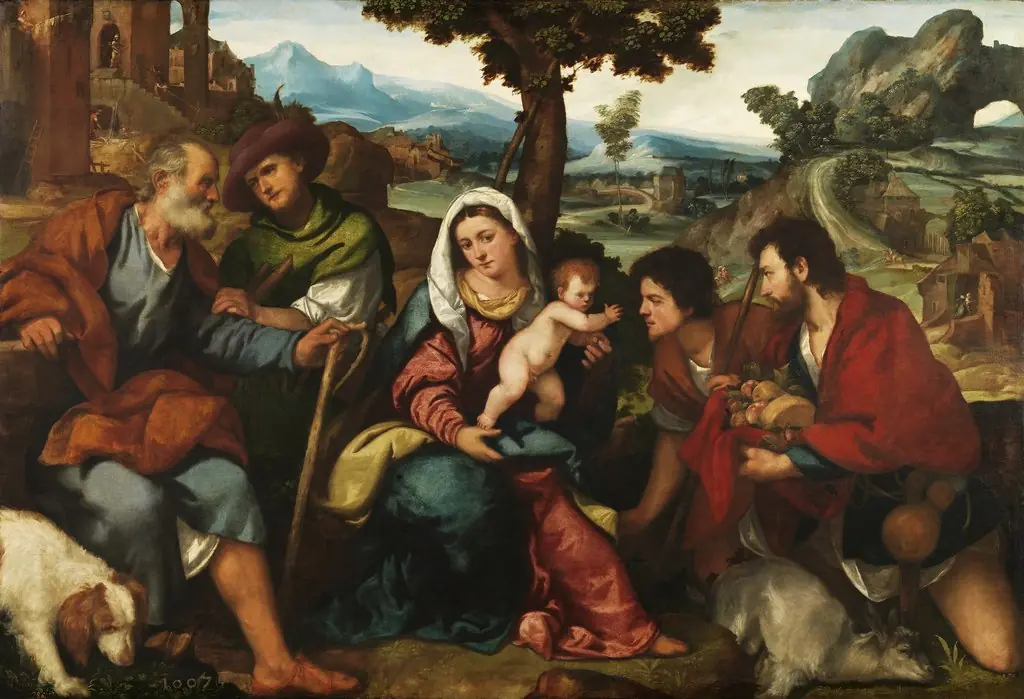 The Adoration of the Shepherds
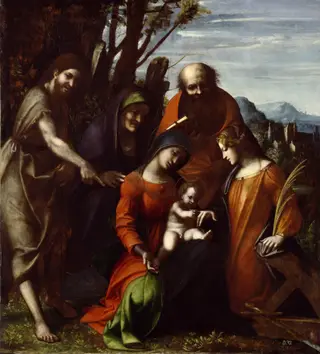 The Mystic Marriage of Saint Catherine