Artwork
Madonna and Child with Saints
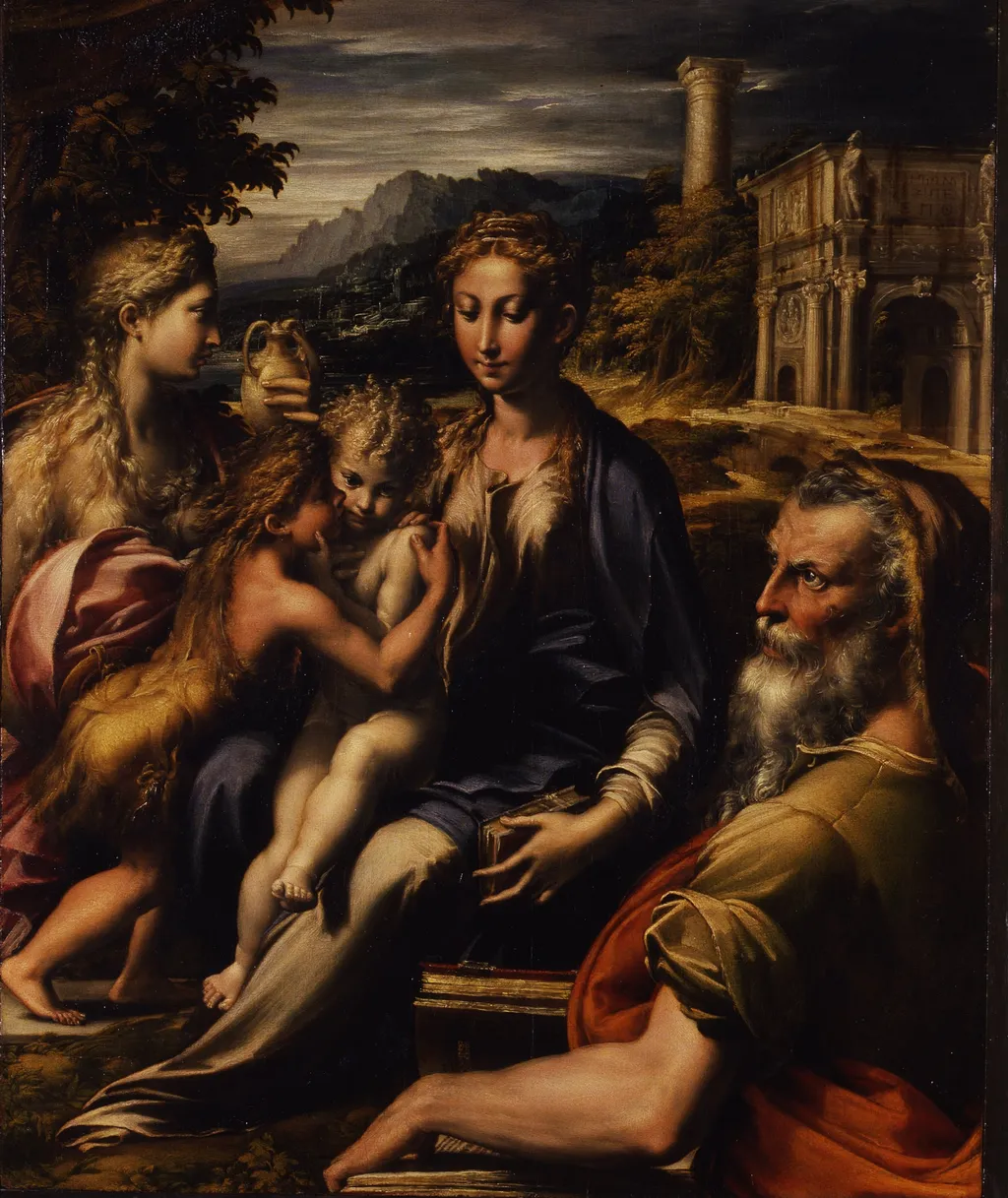
Madonna and Child with Saints is an oil painting by the Mannerist artist Parmigianino. It dates from 1530 and is held in the collection of the Uffizi Gallery.
About this work
Subject & Meaning
The composition is set against a backdrop of ruins and a distant port city, incorporating a triumphal arch reminiscent of Roman antiquity.
The painting depicts an unconventional sacred conversation featuring the Madonna and Child flanked by Saint Zechariah and Mary Magdalene, with the infant John the Baptist kissing Christ. The composition is set against a backdrop of ruins and a distant port city, incorporating a triumphal arch reminiscent of Roman antiquity. Theologically, the work serves as a prefiguration of the Passion of Christ.
This meaning is conveyed through specific iconographic details: the Magdalene presents her traditional jar of ointment, foreshadowing the burial, while the Christ Child is rendered with pale, ashen tones and a pensive expression that suggest a meditation on his future martyrdom. The interaction between the figures, particularly the gesture of John the Baptist, reinforces this narrative of impending sacrifice.
Technique & Style
Executed in oil on wood panel, the work measures 219 × 135 cm, with the figures rendered in a tightly controlled, Mannerist idiom. Parmigianino’s handling combines polished, almost enamel-like surfaces in the flesh passages with agitated, wet-looking drapery and dense, curling locks of hair that catch the light. The composition is organized along intersecting diagonals: one follows the Madonna’s legs, the Christ Child, the Baptist’s body, and Zechariah’s arm, leading into the ruinous background; the other cuts perpendicularly from the lower right foreground through the Madonna’s lap to the Magdalene and then to the distant, stage-like landscape behind.
The palette is dominated by resonant greens and yellows, while the figures, especially the Christ Child’s gray-toned flesh, are rendered with an uncanny pallor that prefigures the Passion. The background presents a fragmentary classical setting of ruins, an arched monument, and a distant harbor city, all bathed in a cool, even light that heightens the artificiality of the space.
History & Provenance
Dated to circa 1530–1533, this oil on panel painting by Parmigianino has a complex ownership history marked by conflicting documentation. The earliest definitive record from October 27, 1533, indicates a sale to Bonifacio Gozzadini of Bologna for 50 scudi, though evidence suggests this payment was never made. Instead, the transaction likely served to compensate Gozzadini for legal representation regarding the artist's disputes over the Madonna della Steccata frescoes between 1535 and 1538.
By 1550, the work was in the possession of the Manzoli family in Bologna, where it was viewed by Giorgio Vasari and Giovanni Lamo. Confusion regarding the original persisted for centuries, with a replica in the Galleria Corsini often mistaken for the authentic piece until 1903, when scholarship confirmed the Uffizi version as the original. The painting has been recorded in Florence since at least 1605.
The painting is held in the Galleria degli Uffizi, Florence, with accession number 1530 oil on panel.
It first appears in Florentine records by 1605 in the Tribuna of the Uffizi. Earlier, it was sold to Bonifacio Gozzadini of Bologna in 1533, though the 50 scudi agreed were never paid; Gozzadini later acted for Parmigianino in legal proceedings related to the Madonna della Steccata frescoes in Parma. By mid-century the work had passed to the Manzoli family in Bologna, where Giorgio Vasari and others noted it, complicating later attributions.
A key exhibition record is its inclusion in the Uffizi by 1605, and it has remained in that collection since.
Legacy
Parmigianino's Madonna and Child with Saints established a significant legacy through its influence on Baroque composition and print culture. Giulio Bonasone's 1543 engraving after the painting amplified its circulation, inspiring copies in major collections including the Galleria Farnese, Uffizi, Pinacoteca Capitolina, and Roman families such as the Corsini, Borghese, and Albani. Contemporary accounts, including those by Vasari and Lanzi, noted its widespread replication, with Lanzi calling it 'the most copied work in the gallery'.
The painting's complex history, initially misattributed to the Corsini family and later confirmed as the original in the Uffizi by 1903, reinforced its status as a benchmark for sacred composition. Its innovative use of diagonal movement, luminous color, and psychological depth in figures like Saint Zechariah and the Christ Child influenced later artists in their treatment of devotional subjects. The work's theological nuance, particularly its prefiguration of Christ's Passion through symbolic objects like the Magdalene's ointment vessel, further cemented its scholarly importance.
The painting remains housed in the Uffizi Gallery, where it has been part of the collection since at least 1605.
Overview
Created circa 1530–1533, this oil on panel by Parmigianino depicts the Virgin Mary with the infant Christ, accompanied by the biblical figure Zechariah, the father of John the Baptist. The work is part of the Uffizi Gallery’s collection in Florence.
Context
Executed in the later phase of Parmigianino’s career, the work reflects the Mannerist tendency toward elongated forms and elegant poses, while retaining the devotional intimacy typical of early 16th‑century Italian religious art.
Own this work as a print
Artist & collection

Artist
Girolamo Francesco Maria Mazzola (11 January 1503 – 24 August 1540), also known as Francesco Mazzola or, more commonly, as Parmigianino (UK: US: Italian:; "the little one from Parma"), was an Italian Mannerist painter…