Artwork
Cupid Making His Arch
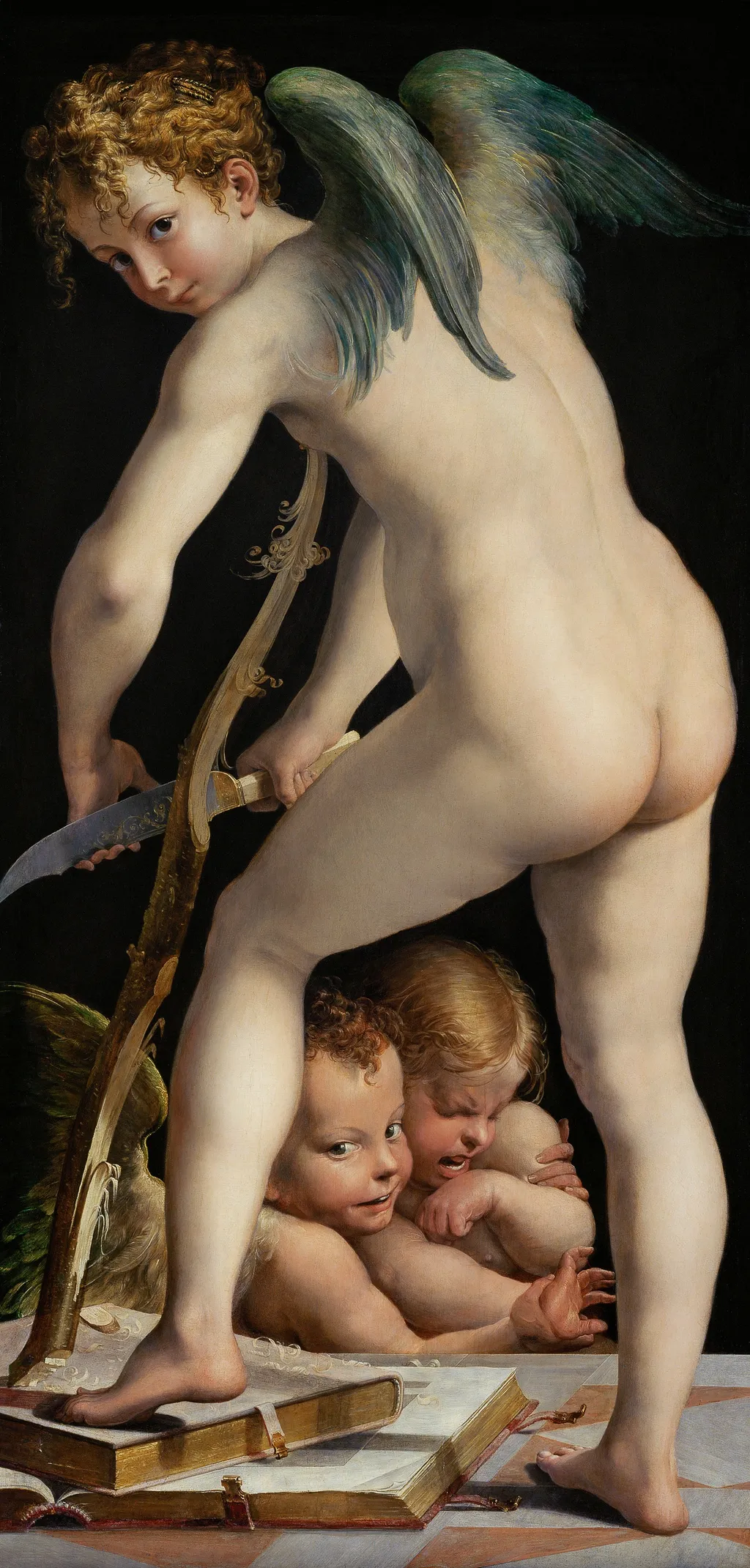
Cupid Making His Arch is an oil painting by the Mannerist artist Parmigianino. It dates from 1536 and is held in the collection of the Kunsthistorisches Museum.
About this work
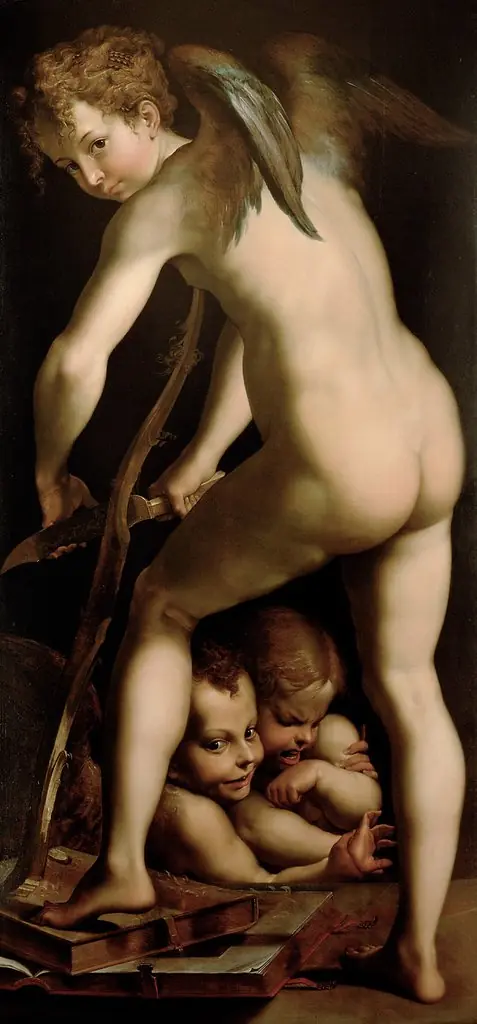
Parmigianino's Cupid Making His Arch shows a boy carving a bow, a small oil from 1536 made when the painter was only in his twenties. It already hints at the twisting, elegant figures, graceful and almost too slender, that he became known for.
Subject & Meaning
The painting depicts Cupid, a nude winged boy appearing approximately ten to eleven years old, carving a bow from a branch using a large knife.
The painting depicts Cupid, a nude winged boy appearing approximately ten to eleven years old, carving a bow from a branch using a large knife. He stands with his back to the viewer, turning his head to engage the spectator, while resting his foot on books that serve as a workbench, symbolizing the triumph of eros over reason. Two smaller putti appear between Cupid's legs: a male figure embracing a resisting female, representing contrasting aspects of love such as sacred versus profane.
Historical interpretations suggest these figures embody the risks of unrequited love or the fear of being burned by love's fire. The work combines Petrarchan literary inspiration with a pagan, carnal celebration of love, characterized by an innocent yet malicious expression and subtle sexual ambiguity.
Technique & Style
The work is executed in oil on a thin lime wood panel, measuring about 135 × 65 cm, typical of Parmigianino's late Renaissance practice. The paint is applied in thin, translucent layers that create a luminous surface, giving the nude boy a statuesque, almost marble-like presence. The handling of light is cold and artificial, emphasizing the sheen of the hair and the delicate rendering of musculature, while the composition's narrow vertical format frames the figure and the two cherubs intertwined among his legs, a motif that art historians interpret as symbolic of erotic tension.
History & Provenance
Parmigianino created Cupid Making His Arch around 1533–1536 as an oil painting on a lime wood panel. The work was commissioned by Francesco Baiardo, a friend and patron of the artist in Parma, as recorded by Giorgio Vasari. Following Baiardo's ownership, the painting was inherited by Marcantonio Cavalca.
It subsequently passed to Antonio Pérez, secretary of state to Philip II of Spain, who transported it to Spain. After Pérez fell from favor in 1579, he was forced to sell the piece; Count Khevenhiller, acting as an intermediary for Emperor Rudolf II, sought to acquire it. Although initially blocked and confiscated by the Spanish crown, negotiations between 1601 and 1603 allowed the purchase to proceed.
The painting arrived in Prague in 1603 alongside works by Correggio and was transferred to the Schatzkammer in Vienna in 1631. A preparatory drawing for Cupid's head is held in the Louvre's Cabinet des Dessins.
The painting is held at the Kunsthistorisches Museum, Vienna, where it is inventoried as 135.5 cm high by 65 cm wide. It entered the museum's collections in 1631, transferred from the imperial Schatzkammer. Prior to this, it was in Prague by 1603 after diplomatic negotiations secured its acquisition from Spain, where it had been held by Antonio Pérez following earlier ownership by Marcantonio Cavalca and its first recorded appearance in the inventory of Francesco Baiardo in Parma.
Context
Parmigianino's Cupid Making His Arch (c. 1533–1536) occupies a pivotal place in the artist's oeuvre within the broader context of Italian Mannerism. Giorgio Vasari, writing in his Lives of the Artists, praised the work as "vaga per colorito, ingegnosa per invenzione e graziosa," underscoring its refined coloring, inventive composition, and graceful execution. The painting's elongated format and polished, marble-like rendering of the youthful figure exemplify Parmigianino's stylistic synthesis of Correggio's soft modeling and the artificial elegance of mid-sixteenth-century Parma.
Its iconography, Cupid carving his own bow while two putti embody laughter and tears, engages Petrarchan literary traditions while foregrounding a pagan, carnal eroticism, a theme recurrent in Parmigianino's late mythologies. Its formal complexity also informed later artists: copies by Rubens and Joseph Heintz the Elder in Munich attest to its influence, while its provenance, from Parma to the Habsburg collections via Antonio Pérez, anchors it in the trans-European exchange of Mannerist art.
Legacy
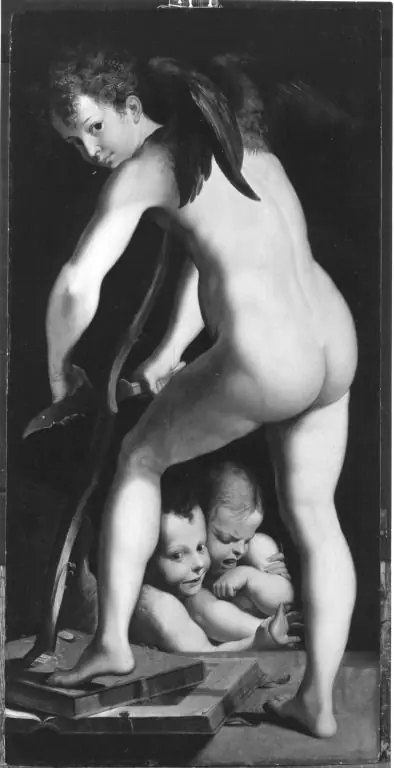
Cupid Making His Arch was highly regarded and frequently copied, serving as a model for numerous artists. Notable copies were produced by Joseph Heintz the Elder and Peter Paul Rubens, both of which are held in the Alte Pinakothek in Munich. Another copy, possibly painted by Eugenio Cajés, is conserved in the Museo del Prado; it was likely created before the original was sent to Prague.
The painting's reputation was established early on; in the sixteenth century, Giorgio Vasari praised it as colorful, inventive, and graceful. By the seventeenth century the work continued to attract significant attention, being viewed and described by Marco Boschini in 1660 and Alessandro Tassoni in 1676.
Overview
Cupid Making His Arch, an oil painting by the Italian late Renaissance artist Parmigianino, dates from approximately 1533 to 1535. This relatively small canvas is presently housed in the Kunsthistorisches Museum in Vienna, Austria. It depicts the mythological figure of Cupid engaged in crafting his weapon, offering an early glimpse into the artist's developing aesthetic.
Artist & collection

Artist
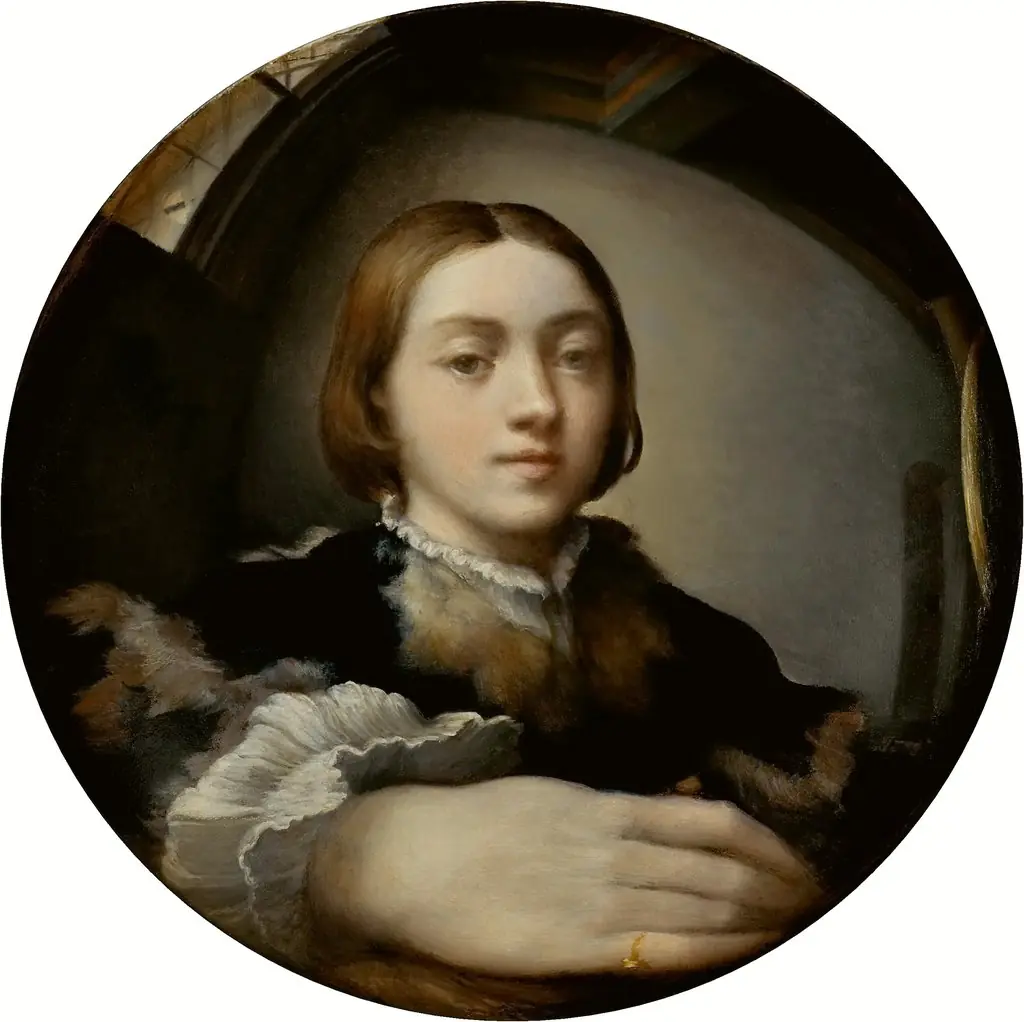
Girolamo Francesco Maria Mazzola (11 January 1503 – 24 August 1540), also known as Francesco Mazzola or, more commonly, as Parmigianino (UK: US: Italian:; "the little one from Parma"), was an Italian Mannerist painter…