Artwork
Self-portrait in a Convex Mirror
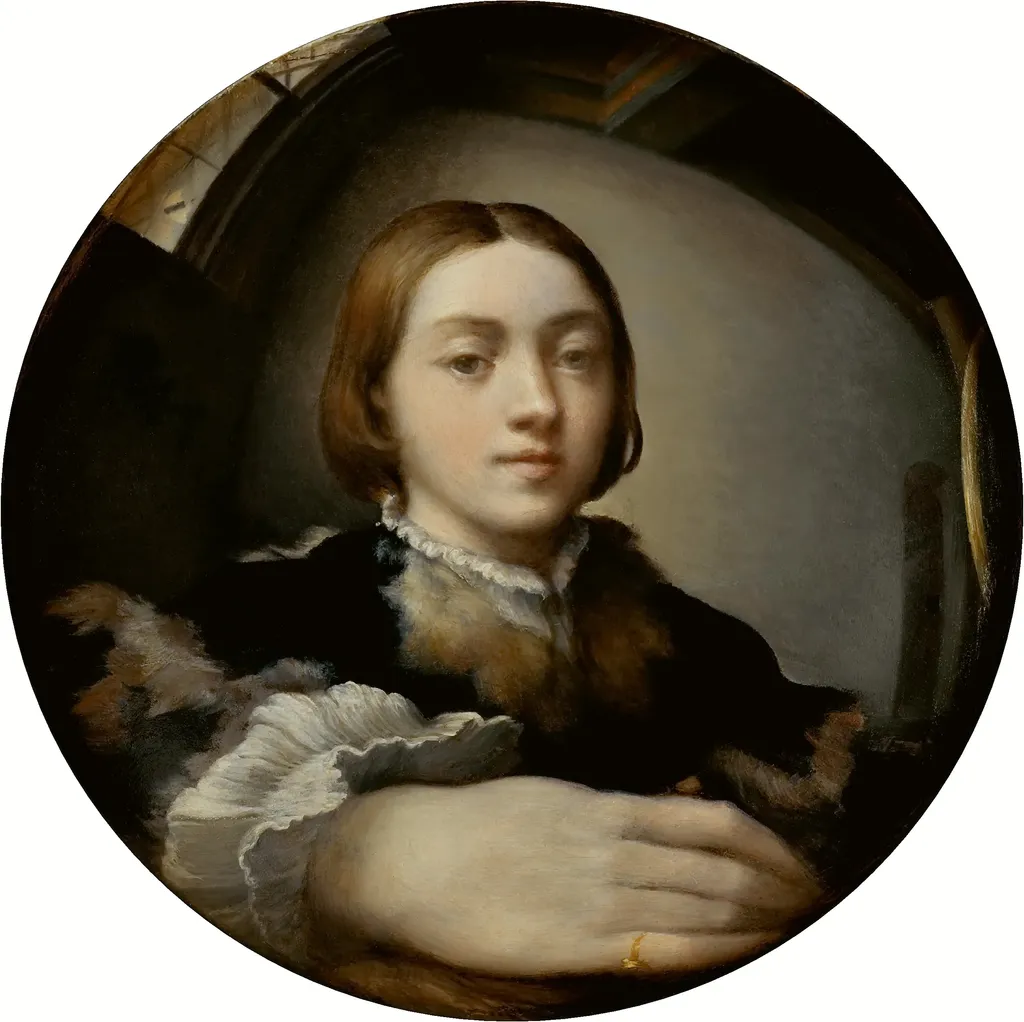
Self-portrait in a Convex Mirror is an oil painting by the High Renaissance artist Parmigianino. It dates from 1523 and is held in the collection of the Kunsthistorisches Museum.
About this work
Subject & Meaning
The painting shows Parmigianino depicting himself as a young artist seated before a convex mirror, his hand extended toward the viewer while holding a drawing tool. The distorted reflection and elongated hand are rendered with precise brushwork that mimics the mirror's curvature, while details of the room behind him are blurred, creating a sense of spatial ambiguity. Symbolically, the work combines technical innovation with self-promotion, presenting the artist's skill as both a demonstration of mastery and a means to gain patronage; the inclusion of a gilded frame within the composition further emphasizes his ambition to attract commissions.
Technique & Style
Created circa 1523–1524, this work is executed in oil paint on a specially prepared convex poplar panel.
Created circa 1523–1524, this work is executed in oil paint on a specially prepared convex poplar panel. The support was turned on a lathe to precisely mimic the curvature and 24.4 cm diameter of the convex mirror used as a visual reference. This unique format facilitates a radical anamorphic distortion, where the artist's right hand appears disproportionately large in the foreground while the background architecture and room details warp toward the periphery.
The handling demonstrates virtuoso brushwork, with rapid, confident strokes defining the pleated sleeves and fur garment, contrasting with the smooth, lustrous finish applied to the forehead and cheek to evoke the sheen of glass. The composition captures the specific optical effects of reflection, including the distortion of light and the inclusion of the gilded wooden frame visible at the composition's edge.
History & Provenance
Created circa 1523–1524 by Parmigianino, the work was painted on a specially prepared convex poplar panel to mimic the distortion of a barber's shaving mirror. According to Giorgio Vasari, the 21-year-old artist produced the piece as a virtuoso demonstration to secure patronage before traveling to Rome in 1525. Parmigianino presented the painting as a gift to Pope Clement VII, who subsequently gave it to the writer Pietro Aretino.
Following Aretino's possession, the work passed to the Vicentine sculptor Valerio Belli and, after Belli's death in 1546, to his son Elio. Through the mediation of Andrea Palladio, the portrait was acquired in 1560 by the Venetian sculptor Alessandro Vittoria, who bequeathed it to Emperor Rudolf II. The painting arrived in Prague in 1608 and entered the Habsburg imperial collections in Vienna by 1777, where it was initially misattributed to Correggio before reaching the Kunsthistorisches Museum.
Context
Giorgio Vasari documented the work as a virtuoso demonstration created in 1523 to secure patronage in Rome, noting its immediate success with Pope Clement VII. The painting has since become an emblem of Mannerism, celebrated for its radical anamorphic distortion and the deliberate elongation of the artist's hand. While early scholarship occasionally linked the convex form to alchemical symbolism, modern interpretation generally favors Vasari's account of technical display intended for a competitive courtly environment.
The work's influence extended into modern literature, serving as the subject of John Ashbery's 1975 poetry collection, which won major American literary awards and contrasted the sixteenth-century aesthetic with postmodern sensibilities. Historically, the piece was misattributed to Correggio during its time in the Habsburg collections before its correct identification.
Legacy
The painting's legacy is anchored in its pioneering technical and conceptual approach to self-representation and its lasting impact on later artistic discourse. Its innovative use of a convex mirror to create a distorted, immersive self-portrait influenced subsequent explorations of perspective and identity in art. The work gained renewed prominence through John Ashbery's 1975 poem of the same name, which won the Pulitzer Prize and highlighted contrasts between Renaissance mannerism and modernist aesthetics.
The painting's provenance, documented from its creation in 1523 through ownership by Pope Clement VII, Pietro Aretino, Valerio Belli, Alessandro Vittoria, Emperor Rudolf II, and finally the Kunsthistorisches Museum in Vienna, underscores its significance in European art history. Contemporary scholarship continues to analyze its alchemical symbolism and role in the development of mannerist style, as seen in Viola's 2007 monograph and other scholarly works.
Overview
Created around 1524, this oil painting by Parmigianino, an Italian artist of the late Renaissance, offers a self‑portrait rendered through the curvature of a convex mirror. The work is part of the collection of the Kunsthistorisches Museum in Vienna and measures the artist’s face and hands within a rounded reflective frame, set against a dark, indistinct backdrop.
Own this work as a print
Artist & collection

Artist
Girolamo Francesco Maria Mazzola (11 January 1503 – 24 August 1540), also known as Francesco Mazzola or, more commonly, as Parmigianino (UK: US: Italian:; "the little one from Parma"), was an Italian Mannerist painter…

![Ginevra de' Benci [obverse], by Leonardo da Vinci](https://artifactworldgallery.com/img/leonardo-da-vinci--ginevra-de-benci-obverse--afb6ec3a3e65f392-w320.webp)