Artwork
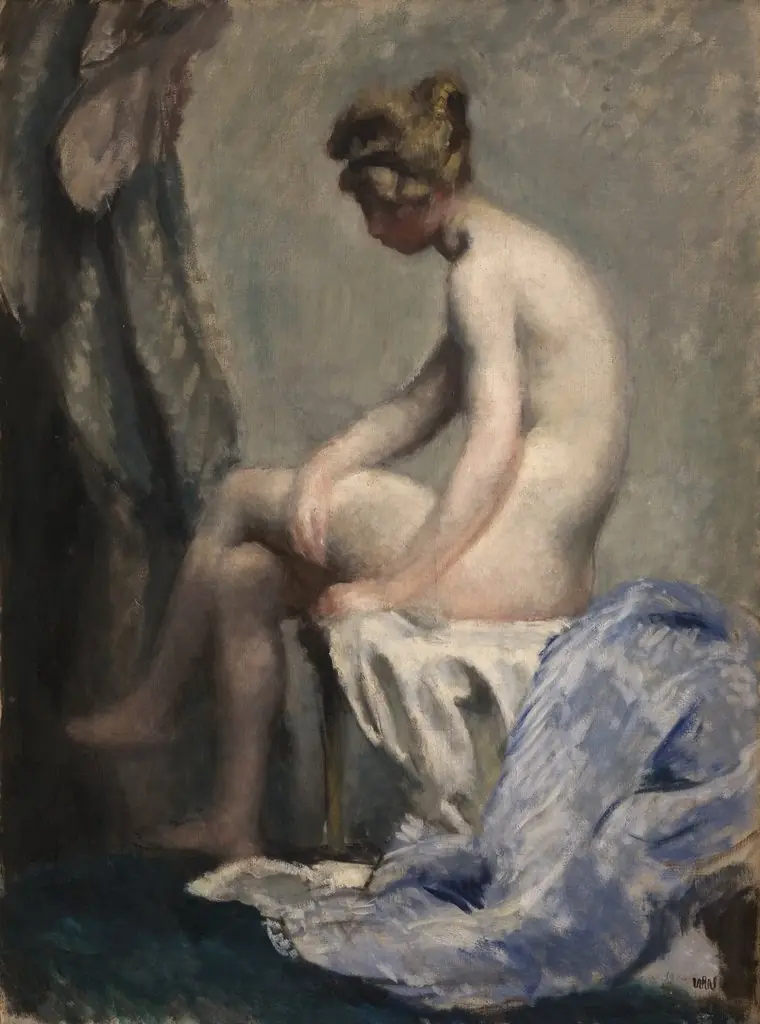
Study of a Nude
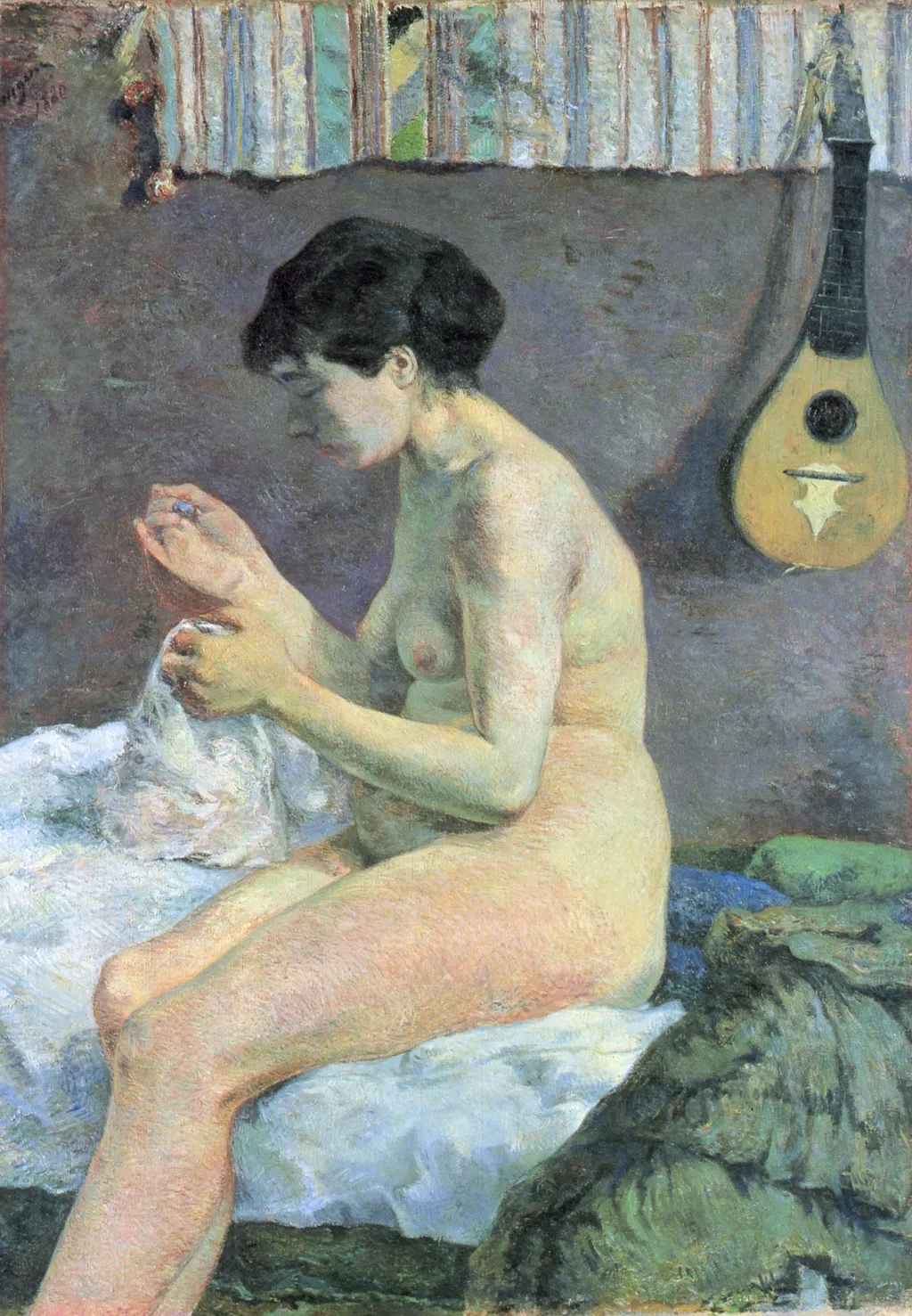
Study of a Nude is an oil painting by the Impressionist artist Paul Gauguin. It dates from 1890 and is held in the collection of the Statens Museum for Kunst.
About this work
Subject & Meaning
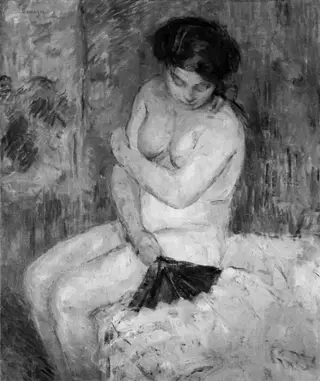
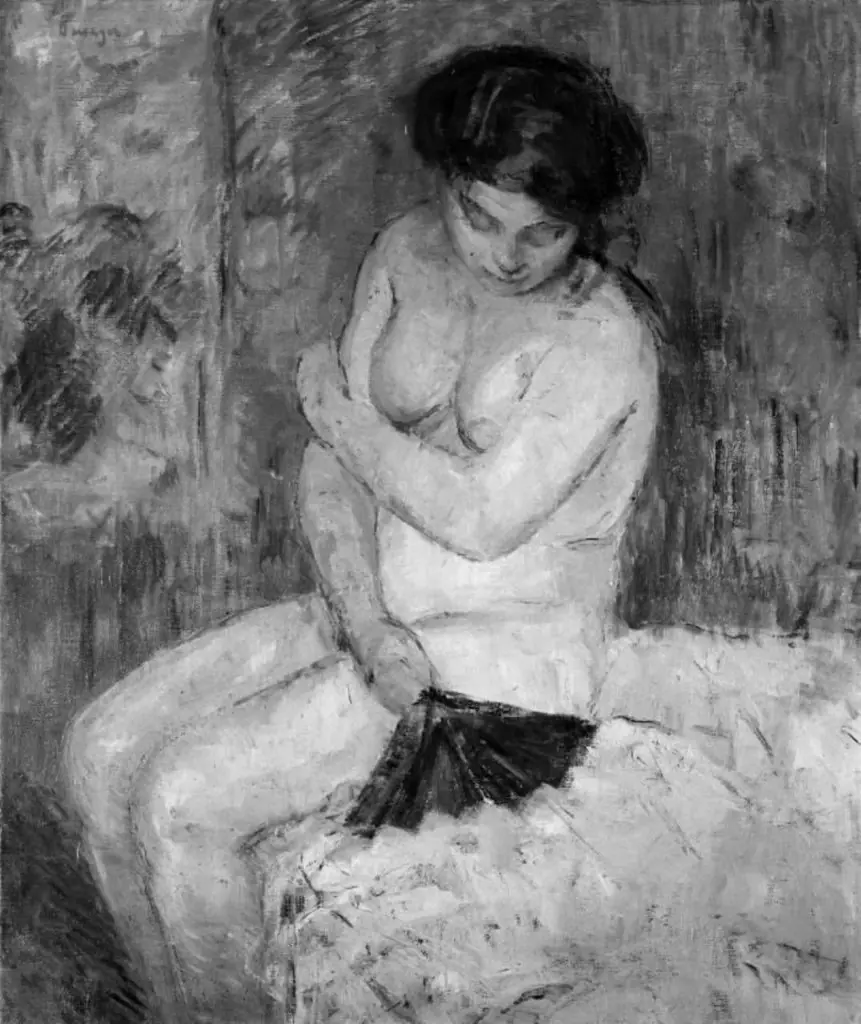
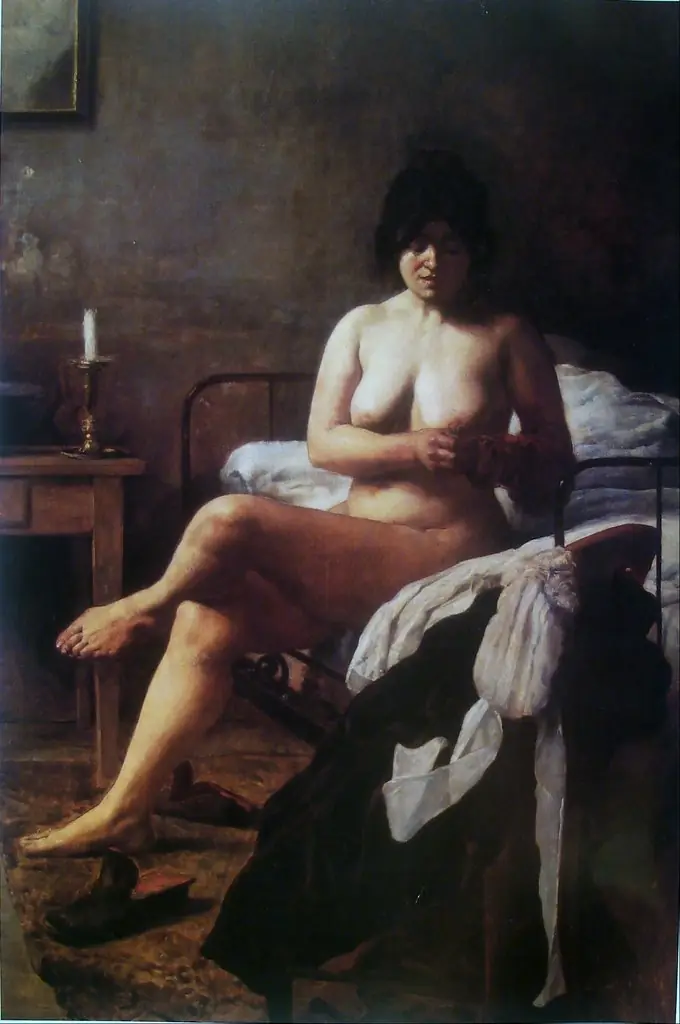
The work depicts a young woman with black hair sitting on an unmade bed in a bedroom, engaged in sewing or arranging a garment while in undisguised nudity.
The work depicts a young woman with black hair sitting on an unmade bed in a bedroom, engaged in sewing or arranging a garment while in undisguised nudity. The figure is rendered with unidealized realism, featuring a larger stomach with rolls and disproportionately large hands, which contemporary critics interpreted as signs of pregnancy. Set against a mauve wall adorned with a mandolin and a tapestry, the scene captures a private, domestic moment where the subject appears unaware of the observer.
While the model's identity remains debated between the artist's nanny and a professional model, the painting rejects academic eroticism in favor of raw, everyday existence. Art critic Joris-Karl Huysmans viewed the piece as a stark "representation of a woman of our time," contrasting its naturalism with the artificial beauty standards of the era.
Technique & Style
Executed in 1880, this vertical oil on canvas measures 114.5 by 79.5 centimeters and bears the signature and date "Gauguin / 1880" in the upper left corner. The work employs a technique experimenting with pointillism, utilizing fine brushstrokes of pure color to generate a luminous sense of movement, particularly in the figure, while contrasting with a static, non-Impressionist mauve background. Stylistically, the painting rejects academic idealization in favor of unflinching realism; the model is rendered with a three-quarter body perspective and profile head, featuring disproportionately large hands, visible stomach rolls, and an overall ugliness that contemporary critics found cruel.
This approach creates a rupture from Gauguin's earlier compositions, presenting a natural, everyday intimacy distinct from the eroticized nudes of his peers, though the artist did not persist with this specific stylistic novelty in subsequent works.
History & Provenance
Study of a Nude, painted by Paul Gauguin in 1880 in Paris, was created as a personal exploration of the female form rather than a commissioned work. The oil on canvas measures 114.5 × 79.5 cm and was first shown at the sixth Impressionist exhibition. Initially held by the artist, it remained in the possession of his wife Mette until 1892, when it was sold to Danish collector Theodor Philipsen.
Philipsen later donated the painting in 1920 to the Royal Museums of Fine Arts of Belgium, and from 1922 it has been part of the Ny Carlsberg Glyptotek’s collection in Copenhagen.
Study of a Nude has been in the collection of the Ny Carlsberg Glyptotek in Copenhagen since 1922, after Theodor Philipsen donated the work to the Royal Museums of Fine Arts of Belgium in 1920. It is catalogued in Wildenstein as numbers 39 (1964 edition) and 64 (2001 edition, W.39/64). The painting was first publicly exhibited in Paris at the 6th Impressionist Exhibition in 1881, where it was shown simply under the title Étude de nu among eight works by Gauguin. Its provocative reception at that show drew critical attention but failed to produce a sale.
Context
Exhibited at the 1881 Sixth Impressionist Exhibition, Study of a Nude provoked polarized critical responses for its unidealized realism. While some critics dismissed the model's proportions as cruel or horrific, Joris-Karl Huysmans praised the work as a truthful representation of contemporary womanhood, comparing its naturalism to Rembrandt and contrasting it with academic artificiality. The painting marks a pivotal moment in Gauguin's early career, serving as his first nude and demonstrating an experimental, pointillist-inspired technique that diverged from his usual Impressionist style.
Although Gauguin claimed the work was merely an expression of experience rather than a social critique, the controversy highlighted his willingness to challenge bourgeois beauty standards. Despite its impact, the piece remained unsold during the exhibition, and Gauguin later expressed irony regarding its eventual acquisition by a Danish collector.
Legacy
Study of a Nude provoked strong reactions at the 6th Impressionist Exhibition in 1881, where critics described it as cruel and horrific while acknowledging Gauguin's evident talent. Joris-Karl Huysmans praised it as a realism no contemporary could match, comparing it to Rembrandt's nudes and hailing Gauguin's bold alternative to academic idealization, calling it "the representation of a woman of our time." Gauguin himself dismissed Huysmans's reading, insisting he had merely sought to express an experience rather than critique ideal beauty.
Despite this impact, the work failed to sell; Mette Gauguin refused to hang it, and it was not until 1892 that it was purchased by the Danish artist Theodor Philipsen. Catalogued by Wildenstein as W.39/64, the painting was donated in 1920 and entered the Ny Carlsberg Glyptotek in 1922, where it remains a touchstone for discussions of Gauguin's early break from Impressionist norms.
Overview
Paul Gauguin's 1880 oil painting, titled Study of a Nude or Suzanne Sewing, depicts a young woman engaged in a domestic task. Created in Paris, this work serves as a direct observation of the human form. The canvas presents Suzanne, the subject, in an unadorned state, occupied with arranging a piece of clothing.
This early work by Gauguin offers insight into his developing artistic practice before his more renowned Symbolist period.
Own this work as a print
Artist & collection
Artist
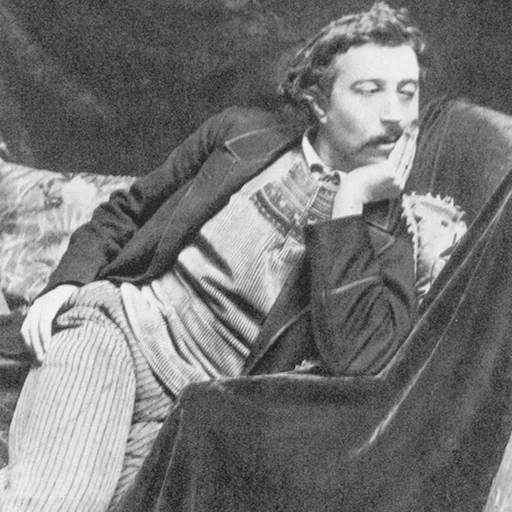
Eugène Henri Paul Gauguin (; French:; 7 June 1848 – 8 May 1903) was a French painter, sculptor, printmaker, ceramist, and writer, whose work has been primarily associated with the Post-Impressionist and Symbolist movements.