Artwork
Fatata te Miti (By the Sea)
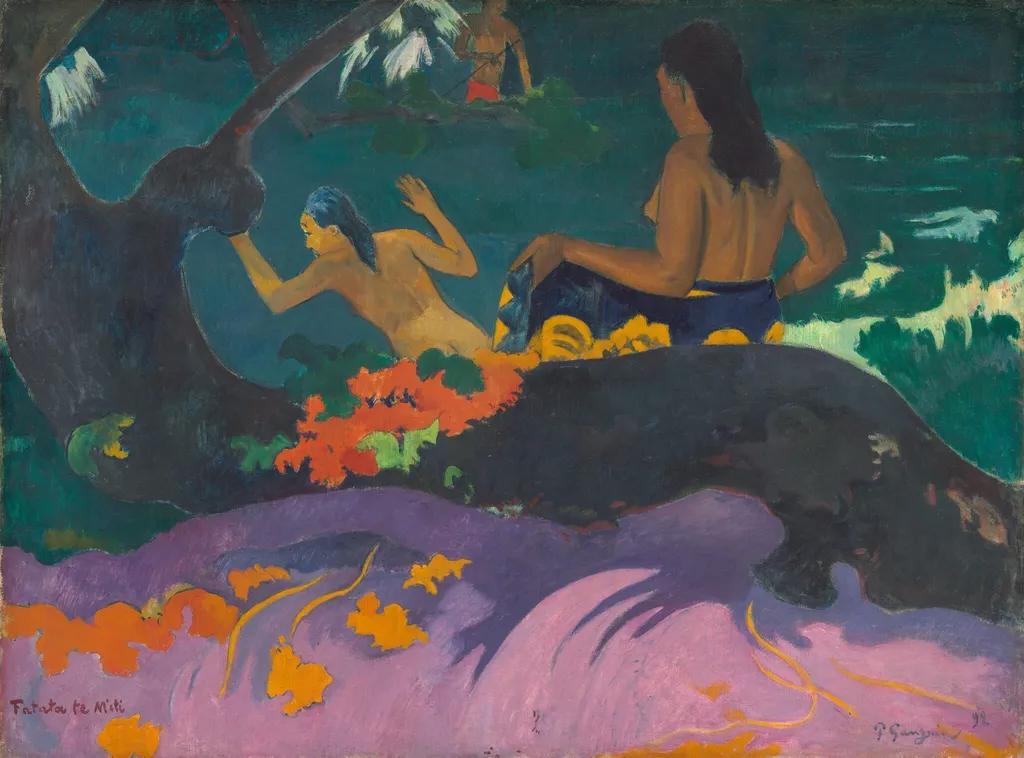
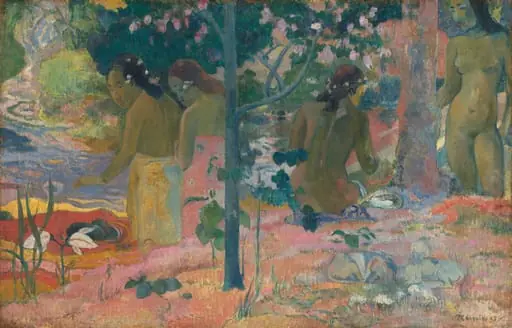
Fatata te Miti (By the Sea) is an oil painting by the Post-Impressionist artist Paul Gauguin. It dates from 1892 and is held in the collection of the National Gallery of Art.
- Inscription
- Inscribed:lower left: Fatata te Miti; lower right: P Gauguin 92
About this work
Two Tahitian women drop their pareos and plunge into pink-purple surf while a fisherman spears fish behind them. Paul Gauguin painted the scene in 1892 in a bamboo hut at Mataiea during his first trip to Tahiti. He tinted the volcanic beach in hues no geology could justify, using the flat-color cloisonnist technique he had sharpened in Brittany. It now hangs at the National Gallery of Art.
Subject & Meaning
The painting depicts two Tahitian women seen from behind, one removing her pareo and the other already wading into the sea, while a man fishes with a spear in the background. Drawing on Pierre Loti's description of Tahitian life as "reverie, bathing, above all bathing," the scene evokes the romanticized, uninhibited paradise Gauguin sought. Symbolically, the hutu tree at left, its white flowers blooming at night and its seeds used to intoxicate fish, reinforces themes of natural sensuality and artifice.
Gauguin's intense, unnatural colors (pink sand, purple waves) and cloisonnist forms transform the mundane beach into a symbolist vision of Edenic harmony between woman and nature. The composition also aligns with the Golden Age tradition of nymphs bathing, reimagined in a Tahitian context, deliberately contrasting with the reality of colonial transformation.
Technique & Style
The diagonal tree recalls Japanese print composition, while the forms and colors aim for a synesthetic fusion of painting with rhythm and movement.
The painting is an oil on canvas, measuring 67.9 × 91.5 cm. Gauguin employed cloisonnism, applying pure, unmixed color in flat shapes bounded by dark outlines, a technique he developed in Brittany. To enhance luminosity, he applied a thin layer of clear wax to the surface. Stylistically, the work uses intense tropical colors, such as pink and purple for sand, and juxtaposes complementary and adjacent hues in jigsaw-like patterns to create a coloristic liminal intermediary.
The diagonal tree recalls Japanese print composition, while the forms and colors aim for a synesthetic fusion of painting with rhythm and movement.
History & Provenance
Paul Gauguin painted Fatata te Miti in 1892 during his first Tahitian journey. The painting first appeared at the Gauguin sale in Paris on 18 February 1895 (lot 27, bought in). It may have been sold later that year to dealer Ambroise Vollard.
By 1897 it belonged to William Molard, then passed to George Daniel de Monfreid before being sold on 7 June 1898 to Ernest Rouart. After passing through Galerie L. Dru, it was sold in 1928 to Louis L. Horch and in the same year to Chester Dale. Dale bequeathed his collection, including this work, to the National Gallery of Art, Washington, in 1963.
Fatata te Miti (By the Sea) is held in the collection of the National Gallery of Art, Washington, D.C., as part of the Chester Dale bequest, accessioned in 1963. Its exhibition history includes a display at Galerie Durand-Ruel, Paris, in 1895, and it was lent by Ernest Rouart to the Salon d'Automne in 1906. No specific inventory number is provided in the sources.
Context
Fatata te Miti has been central to scholarly discussions of Paul Gauguin's first Tahitian period. Biographer Nancy Mowll Mathews argues that, despite appearing as a straightforward genre scene, the painting actively transforms Tahitian ordinary life into an exoticized vision. Art historian Stephen F. Eisenman analyzes Gauguin's use of complementary color shapes as reflecting his belief in reconciling binaries, both moral and physical, a technique developed from his earlier cloisonnism.
The work consciously invokes the Western tradition of nymphs bathing, from Titian to Degas, situating it within that lineage. Its exhibition at the 1895 Durand-Ruel gallery and subsequent ownership by Chester Dale before entering the National Gallery of Art have cemented its canonical status. The painting also illustrates Gauguin's ideal of an uninhibited tropical paradise, a theme he explored throughout his career.
Overview
Fatata te Miti, painted by Paul Gauguin in 1892, depicts two Tahitian women entering the surf while a fisherman spears fish in the background. Executed in oil on canvas during Gauguin's first stay in Tahiti, the work was created in a bamboo hut at Mataiea, Papeari. The composition features a vibrant, non-naturalistic palette where the volcanic beach and water are rendered in intense pinks and purples, rejecting realistic geology in favor of symbolic color.
Gauguin arranged the figures to create a rhythmic balance between the foreground bathers and the distant fisherman, emphasizing the harmony between the human form and the tropical environment. This piece is a significant example of the artist's Synthetist style, characterized by bold outlines and flat areas of color that prioritize emotional resonance over optical accuracy. Currently held in the collection of the National Gallery of Art in Washington, DC, the painting illustrates Gauguin's pursuit of an uncorrupted, primitive paradise and his departure from European academic traditions.
Own this work as a print
Artist & collection
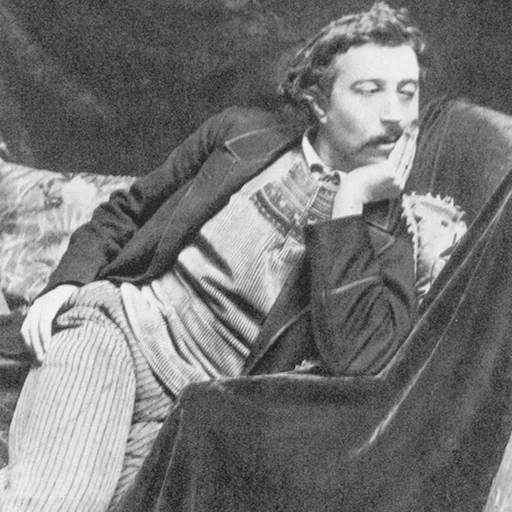
Artist
Eugène Henri Paul Gauguin (; French:; 7 June 1848 – 8 May 1903) was a French painter, sculptor, printmaker, ceramist, and writer, whose work has been primarily associated with the Post-Impressionist and Symbolist movements.